Wednesday, December 13, 2006

Update: how to read this blog

So... it's December 2006, and almost the end of another year. I'm back in Britain, and my jet setting lifestyle has been replaced by a much more mundane life as a student.

I continue to have issues with Blogger about the functionality and appearance of this page, so apologies for those instances below where portrait images run outside their frame and into the next post. Apologies also if you're having problems seeing the sidebar parallel to the main body of text. I'm working on these issues.

Also, the temporary fix that allowed this blog to be read in chronological order didn't work that well, so it's been dumped. I'm afraid that because this is a blog, the most recent entries are at the top, and that if you want to read this blog as a complete and chronological story, you'll have to scroll down to the bottom and read the page backwards... sorry!

Thanks for all your kind comments and e-mails, it's greatly appreciated.

James
Sheffield, Great Britain
13 December 2006

Saturday, June 03, 2006

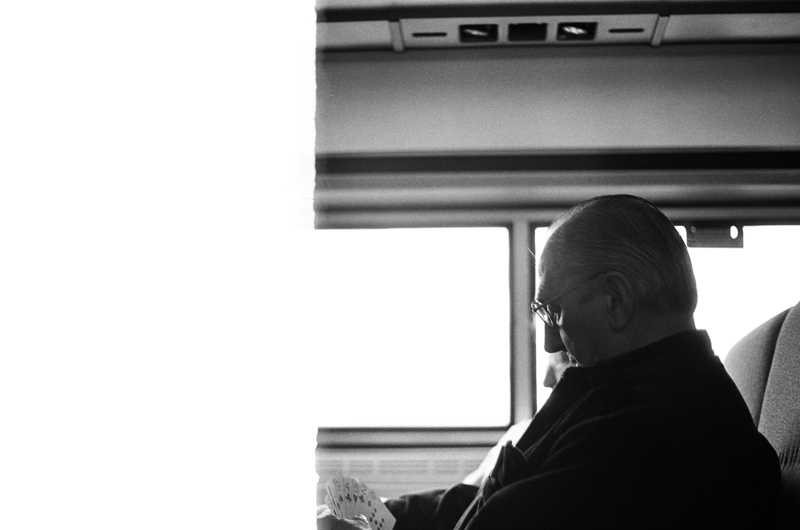
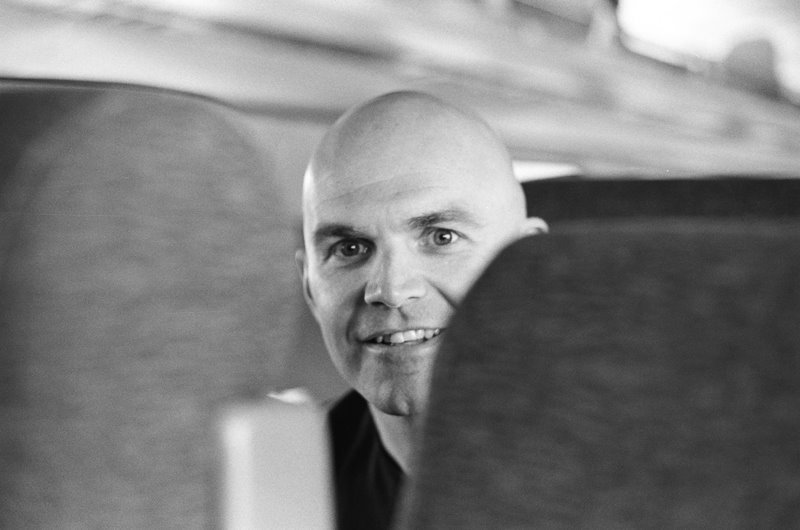
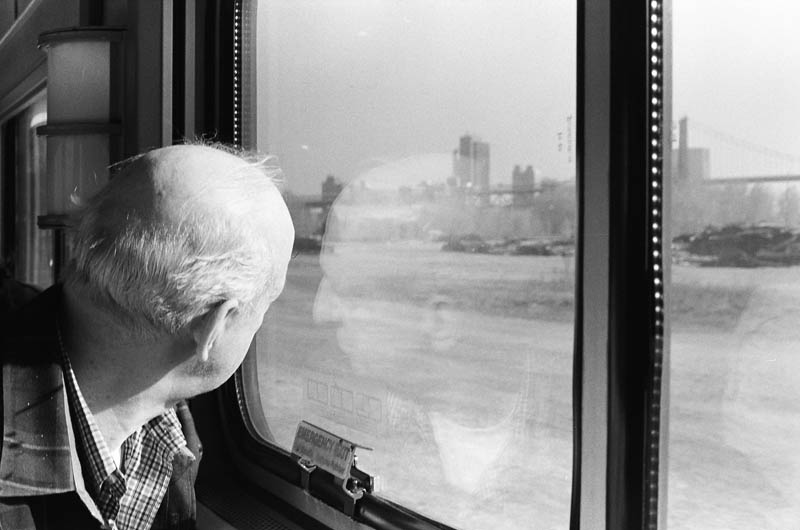
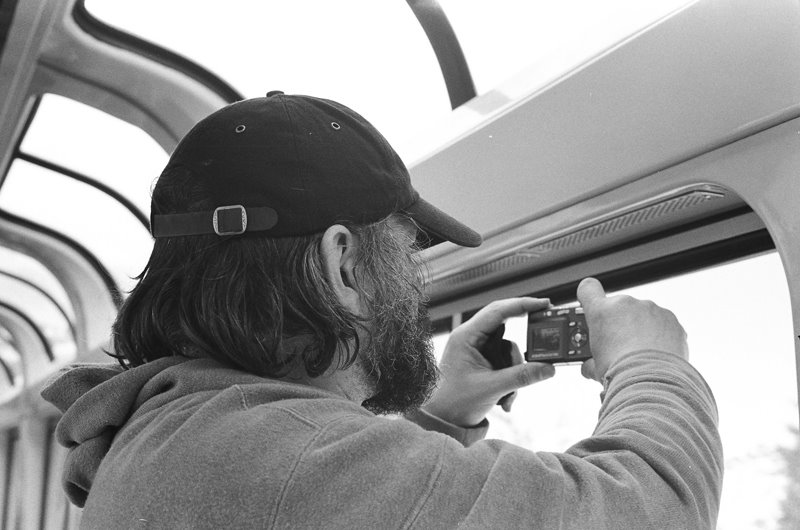
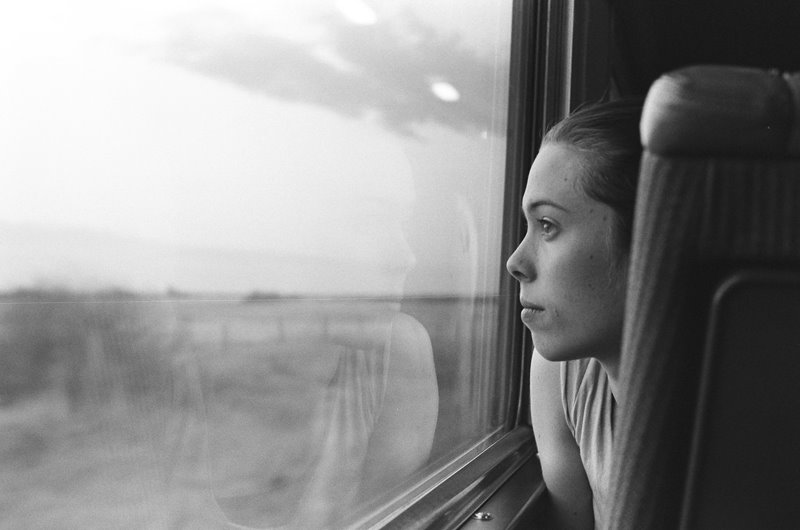
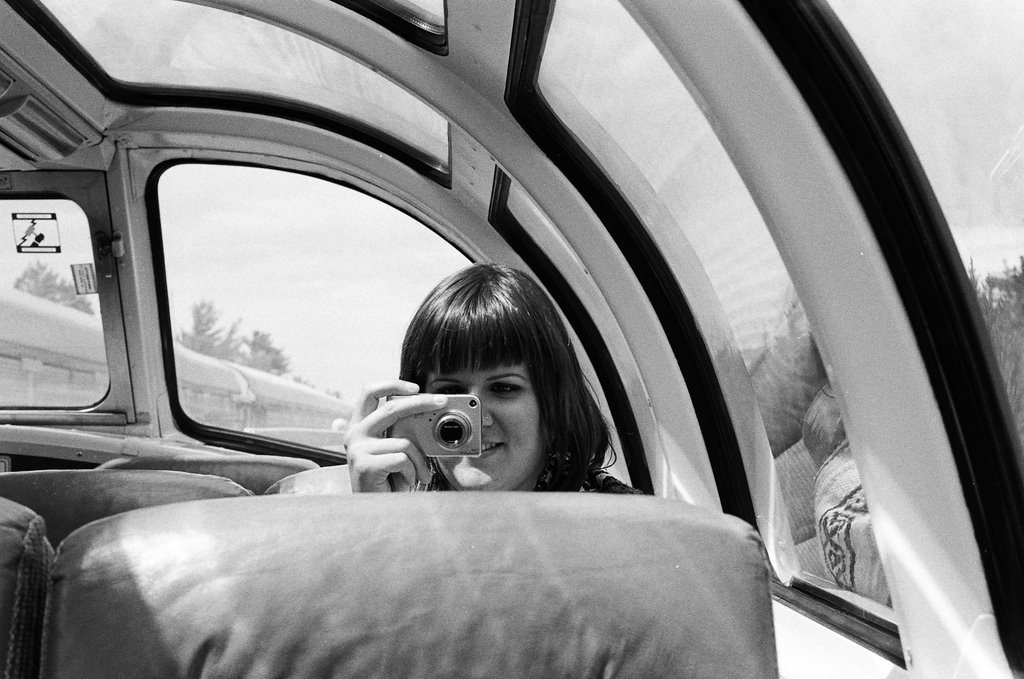
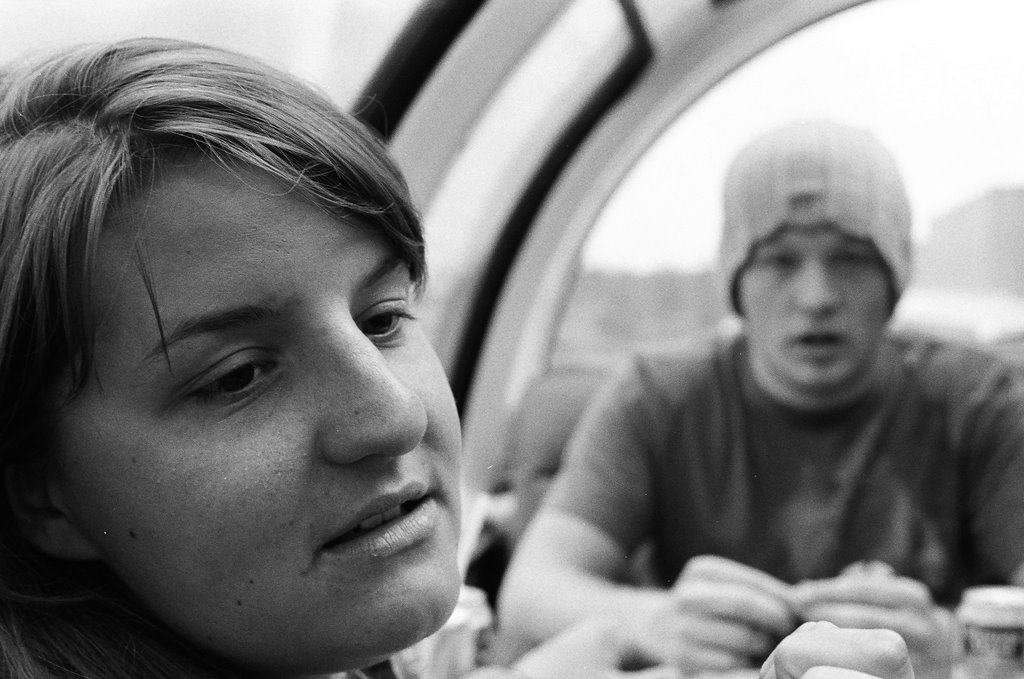
Snapshots: fellow passengers (updated)

Many thanks to everyone who gave me permission to interupt our conversations with my Olympus. I've decided not to include names, just destinations. All photos copyright James Brown 2006, except where credited otherwise. Please ask before reproducing.


Returning to New York City, on board the Adirondack 21 April, 2006


En route to see a friend in upstate New York, on board the Adirondack 21 April, 2006


En route to Chicago to meet his brother, on board the Lake Shore Limited 22 April, 2006


En route from New York to Vancouver, BC, on board the California Zephyr 25 April, 2006


En route to San Francisco, on board the California Zephyr 26 April, 2006


En route to Sacramento, on board the California Zephyr 26 April, 2006


En route from Vancouver to Québec City, on board the Canadian 3 May, 2006


Self portrait, on board the Hudson Bay 10 May, 2006


Heading home to Halifax, NS on board the Canadian 12 May, 2006


Touring Canada by train and bicycle, on board the Canadian 12 May, 2006


Returning to Montréal after a month 'ontherails', on board the Ocean 19 May, 2006 (photo: BMM)

Sunday, May 21, 2006

The end...

It's Sunday afternoon in Montréal, and the trip is over. This trip has been a once-in-a-lifetime opportunity for me, and sharing it with the thousands of visitors this blog has received has been an unexpected pleasure. I'll be writing a round up summary of the trip soon, and please feel free to drop me a question on the Q & A blog below - I'd be happy to answer any question about the trip, and maybe even help you planning your trip. And if you have enjoyed reading my travelogue-o-blog, then why not drop by my regular personal blog: jamesbrownontheroad.blogspot.com

So, that's it. 18,972km. I hope you enjoyed them as much as I did :-)

James Brown
Sunday 21 May, 2006
Montréal, QC

...ontherails Q & A: James answers your questions

So, you want do your own rail trip? Or you want to know why I chose to spend more time in Edmonton than Vancouver? Leave your questions here in this thread (click on 'Comments' below) and I'll be answering all your questions in the coming days.

Thanks!

*j*

Saturday, May 20, 2006

Train 15: end of the line


When I awake, we are racing along the smooth fast railway line between Québec City and Montréal. We are on the home straight. Outside, the flat fields of southern Québec are stretching out either side of us into a grey haze of fog and rain. Small towns flash past, and the slight changes in domestic architecture tell me that we are back in Québec. The houses appear to be more traditional; the porches are larger and the facades have more decoration on them. BMM and I take the remains of our food bag back to the service car, and along with coffee and hot chocolate, have a scratch breakfast. The café attendant has found some large sheets from which a cardboard train can be pressed out and assembled. They are busy making a long train of cardboard carriages and locomotives on the red couches. Eating yesterday's donuts and a bruised apple, it's strange to think that this is really the end of my trip.

We stop at Drummondville, Saint-Hyacinthe and finally Saint-Lambert. The pause here is slightly longer but within sixty seconds of leaving the station we are crossing the wide and fast flowing Saint Laurence river. Was it really a month ago that I began my journey crossing this bridge?. The grey weather has travelled to Montréal with us. It's a dark day, raindrops hitting the windows beside us under a solidly grey sky.

Montréal appears first on our right, through the fast moving steel griders of the bridge. When we land on the island of Montréal, the train makes a gentle turn to the right, and I catch sight of the rail yards where VIA keeps its Montréal fleet. An overnighting four carriage Amtrak train waits for it's journey to New York later this morning. Maybe it's the same set of carriages I took all those weeks ago?

We are now closer to the downtown skyline of skyscrapers, bounded to the north by the heavily wooded outline of the Mont Royal montagne, and these are now appearing on our left. The crew of the train offer their billingual welcome to Montréal, now speaking in French before English, rather than vice versa as when we left Halifax. The train slows to enter the dark underside of the Gare Centrale. In the last one hundred metres, the two diesel locomotives at the front of the train stop their engines, and the lights in our car dims. We coast quietly into the station, and come to a halt...

My journey has ended.

Friday, May 19, 2006

Train 15: the last night on the train

Not only was bringing my laptop a good idea for catching up on the blog, but with a couple of choice DVDs brought from England, BMM and I are able to spend the evening on board train 15 watching some British television comedy. We ate our own packed meals this evening, but share a cup of tea from the service car during the evening. Other coach class passengers go back to take dinner in the dining car - when they return I overhear positive comments as they talk to other passengers.

By Bathurst, we're running about twenty minutes behind schedule, but that's nowhere near enough to bother me. As the daylight dims outside, and the last night that I will be spending on the train sets in, blankets and pillows are distributed. I know this time to seek out an extra one from the sacks at the end of the carriage. Sorry if that makes me a bad passenger, but it's not half as cheeky as the coach passengers on board the 'Canadian' who sneaked back to the sleeper cars to enjoy the showers there :-)

And, as expected, with two people, it's a bit easier to get some sleep. We try a couple of different positions, and each time the attendant passes we get a smile and a joke about being young lovers. I suppose being young means we're more flexible to adopt strange positions to sleep in, and being lovers means we don't mind leaning on each other during the night. I have also made sure to bring more clothing, so I'm not as cold as I was on the way up. We've also chosen a pair of seats away from the noisy ventilation grilles, although it's still pretty noticeable as I go to sleep. We drift off to sleep as we enter Québec... for the first time in a long time, I sleep deeply and dream vividly for more than four hours in one go.

Train 15: travelling together again

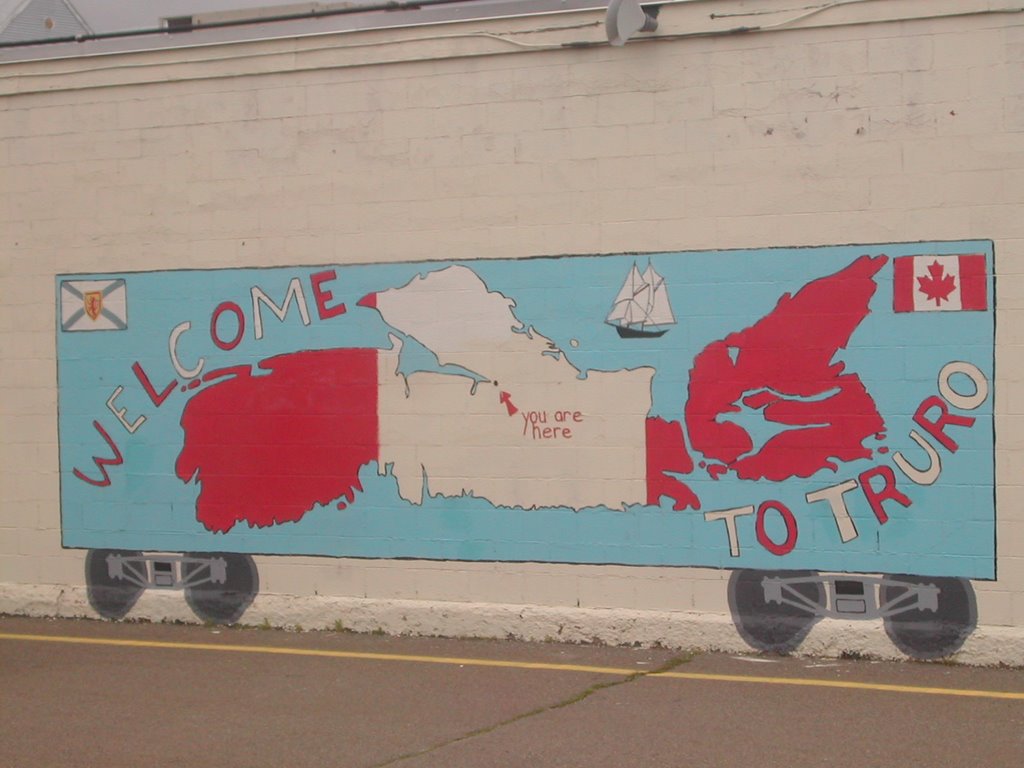
Part of being an annoying boyfriend requires an ability to know the answer to everything that your partner would ask you in an arrogant tone of voice that gives the impression you're not making it up. As we pull into our first station stop at Truro, BMM asks me exactly where Truro is. I'm on the verge of bluffing an answer to hide my apalling lack of knowledge in eastern Canadian geography when the train comes a convenient halt alongside a map of Nova Scotia, painted as part of Truro's colourful station mural. A useful 'You are here' arrow comes to my rescue.

For the last three weeks I've been travelling on my own. I've always been an independent traveller, and this has been a wonderful voyage to make as a solo traveller, because there are always other friendly passengers around to pass the time of day with. However, today, I'm seeing the train in a different light, travelling with my long term and long distance girlfriend. We've lived in different countries for almost two years now, not entirely out of choice but out of a commitment to lead our own lives until such time as our paths cross more conveniently - that being this autumn, when I return to the UK.

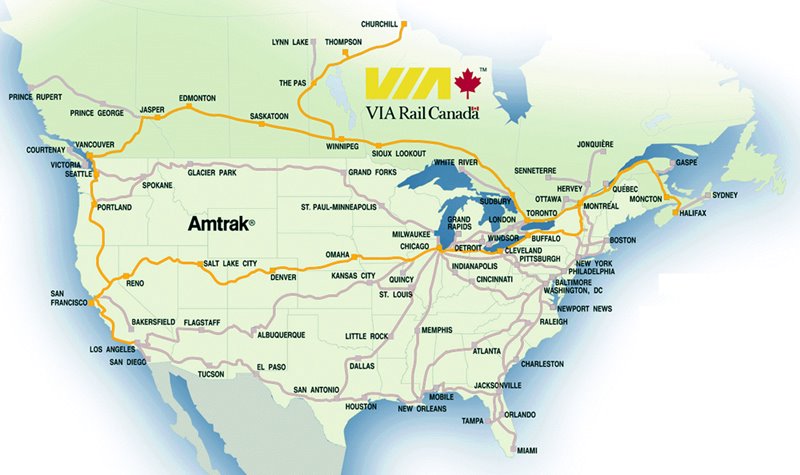
On all the trains of this trip up to now, I've passed the time reading, listening to music, talking to other passengers and just looking out of the window. Surprisingly, it's the last of those activities that occupies the two of us for much of the afternoon, as we enter New Brunswick and race towards Québec. The 'Ocean' takes a very elongated route between Montréal and Halifax, describing a huge arc that remains inside Canada rather than following the more direct route (as plied by the now extinct 'Atlantic' train) through the state of Maine, which juts up into Canada. So we have plenty of time to curl up together and just stare out of the window. We have some newspapers (including a precious copy of the Independent on Sunday brought all the way from London) and books to read, but time after time I find we are both staring out of the window. This is the joy of the train. There are, realistically, very few people who are in such a rush, or who value their time so highly to take a plane on such a journey. Twenty hours might seem like a long time compared to travelling by aeroplane, but then that's how long it takes, and how long it should take. This month long trip has proved to me that I really do enjoy the journey as much as the destination.

There have been individual days or hours when I have been very tired with the train. Approaching Toronto, for instance, or crossing northern California, on the last afternoons of long distance train journeys, I have experienced the frustration of a train journey that took longer than I was mentally prepared for. But overall, as I head towards my thirtieth day 'on the rails', I am still a passionate fan of the train, and would take one tomorrow to another far flung city. It is, as VIA Rail describe with their company motto, the human way to travel.

From this point on, I will be doing everything I can to avoid having to travel by commercial aeroplane ever again. As a student, I can afford the time, and as someone sensitive to the environment, I can happily avoid pumping thousands of tonnes of carbon dioxide into the atmosphere by not taking the train instead of the plane. I have more room, less stress, and more time to think.

Besides... this is more fun.

Train 15: the VIA Rail cup

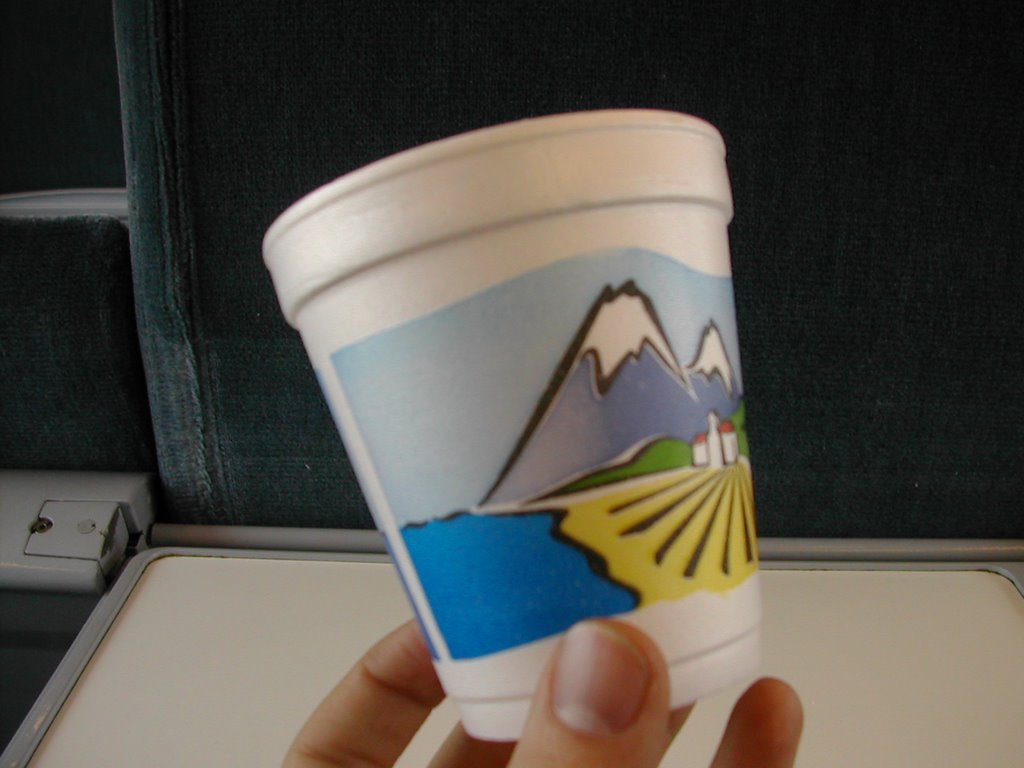
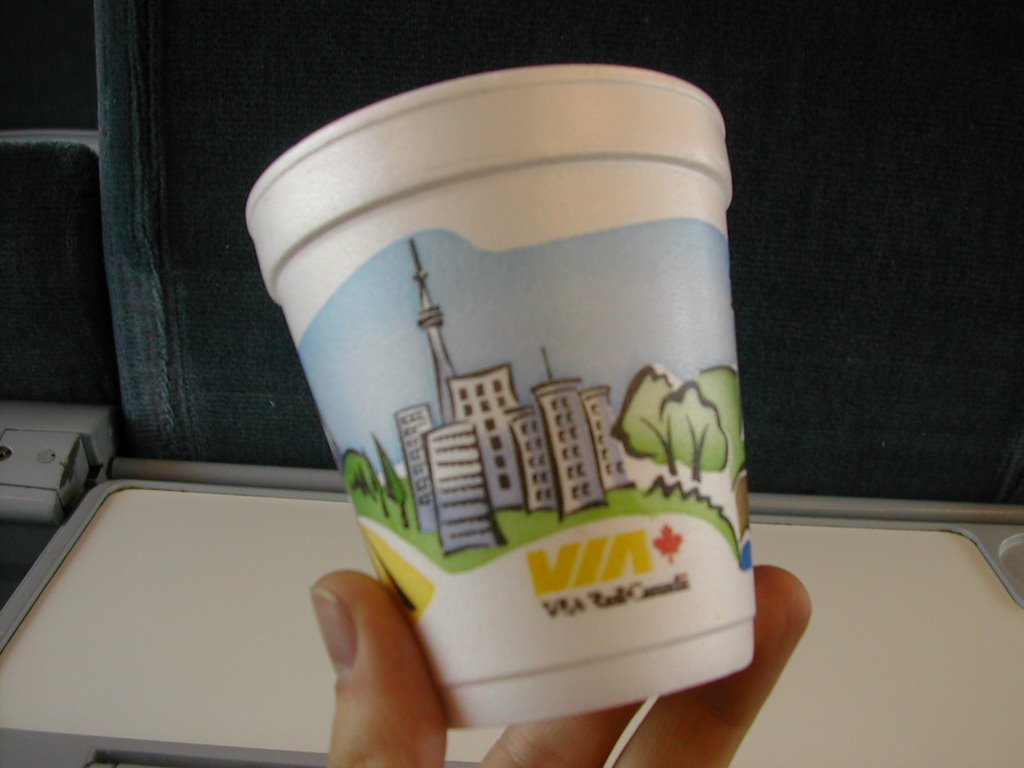
Every time I go to the take-out counter on board VIA Rail, or whenever I buy a hot drink from the at seat service, I'm amused to see the design on VIA Rail's polystyrene cups. Notice how, in just a few centimetres, they manage to summarise the scenery that stretches across Canada...


Pacific Ocean and Rocky Mountains...


Rocky Mountains leading into Praries, leading into the forests of the Canadian Shield...


The skyscrapers of Toronto...


...and the Maritime Provinces.

Train 15: the final trip...

After four brilliant days in Nova Scotia, it's time to get back on a train. Drawing a blank searching for accommodation through my regular host network The Hospitality Club, I eventually found two extremely kind and hospitable hosts through Couch Surfing. So we enjoyed a wonderful week staying with Bruce and Lindsey in the north end of Halifax - thank you both for all your advice and hospitality. We had a great trip and it was your hospitality that saved our time in Halifax from being completely rained out :-)

Although we had managed to get two sunny days to explore the southern half of Nova Scotia by car, when we head to the railway station on Friday afternoon, it's raining hard. Halifax has a grand railway station, close to downtown and in the same complex as the intercity bus station. We arrive at 12.00, having already checked in our luggage earlier that morning. The station hall is busy with passengers for the today's only departure. A line has formed for coach class passengers, which we join for the long walk down to the other end of the train. Since it's arrival yesterday, the Montréal train has been turned, so that the elegant stainless steel Park car is closest to the station building.

Boarding begins at about 12.10, and we walk along the length of the train to the three coach cars that are at the head of the train. Boarding from a low level platform (level with the tracks) it's interesting to see the ingenious folding steps that were fitted to these trains when they were adapted for use in Canada. Mounted underneath the passenger doors, these fixed step units fold out in one piece to allow passengers to climb into the carriage. It's cheaper than re-building every platform in the country, I guess, although I can't quite work out how wheelchair passengers board...

This time I'm with BMM, I'm more optimistic about being able to get some sleep in one of the paired seats, rather than the uncomfortable single seats across the aisle. The only downside is that because the whole train has been turned, I'm now sitting on the same side that I did coming from Montréal. Visibility across the car is hampered by the high position of the seats. Still, it's good to see that the arm rest lifts between our seats, and I expect that we will be able to curl up together a little more comfortably than I did on my own on Sunday night.

By the time our train starts moving just after half past twelve the rain has, of course, stopped. I shall have to come back soon...

Wednesday, May 17, 2006

BMM and the Atlantic Ocean

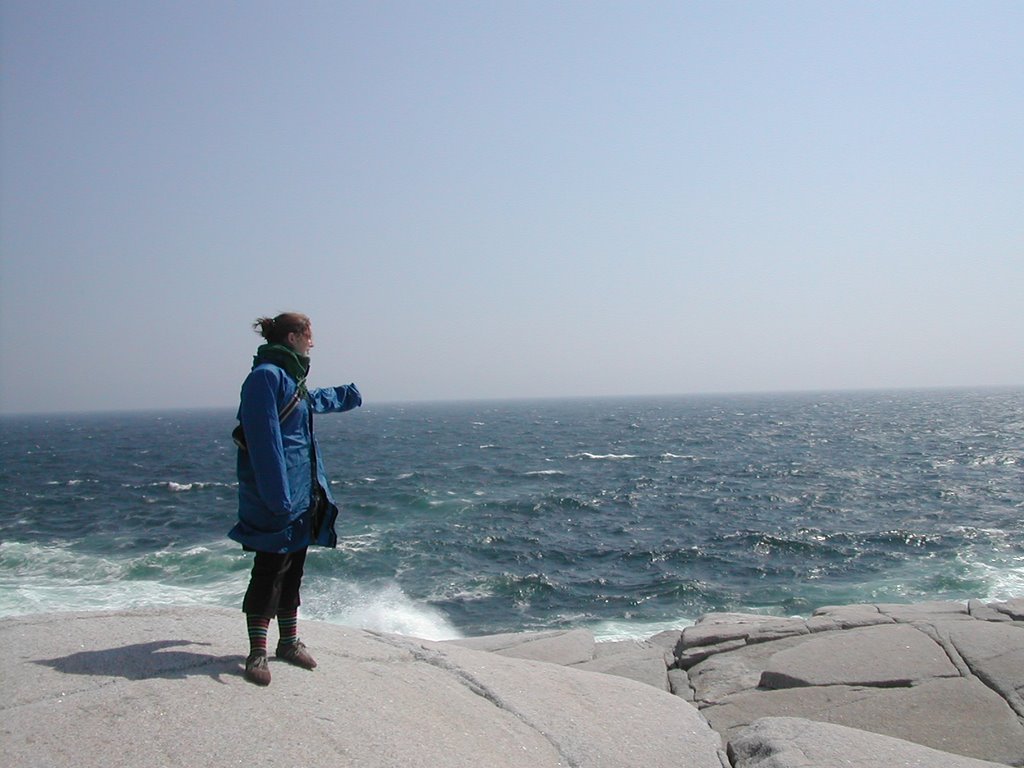
From one ocean to another - I have now travelled 17,626km by train. I have travelled all the way from Montréal to the west coast of the USA. And then two weeks ago, I said farewell to the Pacific Ocean in Vancouver, BC, and returned across the breadth of Canada on board the trains of VIA Rail. So as I stand on the windswept rocks of Peggy's Cove on the South Shore of Nova Scotia, I can take a deep breath of salty (and very windy) sea air and celebrate a landmark point in my trip. I certainly can't claim to have seen all of it, but I have now crossed Canada from coast to coast.

Being an Englishman, I have a much closer connection to the Atlantic than the Pacific, which I saw for the first time on this trip. And while I couldn't help liking the beautiful scenery of southern and northern California, Oregon, Washington state and British Columbia, it's good to be back beside the Atlantic, looking out in the vague direction of Europe, and that low lying little island that I call my real home. The Atlantic strikes me as much wilder than the Pacific, and certainly the coastline along here suggests much less placid winters. But it appeals to me somehow, deep down inside. If I were to ever return to Canada to settle for more than one year, I would be very tempted by one of the small towns we have visited here in coastal Nova Scotia.

I arrived in Halifax on the afternoon of Monday 14 May, and I will be taking the last train of my month long adventure on Friday 19 May, when BMM and I head back to Montréal. She's been kind enough to fly here from England, so excuse me if I gloss over the intervening days - after two nights in Halifax we have rented a big fat American car, and are exploring the southern half of Nova Scotia. The trip continues on the rails on Friday.

Monday, May 15, 2006

Train 14: afternoon

After a walk up and down the platform at Moncton, and a friendly chat with a few of the coach attendants who are working the train, I get back on board and soon after we're on our way again. The train slips in between the buildings of the low rise centre of Moncton, reflecting in office windows and passing lines of traffic at level crossings. It's another Monday morning, and I'm still on holiday.

The afternoon begins to slip by rapidly - we're bowling along at a respectable pace for much of the rest of the day, and I am furiously typing away on my laptop to take advantage of the time to myself. At some point that slips by unnoticed, we leave New Brunswick and enter Nova Scotia. We stop at Sacville, Amherst and Sackville Junction, picking up 'local' passengers for Halifax. It's a thoroughly enjoyable and relaxed way to bring my second last journey to a close. Truro comes and goes (with some attractive murals painted on the wall of the warehouses that back onto the station's platforms) and we're on the home straight, racing through low fields and alongside rivers and lakes. The landscape of this part of Nova Scotia is much like the British scenery I miss so much - gently rolling, and under a blue sky it's looking even prettier.

It's nearing 16.15 as we pass through Bedford. We're running late, and we're on the outskirts of Halifax. Since it's been three months since I last saw BMM, I'm packed and ready to get off the train already, but we slow to a crawl as the line brings us alongside Bedford Basin. Ahead of us are the bridges crossing between Halifax and Dartmouth, and just to the right of them is the gently rising hill upon which the city of Halifax sits. The rail tracks beneath us split and multiply as we approach the container port on the northern side of Halifax, and we pass dozens of multicoloured steel containers stacked high above the water's edge. A container ship is docked, and cranes are loading the ship for another trans-Atlantic voyage. Throughout my trip I've seen and been passed by hundreds of these containers, travelling across the USA and Canada by train. Now the trains have reached the end of the track, and the containers are being plucked from their wagons and lifted effortlessly onto the boat.

The VIA Rail station in Halifax is in the south-eastern part of the downtown peninsular. To get there, the railway line passes through a long and deep cutting down the western side of the city, and round the southern edge of town into the main sea port and railway station. So while I can see that we are have arrived in Halifax, we are still some time away from arriving in the station. The train crawls through the cutting, sliding beneath bridges that carry roads above us. We're too low down here to see the city around us.

After a few pauses, the sea port of Halifax comes into view on our right. We edge forward, and approach Halifax station.

Train 14: old versus new

Surprisingly enough, they've managed to get them to fit together. Since the 'Ocean' is now entirely operated by newer but less swanky European built trains, VIA Rail have managed to do some bodge-work with a welder and duct tape, and have adapted a new car to be able to attach to one of the elegant older stainless steel 'Park' cars. These vehicles are where 'Easterly' class passengers can meet with their Learning Co-ordinator, a specially employed member of the crew who explain the history of the route and places that the train passes through.

It does make a rather odd looking train though...

Train 14: morning

In retrospect, I let my normally attentive standards slip on this train ride. It is the penultimate ride of the trip, and I'm also on my way to see BMM in Halifax. So you'll have to forgive me for dozing through New Brunswick and only not noting anything of interest to share with you now. One definite advantage of this train, however, are the at seat power plugs, which are gradually being fittted to every coach car next to every seat. Although I travelled for most of my trip without my laptop, stopping off in Montréal this weekend has given me the chance to pick up my diminutive PowerBook, and I spend most of the morning writing entries to bring the blog up to date. When I left Montréal, it was barely up to date as far as Churchill, and I am able to bash out about nine thousand words en route to Halifax. There's no wireless internet to make the updating live, but saving the drafts to my computer still saves a lot of time later.

It's a warm sunny day outside: we approach Moncton, and I pack up my laptop to go for a walk during our extended service stop here.

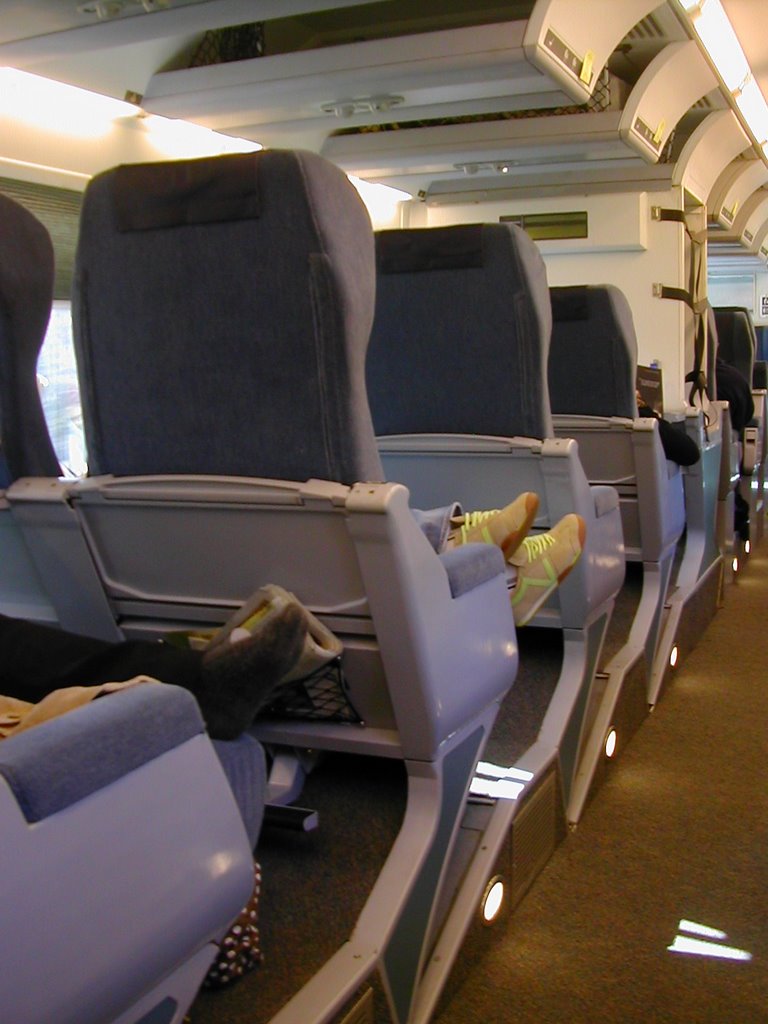
Train 14: feet

Train 14: breakfast

After my first brief experience of New Brunswick (a new day, and the first of two new provinces...) on the platform of Campbelltown station, we are on our way again. I walk back two carriages to the restaurant car, where I have been told there's plenty of room for breakfast. The restaurant attendants are extremely welcoming, and are already joking and chatting with passengers. I'm seated straight away at a table for four opposite another passenger, a physician from New Brunswick. He uses the train to travel to Montréal frequently, often flying in one direction and then taking the train in the other. He explains that there is no better way to travel, especially with the schedule of the 'Ocean', which departs Montréal at the end of a working day and arrives back in his home town of Miramichi just after 10.00 the next morning.

My breakfast companion is just back from a holiday in Cuba. Using his hand-held computer, he proudly shows me a photograph of the beach he has just spent a week on in Varadero. I counter by opening my laptop and showing him the beach in Churchill, Manitoba, complete with frozen ocean. We evidently enjoy very different types of holiday.

For non-sleeper passengers on board the 'Ocean', breakfast costs C$10. It includes coffee, juice and a plate of toast, which comes a bit before my main dish of folded crepes with cheese, fresh fruit and syrup. Once again, these trains have had to be adapted for their new job in Canada. There were no restaurant cars in the original fleet, so sleeper cars were converted for the purpose. The only noticable thing about this conversion is that because the sleeper cars were built with fewer and smaller windows, tables have to be spaced out through the car to make sure each has a window. Food is prepared off the train and re-heated on board, although the quality of my meal was impressive. The crepes did not have the unnaturally hot tell-tale taste of microwaved food, and the fruit was fresh.

As always with my on board acquaintances, we talked of our trips and how we liked to travel. My dining companion was a French speaker, and it was good to be talking in French again. I fluff a few words and a few tenses, but I don't think I drop any clangers. Hopefully four weeks away from Montréal hasn't killed off the young French side of my brain. My dining companion finishes his meal and returns to his sleeper, and I linger over my empty plates to gaze out of the window. The bay is beautiful this morning - a gentle deep blue that stretches to the horizon, merging with the hazy sky once we have lost sight of the Gaspésie shore. The waiter refills my coffee and (on request) my juice, and I enjoy this sunny start to my day.

Train 14: Cambpellton, NB

Train 14: farewell to the Chaleur: Matapédia, QC

Needless to say, I am not a happy camper when I wake up for the last time. I might have managed four or five interupted hours of sleep through the night, and I give up trying when I left the window blind to see that we are slipping quietly into Matapédia. It's here that three times a week the 'Chaleur' and the 'Ocean' part company. There's a short pause in the station, while train 16 to Gaspé is unhooked from the front of our train, and pushed back into the platform besides us. For a few moments, I look enviously across the platform to the coach cars of the other train, which is made up of older stainless steel cars. Every person in coach class seems to be deep in sleep.

Outside, however, it's a beautiful early morning. It's just after quarter past five in the morning, but I change my watch forward onto Atlantic Time now to make sure I don't forget. It also makes it easier to justify being awake so early. Our train pulls away from Matapédia about half an hour late. The 'Chaleur' will leave a few minutes later, and ply the scenic rail line around the Gaspésie peninsular that now appears across the Baie de Chaleurs to our left. The bay is calm, and across the blue water I can see the thick forests that coat the undualting landscape of the remote Gaspé countryside. I think of a distant friend and mentor who is somewhere along that coast, and watch the water between us slowly widen.

I consider my bag of food for this morning's breakfast. I have one remaining bagel, and some odds and ends, but nothing that really inspires me to start the day. I decide to save them for later, and go back to see what the service car offers. As you can see from the photo, the service car is pretty well named. It isn't a lounge, it's a car when passengers are serviced with drinks and snacks. There are two flat screen televisions for movies, and during last night two or three films were shown to entertain the children and families who were on board. However, the lack of seating was a big problem, and when I came through at one point last night, I found most people standing to watch the films. As originally designed, this bistro was much smaller, but an office for customs officials (for the train's original use, travelling from England to European cities via the Channel Tunnel) was removed to make a bit more room.

The counter is open, and I ask what they have for breakfast snacks. I notice a man from coach class sitting down with a coffee, a pre-packed bowl of corn flakes and a horrific looking microwaved 'English' muffin (note to all Canadians: THEY'RE NOT ENGLISH). Nothing much grabs me. The attendant points out that I can go back to the restaurant car, if I like, which is just behind this carriage. This is the first time anyone has mentioned the restaurant car; all the announcements up to this point emphasised the service car and at seat service for coach passengers. So I decide to wait until we have left Campbellton, and will splash out one last time.

Sunday, May 14, 2006

Train 14: tossing and turning

This is, to be honest, pretty bad. I know that problems are always exaggerated when it's the middle of the night, and when you can't get any sleep, but 'Comfort' coach class on train 14 is pretty dire. The fancy modern coaches are revealing all sorts of quirks to make it difficult to get comfortable, let alone get any sleep.

As on other overnight VIA Rail services, there is a blanket and a pillow for everyone in coach, but this time no amenity kit (eye mask, ear plugs etc). The lights have been dimmed since 21.00, but the real problem is the noise. Sitting near the centre of the car in row ten, I'm kept wide awake by the noisy air conditioning vents that are beneath the seats in the centre of the car. When I go to the back of the car to use the washroom, I chat again with the two ladies travelling to Moncton. They have managed to spread out over a pair and a single seat, but they're having problems sleeping because there is no door between their end of the car and the vestibule between the carriages; the noise of the train running over the track is quite intrusive here.

I return to my seat and attempt to fiind my sleeping position. This takes some time, because as I mentioned earlier, the single seat is bordered by two very hard and immovable arm rests. And while the seat reclines in a manner which prevents you from intruding on the space of the passenger behind you, the sliding base of the seat and the rising plenum on which the seat is mounted reduce leg room significantly - a big problem for lanky blokes like me.

I toss and turn a bit, using my own ear plugs to try and drown out the noise of the ventilation. But to be honest one pillow simply isn't enough... my neck isn't supported, despite the chunky shaped headrests and whichever part of my body is propped against the armrests needs some cushionning to stop it going numb. To top it all off, since this is the first journey in which I've checked in my luggage, I've usefully forgotten to bring any extra layers of clothing, and being dressed for Montréal's sunny weather (in just a shirt) I'm now getting extremely cold under the spell of the fierce air conditioning. The blanket helps, but there's always a draft somewhere that keeps me awake.

I manage to sleep a few times, never for more than an hour or two at a time. Each time I awake, I notice other passengers awake trying to get comfortable again. Some have cleverly discovered the sack of pillows at the end of the carriage, and have pinched a few more to make themselves more comfortable. Each time I check my watch, the hands seem to have barely moved.

This is going to be a long night...

Train 14: into the night

We're on time as we head up the busy line towards Québec City. The 'Ocean' doesn't call at Québec City, but after passing through the peaceful towns of Saint-Hyacinthe and Drummondville, we reach Charny at about ten o'clock. A bus shuttle operates between here and Québec City. There are a lot of passengers boarding both coach and sleeper cars on both the 'Chaleur' and the 'Ocean' portions of our long train, so we make several stops. Each time the train pauses to allow people to board, before pulling forward to allow for the next section of the train to take on passengers. Once the last section of the train has pulled into the station, we're allowed off for a 'smoke stop'.

It's dark when I hope down off the train and take in the fresh night air. I have to step away from the crowd of cigarette smokers who are clustered close to the train, but it's a warm night for the time of year. Our train stretches away in both directions - although I'm near the front of the Halifax portion of the train, the Gaspé train is ahead of us, and there's not enough time to do a walk along the full length of the train.

The Montréal - Halifax 'Ocean' is now operated exclusively by the newer 'Renaissance' trains. I've heard very mixed opinions about these trains, and one complaint is that they don't include any dome or lounge cars. There are three levels of service on board the 'Ocean' during the peak season: Comfort coach, Comfort sleeper and Easterly ('Alizée in French). There's a functional 'service' car behind the coach carriages and sleeper carriages, but it really isn't much more than a place for passengers to buy snacks and coffee and to watch movies on small and uncomfortable bistro seats. It's also very small, offering much less space for relaxing away from your coach seat during the journey. Although Comfort class passengers don't get a dome any more, a vintage stainless steel 'Park' car like the one that tails off every Toronto - Vancouver 'Canadian' is included at the far end of the train for passengers in Easterly class. It's fitted to the more modern train by means of a specially adapted Renaissance coach... much of this service reveals this hasty patching together of a train that wasn't designed for this job. It's very flash, but it's not in the same league as the older VIA trains I've been travelling on, which are much grander and more comfortable.

For passengers to the more remote Gaspésie, however, things carry on as normal. Ahead of our part of the train, the 'Chaleur' is formed entirely of older stainless steel cars. I would much rather be spending a night in coach class in one of their squishy seats... age isn't everything, you know...

The coach attendants call 'all aboard' and I hop back on board. I have one more night ahead of me travelling alone in coach class. We pull out of Charny, and I do my best to bed down in my unforgiving seat for the night.

Seen from a train: southern Québec

Train 14: The Ocean

So, I won't go into the details of my rest stop, but it involved butternut squash soup, Tremblay beer, Artic Power washing detergent and Dove body wash. All of those things had been absent during the last three weeks of my trip, and along with a relaxing night at home with friends in Montréal, I was able to catch up and recharge the batteries, leaving just one round trip before the end of my month long rail tour. Although coming home a week early might seem weak, it was on the way, and has allowed me to replenish my hand luggage with home made food and to re-stock my overnight bag with fresh underwear.

I'm back in Montréal's Central Station. It's Sunday evening, and the last trains of the day towards Toronto and Ottawa are leaving soon. The weekend is ending for many, as they head home from two days off with family and friends. Many will be back at work tomorrow morning. I, however, have another week left on my North America Rail Pass, and I intend to use it.

I'm here for the 18.30 departure of VIA Rail's eastern flagship train - the Ocean, to Halifax, Nova Scotia. Halifax will be the final destination on my tour. I have several reasons to make this trip, one of them being a job interview on Tuesday, and another (equally important) being my girlfriend. In fact, she's already there - having arrived by aeroplane from London Gatwick this afternoon. We have a rendezvous in Halifax before we return to Montréal on Friday together. So, as you can imagine, I'm very excited to be boarding this train.

Alongside me a line has formed for train 16, the thrice-weekly 'Chaleur' that runs from Montréal to Gaspé, on the beautiful Gaspésie Peninsular. Once a separate train, this service is now attached to the front of the 'Ocean' and will run with us as far as Matapédia, Québec. After we arrive there in the morning, it will be detached and will run separately along the southern and eastern coast of the Gaspésie. This train boards and 'departs' fifteen minutes before our train - in actuality it pulls forward from the station, and then reverses to be attached to our still stationary coaches, before we all leave on our overnight run up the south shore of the Saint Laurence river.

The friendly atmosphere has started before I've even boarded the train. I'm early at gate fourteen, having checked in my bags for the first time on the trip. In front of me for a short while is a amiable English ex-pat from Toronto who doesn't like flying. He's going to Halifax to visit an old school friend he saw for the first time in decades last year. I say that he was in front of me for just a short while, because it turns out from our conversation that he's in a sleeper compartment, and therefore in the wrong line. As much as I hate truncating an interesting conversation, I point him to the line of sleeping car passengers who are boarding ahead of us through another gate. We wish each other a pleasant trip, and he heads off. I check with the two women standing behind me that they aren't in a sleeper car (it's a good way to start another conversation) but all is well there. They're heading home to Moncton where they live. We talk about Montréal, and I confess my feelings of stagnation. We agree that it's a fun city to live in for a while, but that it becomes remarkably one dimensional after a while. I think that this trip has reminded me that I will soon have the chance to move on, and having criss-crossed the USA and Canada, I'm looking forward to settling somewhere else for the remainder of my year in Canada. Maybe this will not be the last time I board train fourteen for Halifax?

At about 18.10, coach passengers are boarded. We descend the steps in the centre of the grand hall of Central Station, and descend once more to the grim underbelly of the station. It's just over three weeks since I was here last at the start of my trip. And I still have to say that it's a depressingly dark station to start a grand journey from.

Our train tonight is modern and bright green - it's one of VIA Rail's infamous 'Renaissance' trains. These were bought at a bargain price in the late nineties from Alstom in Great Britain. They were designed and built for the unrealised night trains that were to run from London (through the Channel Tunnel) to Paris, Amsterdam, Dortmund and Frankfurt. They were imported to Canada and adapted for VIA Rail by Bombardier: the bogies were widened for the larger North American guage, steps were added for un-improved platforms and the trains were uprated to work through colder winters. The result is an odd looking train - narrower and smaller than others, but much smarter and sleeker than VIA Rail's older fleets.

Coach class is at the end of the long subterranean platforms. Disabled and eldery passengers have already been boarded with the aid of platform buggies, but the women walking behind me are finding it hard going with all their carry on baggage. I offer to help, but it's still a long hike.

Inside, the coach carraiges are unlike any other that I've travelled on, here or in Europe. There are two seats on one side of the aisle, and one on the other. The seats themselves are raised up above the level of the corridor by a plenum, which swoops up to offer passengers a continuous footrest and a deep space for hand baggage beneath the seat. Above each seat is a suspended luggage rack, which is used by the passengers behind - as you stand up from your seat it's directly in front of you. There are individual reading lamps, but the coaches are surprisingly bright when fully illuminated. I'm immediately aware of the very loud rushing sound caused by the air conditioning grilles beneath the seats in rows 7 - 10.

Being on my own, I'm directed by coach attendant's to take a single seat to one side of the aisle. That's fine with me, although I'd prefer to have a pair of seats to stretch out on. The car rapidly fills up, and that looks less and less likely. The raised seats offer a very good view through the window, but I'm already noticing the hard fixed arm rests on either side of me... these could be problematic on my overnight trip. The seats cunningly recline by sliding the base of the seat forwards and bringing the seat back down with them - these means the passenger behind isn't bothered when I choose to recline. A large folding table slides up and out of the chair in front of me, and the seats match up well with each half window. I have my own window blind too. The basic design is clever, but it's far from perfect, as I'm going to find out during my trip.

We're all boarded and ready to depart on time. I don't feel it happen, but a few minutes before we leave, train 16 is hooked onto the front of our train. Just before we leave, Amtrak's 'Adirondack' from New York slips into the platform next to ours. I wish any connecting passengers the best of luck... we leave just a few short minutes later...

Saturday, May 13, 2006

Train 64: the afternoon slump

I’m back at Union Station by 14.40. I just have to pick up my bags from the baggage desk, and then join the line of passengers that has begun to queue for train 64. This is one of the fastest trains between Toronto and Montréal, so on a Saturday afternoon it’s a popular choice for people heading home after a trip to Toronto or who are going home for the weekend. Unlike on the ‘Canadian’, most of the passengers seem to be regulars. They’re easy to spot, because they display the nonchalance of someone who knows they don’t need to take their ticket out yet, and who don’t have the bright-eyed confusion of younger backpackers or travellers like me.

Boarding begins about twenty minutes before departure. We climb the escalator to the track, and are directed to our coaches. This train operates with assigned seating. A surprising number of passengers ignore their assignment, and then get grumpy when successive passengers tell them that they’re in the wrong place.

We leave bang on time, and our train of five or six carriages slips smoothly out of the station shed. I like to be more precise, but to be honest, I’ve reached my afternoon slump. After a short night’s sleep, and the best part of a day on my feet exploring Toronto for the second time, I’ve hit the afternoon brick wall. I kick off my shoes, and as the train picks up speed I curl up and recline the seat. If Amtrak is strongest in the north-east corridor of the United States, then VIA Rail is at it’s best here in the corridor between southern Ontario and southern Québec. The trains are fast, frequent and very popular. Going from downtown to downtown, there is no reason to fly from Toronto to Ottawa or Montréal. The car I’m in dates from the seventies, when VIA commissioned a project to build a train that would be called the ‘LRC’, a (bilingual) name for a train that would be Light, Rapid and Comfortable, or Léger, Rapide, et Confortable.

We’ve not even left Toronto behind before we’re flying along the smooth track towards our intermediate stops of Oshawa, Belleville, Kingston, Cornwall and Dorval. Through the suburbs of Toronto, we pass through deep clouds of mist that have rolled in from Lake Ontario, which we briefly see off to our right before heading in land. Then it's not long until we're racing alongside highway 41. It's satisfying to be passing cars again, even those in the faster lanes of traffic. These trains operate at up to 160 km/h, and soon the cars' tilting mechanism is engaged to smooth our passage round corners, and to make sure that the coach attendant can pour coffee without sending it out of the cup...

Inside, there's less room than the older cars that have carried me across the country, but the seats are comfortable and it's a pleasant environment to pass an afternoon. Muted colours and refurbished materials hide the age of this car. For passengers ahead of us in VIA 1 class, there's highspeed wireless internet that keeps your laptop connected throughout the trip. At the moment it's a pay-per-use service, which seems pretty daft considering the premium first class passengers have already paid (fares start at C$139 one way from Toronto to Montréal). I would like to see VIA Rail expand the service to all corridor carriages, and at least offering it free to first class passengers and accessible for a supplement to Comfort class passengers. Most of the laptops in this train are being used by students, so restricting it to first class doesn't really take full advantage of the technology that is now available.

I chat briefly with a teenager who gets in Oshawa and travels as far as Kingston. She's taken this trip many times before, and I'm pleased to tell her that is compares very favourably with the European standards of rail travel that I'm used to.

Once again, the sun sets in the west, and another day on my trip comes to an end. I drift in and out of sleep, and the train ride flies by. At just four and a half hours, this is one of the shortest trips of my entire tour, and to be honest it feels so short that I feel like I'm taking a local train.

Rain starts to fall against the window, and as the sky turns darker, we approach the border with Québec. I recognise the suburban rail stations of Montréal, and before I know it we're arriving at the airport connection station of Dorval, adjacent to Pierre Elliot Trudeau International Airport (or for the apolitical amognst you, Montréal Dorval Airport). Montréal approaches, and a one night layover in my adopted home beckons me. I've been travelling for just over three weeks, and I'm tired. I need a cold beer with friends, a hot shower (without friends), a long peaceful sleep in my own bed (with cats), and a heavy session down at the laundromat (with suds). The last part of my voyage is a roundtrip from Montréal to Halifax, and that starts tomorrow night.

18 hours in Toronto, ON

Toronto is my rest stop for less than twenty four hours. After arriving, I make a bee line for the TTC subway station that is adjacent to Union Station. Once again it is The Hospitality Club that has lead me to the door of Erika, yet another friendly and fantastically kind host who is able to give me free accomodation for the night. I arrive at during the unfolding of a particularly uncomfortable set of personal circumstances, but despite a very long day it's a real pleasure to be able to show up on her doorstep and have a really interesting and engaging conversation or two, before I collapse for the night on her air bed.

The next morning I offer Erika my sincere thanks and make my way back into town. I've got to get some wool for BMM from a small shop in Kensington Market, which I'm pleased to say I found by back tracking from my trip in January (and with a little help from Google Maps...)

I leave my luggage in Union Station, again for C$2.50 a piece... strange how certain stations charge for this service while others will happily guard items for free.

I use my three remaining hours to explore the markets just east of Union Station (well worth a visit, especially on the weekends) and then stop for a coffee in a friendly diner near-by. In the window is a poster which says "You can pay $5 for an Italian Coffee near-by or $1 for a coffee served by a man who looks Italian." I am happy to go for the second option. I plod up Yonge Street and find a branch of H&M which still has the decency to stock men's clothing. A few garments are dug out from the sale rail, and I find a new pair of trousers for the summer.

I head west to check a few small galleries and to see the new Sharp Centre for Design of the Ontario College of Art & Design (pictured) which actually came across better in the 'flesh' than I had expected. Designed by the British architect Will Alsop, it came in for a lot of criticism from those offended by the black and white tiled skin, multi-coloured legs and unusual spatial arrangement. 'Unusual spatial arrangement' meaning the way in which the whole thing is mounted six storeys above ground level, partly overhanging an existing building. I didn't like it when I first saw the images in the architectural press, but having actually walked around and underneath it and seen the rest of Toronto's architectural variety, I'm pleased to see a brave addition to the city's fabric.

I poke around, pick up some stationery from the adjacent art supplies store and check my watch. It's time to head back to Union Station to get my bags, and to get back on a train...

Friday, May 12, 2006

Train 2: Toronto

Train 2: into Toronto

I'm not the only one who is keen to get off. My English acquaintance decided earlier today to stay on board with her bike as far as Toronto to visit friends there. Her decision was made by the rain we were travelling through this morning. Now, of course, it's a sunny day, and as we pass through warm Parry Sound and Washago about half an hour behind schedule, she's regretting her choice. Card and number games are getting boring.

But there is hope on the horizon. The landscape has opened up into the hinterlands of Greater Toronto. We're running past highways and through suburban towns, picking up speed and rattling over more and more level crossings. I spy the first 'Go' train station, marking our arrival within the region served by Toronto's urban rail system. We are getting close. Soon we're racing under busy road bridges and through residential areas. The industrial units that are strung along the city's arterial routes begin to get denser and denser: more and more units are surrounded by fenced yards that cram old cars and shipping containers up against the tracks.

Our line suddenly descends into (or rather the land around us rises to form) what I think is the Don Valley. High rise apartment blocks gather close to the edges of this wooded valley, and I begin to recognise bridges that span the wide expanse above us, including one double deck bridge that carries a TTC subway line beneath the roadway. It's easy to spot because of the complex and vaguely elegant suicide guards that prevent anyone from jumping off this fifty metre high bridge. We're definitely back in the big smoke.

At one point we slow to allow a GO train to pass. Briefly our windows pass by, and tired Friday evening commuters exchange glances with tired trans-continental tourists. This ride from Winnipeg has not been particularly long, but I am feeling eager to get off the train because everyone else is: our entire train is reaching it's grand terminus. Some of my fellow passengers have been on this train since Tuesday night. I have re-packed my bags and I am wearing my coat, ready to jump off and descend into Toronto's underbelly to catch (ha!) another train to carry me the last few kilometres to a horizontal sleeping surface. What luxury...

The train line crosses industrial wasteland that is the process of being prepared for development. Toronto's massive rail marshalling yards are preparing for a new life, as condominiums and office developments lure developers and eager denizens to live and work in the core of the big city. A view opens up on our right, and suddenly I can see the silhouetted skyline of the city. A cluster of shining skyscrapers mark the culmination of mile upon mile of suburbs, while towering over them stands the unmistakable shape of Canada's most famous tall building - the CN Tower. I'm told that despite the altitude reached by the Petronas Towers, the CN can still lay claim to being the tallest free standing structure in the world.

Another 'Go' train causes us to pause just outside Union Station. Pushing my anxious face up against the window, I can see the dark train shed ahead of us, preceded by dozens of criss crossing tracks. We are so close, waiting on the threshold of our destination.

The train starts to edge forward, and we arrive.

Seen from a train: man on a bike

Train 2: time begins to slow

Such is our progress throughout the morning that not only do we make up lost time, we actually reach Capreol ahead of schedule. VIA Rail make sure that their long distance trains enjoy padded timetables with plenty of time at servicing stops like this one to make sure that the trains can usually arrive close to on time.

The sun is shining down when train 2 disgorges several hundred passengers into the small town of Capreol. This little community must get an economic boost six times a week when the train stops here: people go down Main Street to buy snacks, newspapers and to drain the CIBC bank machine of its fresh banknotes. I turn the other way, however, and do my platform tour to the end of the train. Again, friendly VIA Rail crew greet me at every step, and I exchange a few words with the passengers I spoke to in Sioux Lookout. I turn on my heels, and re-join the crowd of coach passengers who have been into town during the thirty minute break. We make sure that a certain passenger hasn’t been tempted by any more complicated take out meals, and re-board for an on time departure at 12.55.

The rest of the day begins to drag. Much like the frustrations experienced by the smokers amongst us who can only cope by knowing exactly how long until the next smoke stop, everyone is now beginning to focus on our eight o’clock arrival in Toronto tonight. The last few hours start to slip by like whole days. Our track guides us smoothly through gentle curves, past shining lakes and through massive rock cuttings. Like the imprecise faux-landscape I constructed for my model railway as a child (using bits of rock, moss and twigs found in the garden) we’re passing through an extremely mixed scenery, of deciduous and coniferous trees, rocky outcrops, still lakes and brown wetlands.

As we come closer to the densely populated heart of southern Ontario, we start to slow through small villages and lakeside communities. The sign of the approaching metropolis is the gentrification of the countryside homes that we see. I spend most of the last few hours up in the dome car with the people I’ve met in coach class. Newspapers, books and su-doku puzzles are having less and less of a distracting effect. We attempt to occupy ourselves with other puzzles, and succeed in finding ninety-two words using only the letters in the word ‘planets’.

Yep, the day is dragging. But at least the sun is out.

Capreol: not your standard trucks


Note the extra set of metal wheels under the fronts of these CN maintenance trucks. Pull a lever in the cab, and your truck can go off road.. and onto rails. Ford should think of selling that as a standard option...

Train 2: don't forget to stop in Capreol

Train 2: the last breakfast

Before going to sleep I changed my watch forward one hour. We’re now on eastern time, and I am back in my native time zone. However, there are still many more kilometres to cover. I walk back to the restaurant car, having decided that for my last day on-board the Canadian, I should treat myself to the proper sit down breakfast just one more time. Outside, raindrops are falling horizontally against the windows of our carriage. I recall that the last time I was in Toronto it rained as well. I hope my second visit isn’t marred as well.

It’s a short walk back to the ‘Fairholme’ restaurant car, through our Skyline car and three sleepers. It appears that the first two are the ones that are running light with our train, because there are no signs of occupation on board. I get to the restaurant a little before 06.30, and find one table already partly occupied by some of the friendly faces from coach class. It seems I am not the only one up front who has decided it’s not worth eating a picnic breakfast today.

Each splashes out, and I go for fruit yoghurt followed by French toast. My dining companions are excited to be drinking real coffee again, not the slightly harsher liquid served from our take out counter. We talk about our journeys: one girl is going to a conference in Montréal, another is returning to Halifax at the end of a thirty day North America Rail Pass trip like me, and the third is an English student, touring Canada with her bicycle. She has yet to decide whether to get off the train in Parry Sound this evening to cycle and camp, or stay on board as far as Toronto and stay with friends: the weather is likely to decide for her. As the coffee flows, the conversation picks up energy. Much amusement is being derived throughout the car from the pair of loud Brits in our car (brothers it seems, both easily identifiable thanks to a identical wardrobes and goatee beards). They seem to be trying hard but failing to make friends with members of the opposite sex while on the train. Might have something to do with their opening line being “Hello. You’re pretty.” I carry a great deal of shame and embarrassment for Great Britain.

Our table is served today by a pair of young employees, who one reveals are on their first proper tour of duties. My order is fluffed to begin with, and I’m delivered pancakes instead of French toast, but since everyone on the table has had waiting experience and is about the same age as our servers, we are more than happy to wait. Strange how the older you get, the angrier people like to get with waiting staff. I’m more than happy to leave a tip for the friendly service.

Thursday, May 11, 2006

Train 2: sunset over Ontario

Train 2: third and final night

I sink back into my book, and watch the sun go down on northern Ontario. I’ve been warned before that while beautiful, this stretch will seem like the longest part of my trip. I am already glazing over as we pass forest after lake after forest after lake after forest etc. This thinly populated region is in the heart of the Canadian Shield, and it marks a period of the trip with few guaranteed stops.

I make myself another bagel (“ooo… salami and cheese, no there’s a combination I’ve not had before”) and head back to the lounge car to read some of the newspapers that have accumulated there. I start talking with the man who nearly missed the train because of a choice between Dijon mustard and mayonnaise. He works in construction, and lives near Guelph, Ontario. We’re both very familiar with the business of building houses, only he reminds me how little I know about the most reliable way of pouring concrete. We compare how our professions differ, and talk about life in Canada. Wherever I go in the world, I like to ask myself “How would it be to live here.” I’ve been doing this even more in Canada than I have elsewhere, and while it may add up on paper I’ve yet to be absolutely convinced. As he points out, the high tax economy is not the best for someone who works hard and puts in a lot of overtime. I later think to myself that it would be fairly easy to ease off on hard work and overtime, though, if pressed…

During our conversation I spy a beautiful sunset out of the opposite window. I run back to get my camera, and for once on this trip I don’t miss it. The obligatory appropriation of every beautiful sky or landscape continues.

I finish the day with a hot chocolate from the take out counter beneath the Skyline observation dome, and talk for a little while with two French girls, one from Montréal, the other from Lille in France. They’re desperate to speak English while on holiday, and I’m desperate to speak French before I forget everything I’ve learnt in the last six months. We come to a mutual compromise, and speak Franglais for the rest of the conversation. My eyes are getting heavy by 23.30, and I decide to go to bed.

Or rather, go back to my seat. I suspect that re-adapting to sleeping coach class will take some time.

Train 2: Sioux Lookout

We reach Sioux Lookout just before seven o’clock in the evening – incredibly we’ve made up almost forty-five minutes and are now just fifteen behind schedule. This is the next major stop for the ‘Canadian’ and there’s fifteen minutes for me to hop off the train and do a walk to the end of the carriages while the train is fuelled up. Some passengers have crossed over to Sioux Lookout’s main street to get food from the local stores or sandwiches from the town’s ‘Subway’ franchise. Our attendant explains that fifteen minutes means fifteen minutes, and they scamper off.

My walk to the end of the train takes significantly more effort and time than it did on the ‘Hudson Bay’ but it’s worth it for the exercise. Along the train at every open door stands a VIA Rail attendant, smartly dressed in a uniform with a small yellow step on the ground. Each says hello or asks how I am… these people do not miss a beat. Amtrak would do well to send some of their on-board crew for a railroad holiday in Canada to pick up some useful tips.

I reach the end of the train and talk to a couple who are going on to Halifax. They’re travelling in the luxurious ‘Silver & Blue’ class, and we chat standing next to the elegant streamlined Park car at the end of the train. We joke about how VIA Rail like to keep some distance between the cheap seats up front and the classy folk at the back. I make my excuses (namely that I’ve got a long walk back to my coach) and head back to the front of the train. Everyone, it seems, has re-boarded, and it’s just left to the coach attendant to stall the anxious locomotive driver as he yells “all aboard!” at an ever louder volume to the stragglers coming back from town. The steps are lifted up, the door is closed and the conductor calls ‘highball’ over the radio to the engineers, the signal that we’re safe to leave.

But as the train starts to roll, something is not right. The seat behind me is empty, and along with a girl across the aisle, we realise someone has been left behind. Just as we call down the carriage to the conductor, our missing passenger appears off to our left. Leaping like a startled hare, the man is flying across the dusty yard beside the track. His feet barely touch the ground, and when they do they send small puffs of dust up into the air. Moving like an Olympic athlete, he leaps over the sidings, leather coat flying out behind him, one arm in the air, the other holding onto a ‘Subway’ sandwich bag. Frantic radio calls are made, and the train is able to come to a halt within the station. A small cheer goes up as our nearly abandoned fellow passenger walks, breathless, down the aisle. It’s a beautiful moment.

We start up once more, and continue on our way. The army may teach you to never leave a man behind. But VIA Rail have timetabled slots along stretches of single track to keep to. So next time you use a smoking stop to go and buy a sandwich, be sure to avoid those pretentious ‘fresh’ sandwich bars where the server asks you more questions than you’d answer in a driving test.

Train 2: Malachi

The flat fields of Manitoba begin to disappear, and we enter the forests that will lead us into north-western Ontario, the province that train 2 spends the most time in on it’s journey across the country. We make a request stop at the pretty little lakeside halt of Malachi to let one passenger off. As the train pulls away I see her standing back from the track with a suitcase by her side and a big smile on her face. She joins the thick album of mental snapshots I have of people who wave as we go past. Top honour in that category, unfortunately for her, goes to the UPS delivery driver who drove past me while on the California Zephyr somewhere in Utah a few weeks ago. As he overtook the train on a long dusty road, he gave a wave and a friendly smile to all of us along the length of the train through his open sliding door. Thirty minutes later I saw him going the other way, still waving, still smiling.

Seen from a train: pylons

Train 2: like an old friend

I collect my bags and return to the waiting lounges in the VIA Rail ticket hall. It’s a great shame that most of the large railway stations I’ve been in on this tour offer you very little preview of the tracks that you board your train on. Travelling by train is a special event, and it’s rather disappointing to always be herded through waiting rooms and ticket halls that are separated from the tracks by escalators or stairs. When train 2 does pull in, about one hour late, everyone is informed of it’s arrival by the immense sound of heavy cars clanking over tracks above our heads.

The lounge areas here are divided for sleeper car passengers and coach passengers. Both sides are pretty full, and they get busier as the passengers who’ve stepped off the train for a short break re-join us for boarding. The platforms are closed off at Winnipeg in between disembarkation and boarding so that the platform crew can service the train. Winnipeg is also a VIA Rail crew base, so the entire on board team is changing here. Winnipeg based crew operate on three roundtrip routes: to Toronto and back, to Vancouver and back, and to Churchill and back. Less experienced staff generally work without an ‘assignment’ – meaning that they do not know until a day or two before their next departure where they’ve been scheduled to work. Tara, my chef and sleeper attendant on my last two trains, told me how this was her first season with an assignment, and therefore with the benefit of knowing where and when she would be working next.

Just after 12.05, a boarding call is made for the sleeper car passengers. This causes much commotion in our coach lounge, and of course the human instinct prevailed: we all form a neat line ready by the gate for when it’s our turn. I recognise a few faces who had been one or more of my preceding trips on train 2: our overlapping and interweaving itineraries make for enjoyable brief friendships that come and go.

A few minutes later, the gate opens, and the neat orderly line gradually transforms into an eager rush to get on the train, and to find ‘good’ seats. Most people seem to have differing opinions of what a ‘good’ seat is, so to be honest there probably isn’t much need for rushing. I emerge onto the platform to find train 2 occupying significantly more of the length of the tracks than train 692 had this morning. Like a long silvery snake (hey, no criticism, it’s hard finding synonyms for a big long silver train) the front and back ends of train 2 dwarf the length of the station shed, stretching almost to the ends of the platforms.

I later saved myself a long walk, and got the attractive sounding roster of our train from my coach attendant. The train consists of:

Two locomotives, baggage car, coach, coach (me), Skyline (dome), Jarvis Manor (sleeper), Draper Manor (sleeper), Lorne Manor (sleeper), Skyline (dome), Fairholme (restaurant), Blair Manor (sleeper), Douglas Manor (sleeper), Macdonald Manor (sleeper), Chateau Vercheres (sleeper), Skyline (dome), Kent (restaurant), Amherst Manor (sleeper), Drummond Manor (sleeper), Dawson Manor (sleeper) and the Banff Park car.

Two of the first sleepers were ‘dead-heading’. It took some further polite questioning to work out that this meant they’re empty, running without staff or paying passengers. This does mean, however, that every crew member should have a bed to sleep in, which always makes for happier crew.

I find a seat that meets my amateur’s definition of a ‘good’ one (un-obscured window, middle of the car, away from the doors and axles) and settle in. I’m mostly surrounded by continuing passengers from Vancouver and Edmonton, but a number of people get on Winnipeg. This car has an interesting mix of younger travellers and older passengers. A friendly coach attendant checks my ticket, and we’re soon on our way, running about one hour behind our schedule.

I’ve chosen a very warm day to be leaving ‘Canada’s Chicago’. As we turn to cross the Red River through a beautiful old steel bridge, our welcome announcements begin and I head to the dome car behind my coach. We running along a track that is now heading straight east out of Winnipeg, on an embankment that affords me an even better view from the raised viewing section of the Skyline car. We skim along the treetops of St. Boniface, and the green suburbs eventually give way to the suburban commercial and industrial strips. Even out here, everything is somehow green: roadside tracts of grass and the tree lined streets are in full colour, and under a blue sky it feels good to be back on a fast train again. Winnipeg’s eastern freight yards pass us by to out left, and continuing along a dead straight stretch of track, we begin to pick up speed.

I’ve substituted the inhospitable true north of Canada for the prairies that I know and love. In doing so, it’s amusing to notice that I’ve also substituted an entirely Canadian group of fellow passengers for a mix of tourists from all over the world. It seems that it’s only usually Australian, Kiwi, Polish, French and English folk who’d consider taking a train from Winnipeg to Toronto. Snippets of a conversation in the lower level lounge is filtering up into the dome. I can hear two British men discussing Home and Away and Eastenders with a family from Australia.

We have 1,943km ahead of us, and we’ll be in Toronto by tomorrow night.

Winnipeg (twice in one week)

When I descend to the Winnipeg station ticket hall, the monitors are advising the train 2, my eastbound ‘Canadian’ is running on time, and will be departing at 12.25. It should even arrive before then to allow for servicing, so I decide not to stray too far from the station. I cross the imposing foyer, and out onto the street. A little roadside diner across the street caught my eye last time, so I head over the VJ’s Drive Through to eat the ‘special’ hamburger. It was very special indeed, and although the air is still fresh, I sit outside with a newspaper and enjoy the sunshine.

When I cross back to the station a short while later, the screens are telling a different story, and the train is now running late. So I leave my bags at the ticket desk and go for a walk in the Forks. This redeveloped are sits to the south-east of the railway station, in the small parcel of land cut off from downtown by the railway tracks. Old warehouse buildings have been refurbished and opened up into the Forks Market, and what looks like an old pumping station or generator house is a television and radio station. An old CN caboose and an old passenger carriage stand in the car park. The Caboose is intact, the train car is now a sweet shop.

I have a look round the indoor market, which is bustling at ground level with dozens of food joints, fruit and vegetable stalls and other small shops. I spend thirty minutes on a computer sending a few e-mails and bashing out a quick blog entry, and then wander a bit more. To one side of the markets is more modern steel and glass viewing tower, with a stair and an elevator that carry you up to an open air platform. The views from up here of the Forks, the river and across the train tracks towards the skyline of downtown Winnipeg are pretty impressive, and I take a few photographs in the warm sunshine. This would be a good place to watch the ‘Canadian’ sweeping across the bridge into the station, but since I don’t want to miss it, I decide it would be safer to go back to the station.

I cross beneath the tracks just south of the station, stopping briefly to peer into the windows of a car similar to one that I’ve arranged to rent when I get to Halifax. Despite a bit of driving when I was in California, I don’t how easy it will be to return to piloting myself in a vehicle; I’m rather used to being chauffeured around (so don’t forget BMM… bring your license :-)

Train 692: into Winnipeg

I wake up to the familiar sights of Manitoba. We’re back on the mainline, heading towards the town of Portage la Prairie. It’s home, amongst other things, to the world’s largest can of Coca-Cola (click on the photo and see if you can find it!) Next time I’m in town I’ll have to do my own tour of Manitoban big things to compensate for my earlier Albertan tour. I had toyed with the idea of getting off here and joining the ‘Canadian’ here before it reached Winnipeg so as to spread my layovers over a wider variety of cities, but the ticket agent at Winnipeg station had advised against risking it. It is actually better to have more time in the morning on the train – I am less rushed to get packed and off

I take a shower and have a shave to start the day. Although we’re scheduled to arrive in Winnipeg just after eight o’clock, this train always runs slightly late, so there’s no rush this morning. I know for certain that I will make my connection with the eastbound Canadian later today, so I’m not fretting. Refreshed from my shower, I re-pack my bags for the short interval between trains. Breakfast is still being served, so I go forward and have one last meal in the ‘Annapolis’ dining car. I have a hot coffee, and get teased by Carmel for asking if I can have some jam to put on one of my own bagels. Sorry VIA Rail, we Rail Pass passengers aren’t going to help you turn a profit this year.

Tara is in the process of converting our berths back into seats when I return. I shift my bags out of the way while she finishes, and settle down with my book as we race towards Winnipeg. ‘Race’ may not be the most appropriate verb, but it feels like we’re sprinting in after the crawl we moved at for most of the journey.

The suburbs of Winnipeg soon appear beside the tracks. Modern family homes are being construction in faux-communities further and further out from the downtown district. We pass underneath the outer circular highway, and begin to slow as we enter the broad sets of tracks around Winnipeg’s busy railroad freight yards. Passing the VIA Rail maintenance facility, I catch a brief glimpse of the obsolete ‘Northern Spirit’ trains that worked this service for a few years. They’re easy to spot because of the bizarre oversized decals of Manitoban animals that are applied to the sides of the stainless steel carriages. Interesting, but probably of limited interest to the actual Manitoban wildlife who get to see the train pass by every three days.

We arrive in Winnipeg’s station just before 11.00. Tara helps Vera and me down from the sleeper car, and wishes us both a pleasant trip. I’ve been travelling with a small stock of CD compilations that I have been giving to those who have hosted me during my trip – both friends and the volunteer hosts of the Hospitality Club. Since I spent four nights in her company, and she’d been such a good attendant, I apologised for not being able to leave a gratuity, but gave Tara one of the discs. Few recipients are likely to enjoy the whole album, but given my sporadic taste in music there should be something in there somewhere that she’ll enjoy. We bid each other farewell, and I complete my 3,394km round trip by heading downstairs to the ticket hall.

Wednesday, May 10, 2006

Train 692: The Pas

We arrive at The Pas. The train is quiet, and virtually empty save for about a half dozen coach passengers. I step off the train and take a quick walk around the old station building (which apart from the VIA Rail ticket office, is now used as offices by the Hudson Bay Railway company). The locomotives fuel tanks are being filled, and the water tanks underneath the carriages are being filled. There aren’t many people about, and only five new passengers join us.

The sun is setting out of sight, and turning the western edge of the sky pink. The colours reflect in the windows and on the stainless steel of the train. They may be over fifty years old, but these cars are still very elegant. Even on a modest and purely function train like this one, they cut a dash at every station they stop at.

I get back on board, and prepare to enjoy my last night in the comfort of a VIA Rail couchette. Tara has once again been called into action to fold, collapse and unfurl the third pair of berths. One of the passengers who boarded at The Pas has upgraded from coach to a bed, and will be joining us for the night. It takes Tara about five minutes to perform the conversion, and soon we have another pair of beds ready for the night. I’ve enjoyed this little bit of luxury immensely: it’s an affordable and extremely fun way to make an overnight trip by train more comfortable, and I would definitely consider it again, especially instead of a more expensive private room. I’m not particularly fussy about privacy, and the comfort of a berth is more than enough to make a night time journey easy to sleep through.

I close my curtains for the last time and lie in my snug berth with the blind up. In my line of sight I can see the sky dropping from a deep aquamarine, to blue, to pale blue, to grey, to white and to pink. Thicker and deeper silhouetted forests are now speeding past us as we rejoin faster tracks that will carry us in our wide curve through a slice of Saskathewan and back into Manitoba early tomorrow morning.

I tumble into my dreams very rapidly, and sleep soundly.

Train 692: Sunset in The Pas

Train 692: dinner

I take a break from my book and my cheap dollar store su-doku puzzle book, and take a seat at the far end of the restaurant car to make myself a salami and cheese bagel for supper. At the other end of the car, the restaurant only serves three meals tonight. The economies of this train would give a private company a collective heart attack. But the joy of this journey is the reminder that passenger trains are not meant to turn an operating profit. Their benefit to communities and individuals cannot be measured, because they make otherwise impossible connections impossible, as well as providing employment to the people who operate the trains and the businesses that survive because of them.

As we get further south, the landscape gets greener once again. I kid myself that I can feel the warmth of the sun through the window. North of Cormorant, we pass close by a lake, and the bright sun reflects along a sparkling line from the horizon to the edge of the lake next to the train. The sky is blue, and the water is bluer. At perfect moments like this, it’s only the strangest of sights that interrupt the view. We pass alongside a gravel road between us and the lake, and we catch sight of a hearse parked beside the road. The driver has stopped, and is getting out as we pass to take a photograph of our train.

Train 692: like trains in the daytime

The afternoon passes me by. I’m deep in my book, so forgive me for not repeating myself in describing the scenery as we re-trace the route that carried us north two days ago. I’m transported back to the first half of the twentieth century in The Blind Assassin, reading the life story of a Canadian woman who would never have imagined herself visiting northern Manitoba.

South of Sipiwesh (marked by the strange white poles that stand either side of the track as part of an experiment to monitor the permafrost level beneath the track) we pull forward into a siding to allow the northbound ‘Hudson Bay’ train 693 pass. An identical train to ours slips past, but the shaded windows don’t reveal any faces in the bright sunshine. I imagine another blogging traveller on board that train, trying to think of something poetic or apposite to describe our two trains passing, like ships in the night. That synonym wouldn’t work of course, because it’s broad daylight.

We reach Wabowden about fifty minutes behind schedule. The speed restrictions of the track have held us up, but I am assured by both Tara and Carmel that I’ll have no problems making my connection tomorrow in Winnipeg. When we first came through Wabowden it was raining – not it’s a bright sunny afternoon. Several of the passengers and our conductor cross to the ‘Lucky Dollar’ general store to buy lotto tickets. Tonight’s draw is worth five million Canadian dollars, which could probably persuade even the happiest VIA Rail employee to consider early retirement.

We’re directed into another siding a little further south. A northbound freight train trundles past: about forty empty lumber cars and tankers are pulled by two very shabby looking locomotives with the name of the Hudson Bay Railway stencilled onto their flanks. I can’t imagine painting them would make them go any faster, and besides not many people see them up here, so appearance is hardly important.

Train 692: Thicket Portage

Train 692: Thompson


Train 692: a trip to Thompson

We’re about half an hour late into Thompson, having turned off the main line once more, and performed the slow manual turning manoeuvre just outside town. This time, though, there’s a longer stop, and I have plenty of time to walk into town to get some more food supplies for the rest of the trip. Tara opens up the door at the back of the train for me, and she points me in the direction of town. I walk along the rusty tracks in the opposite direction to that from which we arrived, and at a level crossing with the road to the station make a right. In fifteen minutes, I’m back in the Canada that I know: grey suburban sprawl. Featureless suburbs, carpet shops, hardware stores, car dealerships, kids out from school for lunch, their hands stuffed in brown paper bags from Kentucky Fried Chicken. It’s strange to be back in a miniature metropolis.

I turn right again at a garage where dozens of shiny Ford trucks and minivans are lined up (‘Built with pride in Ontario’) and find the side entrance to a large Wal-Mart mall. I steer clear of the Wal-Mart, but instead go into the Safeway store to buy hot soup, bagels, salami and cheese. I retrace my steps up a low hill and over the crest between electricity pylons and next to a yellow traffic sign that warns drivers to beware of crossing skidoos. Now that the snow has all gone, I doubt there’s much to look for now, but I make a precautionary glance to my left and right just in case.

I’m back at the station with plenty of time to spare, so I walk past the train on the side of the freight sidings. There aren’t many wagons here, but to my left is a low pile of left-over ballast, and between some of the sleepers are small piles of wood chips, memories of departed loads. I walk the length of the train, take a few photographs, and then walk round to the platform side. I surprise the two Winnipeg tourists, who see me emerge from the wrong end of the station with a Safeway shopping bag. The station is a small pale yellow building. The platform has an old hand pulled cart for loading freight and baggage onto the train. I crunch across the unpaved car park, but there isn’t much to see in this muddy end of town. I re-board, and eat my scratch lunch in the part of the dining car where the tables aren’t set for lunch. All sense of obligation to Tara’s cooking has gone by now – it’s very good, but I’m still getting by on C$30 a day.

We leave on time at 12.35. The train has now emptied of it’s Churchill passengers. Vera and I are alone in the sleeper car, and there are maybe a half dozen passengers in the one unlocked coach.

Train 692: smoke stop

Train 692: the first morning

I sleep well once more, and enjoy being a little closer to the train’s centre of gravity. The upper berth is definitely more fun for a first time sleeper passenger: climbing up into it makes it even more special. The lower berth, however, is much more practical and suitable for most adults. I say good morning to Vera, who’s already awake, who says that it’s by the far the best sleeping accommodation on the train. The return of mainline VIA Rail coaches to the ‘Hudson Bay’ is to be welcomed – apparently the unreliable ‘Northern Spirit’ trains didn’t offer this budget sleeper accommodation.

I take a shower. While I’m washing my hair I sense the train slowing down. The distant rattling of wheels over bolted tracks begins to recede through the drain beneath me, and we come to a halt. Crouching down, I can see gravel and a sleeper directly beneath me. I towel myself dry, and when I emerge from the bathroom I see that we have been pulled into a siding to allow the engineer to do a wheel check. The train’s smoking population has been allowed off to inhale the ‘fresh’ air, and they’re beside the track enjoying their morning fags.

I come forward to have breakfast. We pass a junction with another rail line that seems to go north-west to a point on the Nelson River called Kelsey. I believe that this is the site of one of Manitoba Hydro’s larger dams, although I’m not sure. Unlike Thomson’s spur, there is no passenger service on that line.

I order the ‘Continental’ breakfast. As always, I’m still not sure which continent this breakfast comes from, because it’s definitely not Europe. I substitute cereal for hot oats, which are served with brown sugar and milk, and have coffee, toast and juice to start my day. It comes to a very reasonable C$6.

Vera is sitting near me, and as we cross a bridge high above the Nelson River (downstream from the Kelsey hydro dam) she says that it’s looking higher than she has seen it in a long while. In a recent trip south she says that the train was held up even more by very high water levels in the streams on either side of the track. I’ve yet to see a beaver on my trip, although their dams are everywhere, and these frequently have to be broken by track maintenance crews to stop overflowing water from causing subsidence to the already fragile track bed. A little later I even see a few trees felled by beavers; their trunks chewed away to leave the timber and stump with perfect exposed points, like freshly sharpened pencils.

We reach Pikwitonei at 09.30, keeping very good time so far.

Tuesday, May 09, 2006

Train 692: ready to return

Shortly after we arrived this morning, our train reversed out of Churchill station, and was turned in a triangular turning circuit just outside town. It subsequently backed into the station, and was left there with engines running all day. From time to time I would round a corner and hear the not too distant hum of the gently throbbing locomotives. It might seem like a waste of diesel, but it’s safer than shutting down the engines and then discovering that they can’t be re-started. This especially important in the depths of winter, when a train failure could be extremely difficult to fix, and a replacement locomotive could take days to reach us. Despite their normally short consist, trains 693 and 692 to and from Churchill operate with two locomotives not for pulling power, but for safety. If one were to break down, there would not be much chance for another to reach a stranded train for some time. And in the depths of winter, if a train with a single locomotive was to break down, the heating in the passenger cars would soon drop far below freezing. It would cease to be a matter of convenience, and soon become a matter of life or death.

I’m early at the station (old habits die hard) but there is already a hub-bub on the station platform as luggage is loaded into the baggage car. The tourist office inside the old station building has a single VIA Rail ticket desk, and it’s from here that a locally employed agent sells tickets and provides information to passengers. I notice that on the desk is a pile of the new Amtrak system timetable. Perhaps a few other long distance journeys have commenced here?

Most of the tickets being sold, however, are for Thompson. There is a small group of young teenagers here this evening, all with violin cases and luggage for a couple of days away. I learn through overheard conversations that they are actually fiddles, not violins, and that they are presumably going to play in a concert or competition.

Of the handful of passengers who travelled north with me, two are returning to Winnipeg this evening as well. The two gentlemen, who I’d already met on the first night, had taken advantage of a VIA Rail special offer, which allows one passenger over the age of sixty to take a companion of any age for free. Both being over sixty, they paid one fare and split it between the two. Having lived in Winnipeg for much of their lives, they had decided (much like me) to take a trip to Churchill just for the sake of it. They had had a similarly interesting day, but had also retreated indoors in the afternoon to warm up.

Our train began boarding at about 20.15, preparing for a 20.30 departure. There was a healthy load of coach passengers, most going to Thompson and connecting to bus services from there. I boarded the sleeper car shortly afterwards.

Earlier today, Tara had mentioned that she would be making up another of the berths for another passenger. So when I re-board the train and head to the familiar couchette end of the carriage, I meet a new travelling companion. Vera has lived in Churchill since 1979, and she runs a three room bed and breakfast on Hearne Street (call 204-675-2544 for details). She has two sons in the town, and ever since she arrived here almost thirty years ago following a period in the Wrens, has called Churchill her home. One son works on a pilot boat that guides ships into the harbour. The other is an engineer in the Town Complex, and helps with the maintenance of the water supply. Tap water is sourced from the Churchill River, at a point about two miles inland from the town. Part of his job is to maintain the water heaters that heat the water three times between the river and the two. Without these (and the element heaters that many houses have in the pipes where the water enters the house) the pipes would freeze solid throughout the winter. Along with heavy duty engine block heaters that require cars to be plugged in overnight to prevent them from freezing up, it’s just another practicality in the life of the town.

It’s rewarding to finally talk to a Churchill resident for a short while. She says she is yet to be convinced that the port will ever be open for much longer, but says that despite the bitter winters she enjoys living here. Everyone knows everyone, and it’s a tight community. I ask about the inevitable flip side of remote life in Canada: are there drug or alcohol problems in Churchill? Her answer is yes – there will always be a few heavy drinkers, but the drug problem is harder to solve. A town meeting later this week will be bringing together the officers of the RCMP and local residents. Until specific information can be brought against members of the community suspected of supplying drugs (such as fatally addictive crystal meths) not much can be done.

We leave a few minutes early, and together we watch the settlement slip away. In ten or fifteen minutes, we cross the level crossing that had announced our arrival to me this morning, and we’re on our way back across the wilderness once more. Ten hours in Churchill might seem a short justification for eighty hours of travelling, but at this time of the year I didn’t miss much in town. Besides, for me the journey has been as much the destination as the town itself.

Shortly after leaving Churchill, Tara returns to make up the third pair of bunks. A passenger in coach class has decided to pay the night fare for a couchette through to Thompson, so we’ll be losing the spare pair of seats for the night. It’s fine with us – Vera goes forward to read in the coach car, and I decide to turn in early to read. For this half of the Churchill run, I’ve paid a bit more and booked a lower berth. Getting in and out of it is easier, and I get this time I get window. If there’s one complaint it’s that the lower bunk is just slightly too low: it’s not possible to lie in bed and look out of the window at anything other than the sky or the tops of the trees beside the track. But that’s hardly a major complaint. I curl up under the sheets, button the curtain closed and dive into The Blind Assassin. Beside me, my picture window fills with an ever deepening blue, as the sun sets and night falls. I’m back in my natural habitat, it seems, warm and cozy, gently falling asleep to the sound of the train rattling over the tracks. It’s Tuesday evening: I will arrive in Toronto in three days time.

Train 692

Churchill: farewell to the frozen ocean

Churchill: at the end of the day

The rest of the day passed slowly but leisurely. Churchill seems to shut down outside the major tourist seasons, so I was able to spend a pleasant afternoon just walking and stopping off for a coffee from time to time in one of the town’s cafés. There are a handful of attractions outside town, such as the wreckage of a freight plane that crashed near Churchill Airport in the seventies. I’m told it was brought down because of a heavy load of Pepsi, but I suspect it might have had more to do with something more mundane. Seeing these requires transport, but I decide not to spend C$20 on a taxi tour.

I explore the town some more, stopping off in the post office for stamps (and to ensure my postcards get a suitably interesting postmark) and going back to the Northern store to get some supplies for the return trip. I go back to the library when it opens again at 19.00 for a second burst of blogging, having realised how far behind in this travelogue I am. On my way out, I notice some boxes by the door. A large quantity of old books, some from Churchill Library, are being offered for free to anyone who can offer them a better home. So I rifle through, and pick out the Booker Prize winning paperback The Blind Assassin by Margaret Atwood, and an old hardback biography of the inventor of radar (something my father would doubtless approve of…). Having been turned off by the imported souvenirs I’d seen today, this would be an excellent souvenir of my trip. Inside the front cover, this decommissioned library book still carries it’s loan record and the insert library card. It was given to the For Churchill Library in 1953, and has spent the last fifty years being read by generations of Churchillers with a passing interest in radar. It adds quite a weight to my luggage, but I’m happy to leave with a special souvenir.

Just before returning to the station, I turn round the corner of the Town Complex once more and walk down to the beach. The sun is falling behind the pretty solid grey cloud cover, and the temperature is beginning to drop again. I crunch through the untouched banks of snow and down onto the sand. I stand alone, staring out across the frozen bay once more. Another cinematic reference pops into my mind – this time The Winter Guest, filmed on an unnamed Scottish island during a particularly cold winter, during which the straight between the island and the mainland freezes over. Despite being quite unbelievable for Scotland’s mild climate, it’s still an enchanting image, and throughout the film people do as I do, and come out to stare across the immensely solid yet dangerously fragile surface. I’ve never seen anything quite like this before, and the immensity of this frozen sea is almost overwhelming. Having lived in Montréal for almost eight months now, I have realised how much I miss being near to the sea. I miss the smells, the sounds, and the sense of enormity that borders seaside landscapes.

But here, there is no sound, other than the wind whistling off the ice and across my numbing cheeks. Every quality I associate with the sea has been obscured. Part of me agrees with a young female character in The Winter Guest, who runs out onto the ice, teasing her more cautious friend that he shouldn’t be afraid: he might never get the chance again to walk on the sea.

But fears of plummeting through a cracked ice flow overcome my subconscious urges. I turn my back to the sea, and walk back to the station.

Churchill: snow mobiles


Churchill: you can't keep a blogger down

I spend the rest of the day exploring what’s left of the small town. The population of Churchill once numbered 7,000. It’s now less than 800, following the closure in 1979 of the large US Military base. American service men and women were dispatched to Churchill for cold weather training, since Churchill’s climate bore more than a passing semblance to much of that of the then Soviet Union.

The Eskimo Museum opened at 13.00, and I go in for a look round. Incredibly the museum is free, although it does depend on donations to help maintain the beautiful collection housed in the modest building next to the town’s Catholic church. The museum’s single large room is lined with glass display cabinets, and these are filled with hundreds of Inuit artefacts and sculptures. In fact the collection of ivory and soapstone figurines and carvings is easily the highlight of my trip. There are also a couple of stuffed artic animals which sit in large cases, lamely caught in poses designed by a distant taxidermist.

The museums is also worth visiting for the large collection of books that are on sale. They cover the natural environment of Churchill and also the history of this town and the region. I bump into one of the other passengers who had travelled up from Winnipeg with me, and he was pleased to have finally found a copy of the book that chronicles the history of the construction of the Hudson Bay Railway. Apparently it was sold out everywhere else, and even though there’s a copy in the display cabinet of the town council offices, no-one there seemed to know anything about it.

After seeing the museum, I visit the library, which is inside the Town Centre Complex. You can use the internet here for free for up to thirty minutes. The lady at the counter raised her eyebrows and shrugged, saying that the computers were mainly for tourists who wanted to be able to check their e-mails every day while staying in Churchill. Apparently some people don’t take to the wilderness too well (although you’ll no doubt be pleased to hear that I spent my free thirty minutes updating this blog, rather than writing emails…

The (frozen) Hudson Bay, Churchill, MB

Churchill: until it I can't feel my cheeks

I walk back into town, cutting down through some of the residential streets at this end of town. The architecture here tells you everything you need to know about the climate. In some cases, the windows are deeply set in thickly insulated walls. On some buildings, there are no windows or openings at all on the side facing the bay.

I return to Kelsey Boulevard and stop into a large shop selling souvenirs. I’ve spent much of the last winter in much colder temperatures in Montréal, but to return to this climate again suddenly without any time to acclimatise is making me balance my time walking around town with my time inside. The shop is quiet, but I can imagine that in a busier time of year it’s hopping with tourists. All sorts of Canadiana is available to purchase, although it’s hard to find anything that you can honestly say is from Churchill. More or less everything is imported via the same long route that I came. Even the plastic polar bears are made in China.

I walk the length of Kelsey Boulevard, and decide that there’s no point holding out on a nice warm meal any longer. By the time I reach Gypsy’s Diner, I don’t need to be persuaded by the recommendation in my guidebook. It’s already sold itself to me. It’s a basic diner and bakery with a solid menu. I choose today’s lunchtime special, a beef and pork stir fry, which reminds me to warn any vegetarians thinking of moving to Churchill not to underestimate the difficulties you’re likely to encounter here. I sit and write postcards over my coffee, listening in to the gossip from a group of retired ladies on the next table.

Churchill: gloved up

I leave the Northern stores wrapped up snugly and prepared for a day out in Churchill. The Northern is Churchill’s biggest store, and it really is a ‘general’ store. It has a small supermarket with a surprisingly large selection of fresh fruit and vegetables, a small electrical department, a video rental store, a clothes department and just about every small thing you could need around the household.

I walk back towards the station and then turn left alongside a partly snowed over park, towards the Town Centre Complex. This large, low building hugs the crest of a low hill on the north-eastern side of town, stretching along the edge of the community for several blocks. It’s not particularly pretty, but then its large amorphous shape serves a purpose. As well as housing the town’s school, hospital, theatre, library and council rooms, the large complex forms a large barrier between the town and the shore of the Hudson Bay. As soon as I walk round the side of the building to visit the beach, I realise why that’s a good idea. As far as I can see, the bay is still frozen over. All my hopes of seeing the ocean at the end of my forty hour train ride evaporate.

And because the sea is still frozen, the wind that is coming off the bay is perishing. The moment I turn the corner and walk towards the beach, the temperature drops about another ten degrees with the wind-chill. Even with my extra layers, the icy wind cuts through me, and it feels about –15C. And remember, this is May. In January this icy wind-chill factor can push the temperature down to nearly –60C.

I trudge down the track towards the sandy beach. The last time I saw sand, I was in California, when it was a rather agreeable 15C. I can’t believe that just a few weeks ago I considered that chilly. On the edge of the beach stands a stone Inuit sculpture. These beautiful abstract structures don’t require much explanation. In this inhospitable environment, these simple stone structures tell you that other people have been here before; that you are not alone. They are a friendly greeting, made from the materials found lying to hand, but arranged in a way that could only be made by another human being. The precise meanings of different sculptures revealed messages about hazards, territories or even good fishing grounds. Although Churchill’s population is now predominantly white and Anglo-Canadian, this sculpture is a beautiful reminder of this territory’s traditions and origins.

I feel like I should sit and consider this barren seascape for a bit longer; maybe stop and sketch for a while. But as they say back home, it’s brass monkeys out here and I’m cold. I scoot back towards the town, but take a right and walk a little way out of town towards Churchill’s most notable landmark. Out on the edge of town stand the enormous grain elevators of the Port of Churchill. It’s because of the port that Churchill has a railway line. I don’t know the exact figures, but Churchill handles tens of thousands of tonnes of grain and other freight every year, even though it is closed in by ice for almost half of the year. In a magazine article published in Montréal before I left on my trip, Omni-Trax (the new owners of the Port of Churchill) were openly optimistic about the opportunities for increasing the volume of freight that passes through the port. Over the next few decades, it is expected that the effect of global warming will be to allow sea passage to and from Churchill for longer every year. The period that the port is iced in has already been seen to be slowly reducing. Some of the Churchill residents I spoke to were pessimistic, however, and pointed out that despite the effect global warming on the polar ice, it’s still impossible to work outside in the winter when it gets below –40C, and the winters don’t appear to be getting any warmer up here..

Churchill is the only sea port in the Canadian prairies, and grain shipped through here can reach Europe two and a half days more quickly than if shipped through some of the eastern ports, such as Montréal or Boston. Importing and exporting produce and products through Churchill avoids thousands of kilometres of railway and, because of the curvature of the Earth, allows for a quick sea crossing to Europe.

But at this exact moment, the port stands silent. The ice is beginning to break up and melt, but it will be some time before shipping commences for the summer season of 2006.

Churchill: 75% off all outerwear

Tara comes through to make my bed up as we arrive. We talk about what we're going to be doing between now and tonight's return departure back to Winnipeg. She says she's looking forward to getting some sleep in the hotel room that VIA Rail provide her with for her daytime layover. Apparently Churchill is the only place where she can sleep peacefully through the day. She recommends that I stop by Gypsy's Bakrery and Diner for lunch: she always enjoys the food there, and coming from a chef I take the advice.

I'm the only person getting off the train from the steps at the back of the sleeper car. Further up, the thrice weekly arrival is being met with great activity, as supplies and luggae are unloaded from the train. I hang around for a while, waiting for the station master to return from unloading the train so that I can leave my bags here for the day. It is, however, bitterly cold. I check the weather forecast that is pinned inside the station, and today's high is not predicted to be above -8C. This is, in fact, unseasonally cold for Churchill, and just last week a period of warm sunshine and spring like temeratures was apprently broken by a sudden snow and ice storm. Regardless, I am hopeless unprepared for this unpredicted drop in temperature, and just waiting outside my extremities are getting cold. I joke with one of the other passengers that this is quite a change from California the week before last. If I'd known I would have packed gloves and a hat. He replies that if he'd known he would have packed his thermal underwear. I fantacise about my soft silky long johns, far far away from here, stuffed in a drawer back in Montréal.

I manage to leave my bags with the station manager (no charge) and am told to be back before 20.00 to collect them. The train will be leaving tonight at 20.30. I have no intention of missing it. Just outside the large, beautifully restored station is a big sign, welcoming visitors to Churchill. It says that apart from being the 'Polar Bear Capital of the World', Churchill is a' Bird Watchers Paradise' (late May through September), 'Belguga Whale Capital of the World' (late June to late August) and home to the Aurora Borealis (late November through late March). So it's no wonder that the train was empty - I've conveniently arrived at the one time of the year when there isn't much going on in Churchill for the tourist.

I scamper up Kelsey Boulevard, the closest thing Churchill can claim to have to a busy shopping street. It's a broad tarmac road, with wide unpaved strips either side. Low-lying one and two storey buildings are dotted out at even spacings along the street in both directions. I head straight for the 'Northern' supermarket and general store. I am fully prepared to pay a fortune for some gloves and hats, knowing full well how expensive things can become up here because of their long journey to get here. Much to my amusement, however, because it's now the end of winter, there's a clearance sale on all outerwear. I pick up a 75% discount on a pair of gloves and a toque (hat). Total price: C$3.13.

I am now prepared.

Train 693: Churchill

Train 693: The second breakfast

I make my way inelegantly forward to the restaurant car, bouncing off the walls of the corridor and leaping through the vestibule connecting the carraiges, hoping not to get smacked by the door as we go over another bump in the track. I'm greeted with smiles and a friendly hello from the crew, who by now call me by my first name. This is one of the most pleasant train rides I've had, simply because I've had so many opportunities to get to know and talk with the on-board crew. I skip the larger plates and just have coffee and hot oats from the 'a la carte' menu to start my day (C$4.75). Carmel tells me that we'll be in Churchill some time before 11.00. It's particularly difficult for this train to ever make it's optimistically schedhuled 0830 arrival time. But I'm in no rush, and with a hot coffee, this is a lovely warming way to start the day. I'm back in my usual window gazing mode, drinking up the incredible bleak tundra landscape outside our windows.

I start talking with another passenger, who's also having breakfast. He's a father and a self employed truck driver from near to Winnipeg, up here for a few days helping to chaperone a school trip. The school children are heading to Churchill to learn first hand about some of their country's geography and history. In milder months, this is also a popular starting point for trips into the Wapusk National Park, which can be reached from Churchill by helicopter or (so I'm told) from the train line by kayak.

At about 10.25 I glance out of the window and notice something on the horizon. The huge, boxy grain elevators of the Port of Churchill are coming into view. Above and to the left, two birds flap together. We're nearing the Hudson Bay, and the end of the line. Off to the left I can just make out a thin silvery streak that must be the mouth of the Churchill River. Conversation in the mostly empty carraige seems to have receded, and everyone is looking out of the window at our approaching destination. I sink into the soundtrack of the train, hearing every creak, clank and high pitched squeek. It merges with an imagined electronic soundtrack that opens up to the horizon in every direction. I immediately remember an astonishing sequence in Andrei Tarkovsky's film Stalker in which three men break into a deserted post-apocalyptic 'zone'. They travel deep into the abandoned countryside on board a small self propelled rail wagon, and an intense scene of almost several minutes passes just watching the three men sitting on this car, contemplating their journey, their destination, and why they have come this far.

At 10.30, I am woken from my daydreaming. For the first time since yesterday, I hear the warning horn of the locomotives. We are passing over a level crossing, and after hundreds of kilometres of silence through uninhabited tundra, we are arriving into a human settlement.

Seen from a train: Northern Manitoba

Train 693: Rock-a-bye-James

As soon as I open my eyes, I know that we are on the famous home straight, the long straight stretch of track that runs from north of Gillam (our last stop late last night) to Churchill. The track here is at it's most unstable: while the sleepers safely keep the rails evenly spaced, the variation in the thawing of the ground means that the train is lurching from side to side. Being in the upper bunk and lying lengthways along the side of the train, I'm feeling the movement a lot. It's not inducive to motion sickness, and it doesn't feel unsafe, but it can catch you unawares. I gingerly step down from the upper bunk, trying not to be thrown off the ladder when the train lurches to one side.

My first glimpse outside confirms that we are most definitely in Manitoba's far north. This is wilderness. Nothing but rough tundra and occasional stumpy looking trees, growing as if under twice the normal pressure of gravity. The sky is a bright grey, and there are patches of snow on the ground. Some still patches of water are frozen over. While the ground supports some very green moss, the pallette of colours outside my window is much more muted than down south. It's an earthy, cold scene. Other than the bright moss, the trees and bushes are dark dark green. However, for what must be such an inhospitable place, there is a remarkable variety of plant life here.

To our left are tall steel electricity pylons. To our right are the much older wooden tripod telegraph poles. These were probably built soon after the railway opened in the late nineteen-twenties, and they no longer support any wires. They were built in a tripod form so that they could move up and down with the freezing and thawing ground. A normal wooden telegraph pole would soon fall over as the earth moved around it's base.

Train 693: The second morning

Monday, May 08, 2006

Train 693: Dinner

Since I'm going to be on this train and the return service for a total of nearly eighty hours, I've packed a fair quantity of food and snacks. However, I find it's all part of the experience to try and take at least one meal a day in the on-board restaurant car. I could quite easily get by on sandwiches, tinned sardines, fruit and other snacks, but over four nights that would get a bit boring.

There was no meal service leaving Winnipeg last night. Breakfast, lunch and dinner were served today, and breakfast will be served tomorrow before we arrive in Churchill. The same pattern works on the southbound return trip. The restaurant also acts a take out snack counter, and sandwiches or other over priced odds and ends can be bought for consumption at your seat. The tariff for the take out counter is published online here. You can read all of VIA Rail's restaurant car menus here.

I'd not taken lunch here, but I had promised the ever friendly Tara (my chef and sleeping car attendant) that I would be back for dinner. As we pulled away from Thompson I sat down to eat. Only three or four other passengers (all travelling the full distance from Winnipeg to Churchill) had taken a sit down meal, although many of the coach passengers were coming through to buy snacks or beer. The menu on the 'Hudson Bay' is much like the restaurant car itself: compared to the 'Canadian', it's pared down for more modest journey. But that also means it's much more reasonably priced. Since I wanted to stick to something appropriate for my trip, I chose the Grilled Arctic Char. The menu describes it as: "From the icy waters of the Canadian North, grilled with fresh garlic and seasonings and finished with fresh lemon." It costs C$11.50, and I had a beer (C$4.75) with it.

Char is much like salmon, only somewhat lighter. It was served with potatoes and green vegetables. Overall it was good; maybe not the most impressive sea food meal I've eaten, but then the fish would have had to have been frozen to brought this far. I was happy to pay this price for it, and I have lots of respect for anyone who can prepare a meal while bouncing along this notoriously rough track.

After dinner, I stayed in the restaurant car and chatted with the crew, including one of the Hudson Bay Railway employees who was working the train. We talked about my trip and my career, and then I asked him about how he found life up here. He lives in Gillam, about mid-way between Thompson and Churchill. It can, he admitted, "be very depressing" being so far from other towns and living in such a small community. He seemed to be considering returning south in the future, but as for his job, enjoyed working on board the trains. A good team of colleagues seemed to help.

I made my excuses, and head to bed. Before leaving I'm advised that one of the coach passengers has chosen to pay a 'night fare' and upgrade to the berth below mine for the ride up to Churchill. I'm slightly disappointed about having to share an entire sleeper carraige with another paying passenger, but then one can't travel in absolute luxury all the time... :-)

The track is too bumpy for a shower or a shave tonight, so I wash quickly, haul myself up into my bunk, and pull the curtains closed. Thinking of all the nights I've spent roughing it in coach class makes it easy to curl up beneath the thick duvet. I read a bit more of Johnny Fedora's exploits in Trieste. He seems to lack the intelligence, style and subtlety of James Bond, which leaves him particularly laughable. Still, he always has time for a drink and has amazing luck with the ladies. Some men get away with everything...

Good night.

Train 693: Leaving Thompson

I take advantage of our extended stop in Thompson to step off the train. It's raining here, and even the hardened smokers are finding it hard to justify huddling outside for longer than their cigarettes last. There's also a slight chill in the air - perhaps a hint of what is to come? I walk up and down the platform to watch the activity that has started with the arrival of the train. A number of pick-up trucks are loading supplies onto the train, and a large crowd of people of virtually all ages is preparing to board the train. They are all going into the seated coaches, which soon fill up their comfortable limit, allowing every family a group of four seats and every individual a pair of seats on their own.

The train is fuelled and watered, and I hop back on board. Thompson is actually some way off the main line between The Pas and Churchill. We left it about an hour before getting to Thompson at the usefully named Thompson Junction. After the train is loaded and secured, we back out of the station and perform a slow reversing manouever over a triangle of tracks that turns us back towards the main line.

It's not just the passenger number that has grown. From this point on, the Hudson Bay Railway (over whose tracks we are running) insist on their own engineers piloting the train, and their own conductors managing the passengers and collecting tickets. I suspect that this would not be entirely necessary, but it saves VIA Rail having to base crew in Thompson, and also increases the number of local people who can benefit from this government subsidised source of employment.

We crawl over the turning tracks, and rumble on, back on the line towards Thompson Junction. We're now running about two hours behind, although this is hardly a complaint considering the circumstances in which this train runs. Exploring the two coach cars, I find people chatting, playing cards, sleeping or watching movies on portable DVD players. Up to now the train has been particularly quiet. That's because it's only the hardened rail fans or tourists who ride all the way from Winnipeg. If you live in Churchill and want to go to Winnipeg, it's faster to travel to Thompson by train, and then take the Greyhound bus to Winnipeg. It took us nearly twenty-three hours to travel from Winnipeg to Thomspon along an indirect route of almost 1,150km. By bus, the same trip by more direct roads takes just nine hours.

Train 693: Thompson


Our train "cools it's heels" at Thompson station.


Local businesses deliver large quantities of food and supplies for northern communities to the station, where they're loaded into the baggage car. Three trains a week all year round bring supplies to the villages and towns north of Thompson. Other than by plane, rail is the only way of reaching Churchill and communities north of Gillam.


About twenty or thirty passengers board at Thompson, and the coach cars start to liven up.

Train 693: Thicket Portage

We arrive at the small trackside village of Thicket Portage at about 17.30. I've begun to realise that I am hopeless at identifying trees and plants. I'm ashamed to admit that I even had an extensive 'field' education during my A-level general studies class, in which I studied some of England's woodland. Now I am reduced to bad poetry to try and describe the sometimes barren, sometimes straggly scenery of thin woods and empty lakes.

At Thicket Portage (which I still feel compelled to pronounce alternately in English and French accents... Thikkett Por-tayge or Thiquet Porrr-targe) a native Indian family of five gets on the train and starts playing a game of cards in the restaurant car. A cluster of pick up trucks and quad-bikes have gathered around the open doors of the freight car to collect supplies that have been carried up from The Pas.

Once we leave the small community, the signs of human existence beyond our tracks disappear once more. From time to time I catch sight of old railways sleepers that have been removed and tossed to the sides of the track. Sometimes I glimpse rusting tin cans that might have carried oil or grease. More often than not I see collapsed telegraph poles, long since made obsolete, and now just sinking into the ground or rotting away.

Train 693: Sidings

Just near to Wekusko, the train slows to a halt and reverses into a siding. While 95% of our route is along single track, occasional rusting sidings appear alongside us. Some times it appears that these are still used from time to time for the loading of lumber trains, and on a couple of occasions I notice large piles of felled trees stacked in adhoc clearings by the tracks for loading onto freight trains. I’m told later that most of the lumber felled up here is used for paper production.

We wait for a short while in the siding, and then a freight train rumbles past us, heading south. There is a mix of grain cars and empty lumber wagons behind two very shabby looking locomotives carrying the marque of the Hudson Bay Railway. The HBR was formed when the American company Omni-Trax bought the line from The Pas to Churchill for a nominal $1 from Canadian National. Omni-Trax also own the Port of Churchill, and have committed themselves to a very expensive programme of maintenance on this line. Starved of anything more than the essential investment for decades, the line is in need of millions of dollars of work just to keep it open. Omni-Trax is banking on being able to increase the amount of freight that passes through Churchill which, I’m told by a fellow passenger, never really operates above fifty percent of it’s capacity.

Once the freight train has passed, we return to the main line. All junctions up here are operated manually: the second engineer climbs down and pulls the lever right by the trackside. There’s no visual signalling either: I’m guessing that radio communication is used to dispatch the trains.

After the excitement of seeing another train, I curl up again and listen to my iPod. Before leaving Edmoton I made the mistake of replacing my selection of music (which I had begun to tire of after two weeks) with a random selection of my friend's collection. Big mistake. I have a strange compilation of Christmas tunes and Spice Girls karoake instrumentals. Luckily I also downloaded a few podcasts from BBC Radio (how I miss thee), so I've been contrasting the wilderness of northern Manitoba with indepth discussions and reports on the continuing trafficking of Eastern European women into the English sex industry; the thousands of unreported deaths in Darfur's civil war; and an assessment of the Labour party's disastrous results in the recent local English elections. I close my eyes, and imagine I am home again.

Train 693: 21 crew

After we leave the Pas, I return to the sleeper car to read and to gaze out of the window. It’s hard to identify any clear change in the landscape that we are passing through. It is already less agricultural than the south of the province, but the forests come and go, and we frequently pass alongside lakes or streams: you don’t have long to wait until you see a body of water somewhere.

At about 11.30 the service manager passes by. She offers very briefly to let me look out of the train from the vestibule at the end of our car. As we slow to a gentle crawl alongside the vast expanse of Cormorant Lake, I am able to lean out and take a photograph looking along the length of our train as it turns on a corner. Take note, however. She explains to me how frustrating it can be to deal with eager rail fans and tourists who let themselves out onto this open deck to take photographs. It’s not strictly permitted, and can get you and the crew into some trouble. So if you ever want to take a photo from back here, be sure to be on good terms with the crew first, and ask politely for them to acompany you back there when it’s safe and convenient for them. And don’t forget that a little gratuity at the end of a trip will always be appreciated by the on board crew.

The service manager explains to me the crewing of the train. In addition to the three VIA staff on board the passenger cars, there are always two engineers up front. Both operate together, and change for a fresh crew at certain points along the way. Going north, the crew changes in Dauphin, Canora, The Pas, Thompson and Gillam. North of Thompson, the Hudson Bay Railway requires that the ticket collecting and train management be handled by two of their employees, so there are another four employees who work in pairs from Thompson to Gillam and Gillam to Churchill. By my calculations, and assuming that the same engineers who operate the train between two points going northbound get back on board to operate it on it’s return between those points, the ‘Hudson Bay’ employs 21 VIA Rail and Hudson Bay Railway employees. Impressive, when you consider that for much of our trip, the passenger count was in single figures.

Signs of human life recede, and although I know that we are running nearly parallel to route 39 (running from north of The Pas to Thompson) it’s not often that it runs right alongside the track. We make a few stops along this stretch: Cormorant announces itself as we rattle over a level crossing and I look up to see a ubiquitous North American yellow school bus. We reach Wekusko at 13.55. At these stops maybe one or two coach passengers get on or off. At this time of year the true nature of the train is revealed. This heavily government-subsidised train offers a life line to the remote communities of northern Manitoba. Most are Indian communities, some in designated reserves. At some stops no passengers board or disembark, but food or other supplies that have been ordered by telephone are unloaded from the freight car at the front of the train.

Gradually I detect a change in the vegetation up here. The luscious arboreal forests have been replaced by bands of thin, leafless trees. Some areas were burnt out by forest fires, and you can begin to guess how long as elapsed since the burning by the size of the young saplings that are growing up from the forest floor.

I’m reading for much of this trip. I’m deep in the awful spy thriller paperback that I picked up in Denver (Johnny Fedora on assignment in Trieste). I escape his compulsively addictive adventures to catch sight of Hargrave Lake, which appears briefly to my right, a small blot on my map, but an immense volume of water that stretches to the horizon.

Train 693: James and the map

If I haven't explained it enough already, don't be fooled into thinking that the 'Hudson Bay' is a scenic train. This is a long, slow, drag. The timetable suggests that it will last thirty-six hours, but I've already been told to expect a few more on that. The seasonal thawing of the ground and the track bed of our railway line has already started to slow our progress, and we are frequently travelling at about 40 km/h for long periods of time. You have to be an alternative traveller to appreciate this one, especially at this time of year, when Churchill's natural attractions aren't easy to observe.

I have plenty of reading material with me, and of course a good map. I've invested the princely sum of C$4.75 in Rand McNally's 1:1,250,000 scale provincial map of Manitoba. It costs the same as every other provincial map in the series, although they've had to use significantly less ink in this one than some other provinces. With the exception of the gentle curve that we made through a slice of Saskatchewan, our rail line is clearly marked for the whole of it's route. Using the standardised system of symbols, every community with a population of less than 1,000 is marked with a small white circle. Which means that many of the train's request stops along the railway line are marked as having a 'Population under 1000'. In many instances, however, these stops are hard enough to even notice. Named by the crews who built the line, many are just flag stops, marked by small yellow metal triangles on posts beside the track. Even at 40 km/h, if you blink you will miss them.

Take a look at the 'Hudson Bay' train's timetable here to get a feel for some of the exotic names applied to isolated flag stops. Many have no immediate population near-by. Some might be used occasionally by native communities who live within 20 or 30km, but in most cases their only purpose would be for hikers or kayakers who want to access some of the remoter regions of the province. Even then, it's not exactly obligatory to get off at one of these flag stops: the 'Hudson Bay' is one of VIA Rail's services which will make a special stop to let you get off at any point along the train's route.

I dip in and out of my books, my newspapers and the map, tracking our slow progress towards Thompson, the last major town served by the train. We'll be making an extended stop there this evening to take on passengers and freight for subsequent halts and Churchill.

Train 693: Chateau Levis in The Pas

Train 693: The Pas

At 10.15 we arrive at The Pas, the first major stop for train 693. The engineers up front change, the train is refuelled and the water tanks are filled up. A couple of people get off, including the only other sleeper passenger, and a few get on into coach.

I walk the length of the train (which doesn't take long) and talk with the station worker who is filling our water tanks. He's having a quiet day it seems, normally there are lots of chatty visitors stepping off the train and asking him questions about the train. He recalls when it was seventeen cars long. Even in the high tourist season, it seems it's never made up of more than three coaches and four sleepers.

The original station building is still used, although since it handles substantially fewer passengers for fewer trains than it once did, it's a rather shabby shadow of it's former self. To the southern end of the station, parked on a side track opposite our train, are three blue and yellow VIA coaches. These are old cars, built by the Canadian Pacific Railway and subsequently used by VIA all over Canada. I'd never seen one before, though, and I have to ask what they are. I look back into my timetable and discover that they must form the twice weekly connecting train to Pukatawagan. A VIA employee (who will remain nameless) advised me against considering taking this train, which used to run as far as the town of Lynn Lake. I ask why.

"Not safe."
"Dangerous train or dangerous place?"
"Dangerous train. There have been stabbings, and there are always fights on that train. And they don't like whites."

I had imagined that my train was the closest I would get to a working Canadian train that was princiapally used by those whose communities it passed through. But watching (the mostly native) people loading luggage and goods onto the freight car of the Pukatawagan train for it's departure later that day, I couldn't help feeling distant once more. Our train was, in comparison, luxurious, and didn't make me feel any less of an outsider. Our train slipped out of the station, and the ancient blue cars of the Pukatawagan train slipped out of view. I was lost in thought as The Pas left us behind.

Train 693: the first morning

For the first time in two weeks, I am able to sleep on board a train beyond 06.00. In fact, by the time I pop open my curtain and swing my legs down onto the step ladder to my upper berth, it's nearly 08.00. I could definitely get used to this. The mattress was comfortable, the ventilation adequate, and the sleep most rewarding. My dreams were much more balanced than those I have sleeping in coach class.

I dress and walk through to the restaurant car. I'm seated on a table to myself - there's no problem with space on this train - and offered the menu by my Service Manager. The car that I'm in is identical to those used on the mainline 'Canadian' services. According to a VIA employee who I spoke to later, for about five years VIA experimented with a fleet of cars called the Northern Spirit fleet. These had been imported from Florida, but were rejected after a few years because of their hopeless unreliability in the Manitoban winters. The major difference with the mainline service here is visible - no linen tablecloths and only the bare minimum of china. However, the menu reflects the more modest approach, and prices are reasonable: C$6.75 for three blueberry pancakes, which I take with some coffee.

As I start eating, we leave our last stop in Saskatchewan - the little town of Hudson Bay. No doubt named after the final destination of the railway line that passed through, this attractive prairie town now offers plenty of confusion for the uninformed train passenger. We continue on our way, now heading back into Manitoba and towards our first major stop at The Pas (pronounced The Paah). After a few delays during the night, we're about an hour late. A few passengers have also slipped away, leaving the train at small station stops during my deep period of sleep.

I enjoy a refill of my coffee, and look out on a sunny morning.

Sunday, May 07, 2006

Train 693: the first night

We're slipping along the tracks to the west of Winnipeg, heading for our first stop in Portage La Prairie. So I'm actually back-tracking now, but we'll soon be heading off the mainline. Although a line as the bird flies from Winnipeg to Churchill would be a neat idea, the trains can barely manage running on the old grain routes as it is. We will actually descibe a gentle arc as we head north, even crossing the border back into Saskatchewan for a few hours tonight before skirting back into Manitoba. Nothing about this train makes sense at first, but then that's what's so appealing.

Our miniscule train reveals that this is the low season. The 'Hudson Bay' does moderately well through the winter with tourists who travel from Winnipeg all the way to Churchill to see the Aurora Borealis (or Northern Lights) and the Polar Bears that can be found in great numbers around the line's northern terminus. In the summer too, there are many who travel north to see whales in the Hudson Bay, or to see the amazing variety of bird life.

But right now, we're in between seasons, in terms of both climate and tourists. Without a major tourist draw, this is a slow time of year. But with the return of warmer weather to the north, this is also a slow time of year on the train. I'm warned that once we pass north of a certain point tomorrow night, our progress will be slowed dramatically as the train crawls along unstable track. This railway line experiences as much as 90 degrees of temperature variation throughout the year, and as a result the trackbed moves a lot with the freezing and thawing of the ground.

I explore the train a bit. It's easy to spot the regulars and the once-in-a-lifetime rail trippers like me. We're the ones with cameras who are constantly checking timetables and peering out of the windows. There are a handful like me in the coach car that has been opened up (the other will remained locked until more room is needed) and I've already heard at least one other English accent (honestly, what is it about British men and trains?)

There's no meal service tonight, but a take out counter in the restaurant car serves drinks and snacks until 23hr (alcohol until 22hr). I have a hot chocolate (C$1.75) and do some notes in my book. I'm alone this evening; the crew of three are on hand at the other end of the car and are already scoring highly in my books for attentiveness. I suspect that being the only sleeper passenger for both the whole ride up and down again leads to personal service.

I head back to the sleeper car, and decide to enjoy the luxury of a shower (denied to all but the most enterprising of coach class passengers). The shower itself is responsive and powerful. The drain beneath my feet appears to drop straight down onto the tracks, although since it's the only source of outside noise into the cubicle, the clickety-clack sounds removed from my shower. I bounce back and forth under the hot water, but enjoy being able to be properly clean after so many nights on and off the train.

After stepping out of the shower, I sense the train slowing to pass through a village. Looking out through the window I make out the small community of Gladstone, Manitoba. We cross deserted streets, passing clanging and flashing barriers that bar empty streets from interupting our progress. The town is sleeping, and I am ready to sleep as well.

The key to making the sleeping-in-a-berth process easy is preparation. Keeping a soap bag, nightwear and tomorrow's change of clothes handy saves delving around in your luggage. I hurl everything up top, and then climb into my upper berth. There's no window, but the sounds and motions of the train are extremely conducive to slumber. I stow all my bedside accoutrements in the bedside net or the leather pockets by my pillow. There are two reading lights that can be set to two levels of brightness, so once I've buttoned my curtain shut, I'm able to read for a while. As I curl up with an appallingly bad fifties action novel (starring Johnny Fedora, a James Bond lookalike who seems to make up for his alcoholism by being in the right place at the right time) and contemplate that this is a fine way to travel. It's how I imagine Tintin crossed Europe. All I need is a little white dog curled up at my feet, and the image would be complete.

I fall asleep quickly...

Train 693: Boarding

I'm back in the station with plenty of time to spare. The agent at the ticket counter has looked after my bags, and what's more, there's no charge ($2.50 a bag at Vancouver station...). It's much quieter now that it was when I got off the 'Canadian'. During that extended stop, the station hummed with excited passengers joining the train, and continuing passengers who were allowed to get off the train to explore the station and get some fresh air. There's a beautiful domed entrance hall in Winnipeg station, but the two ticket desks and passenger lounges are all grouped together in the comparatively cramped and low-ceilinged space beneath the tracks.

20.30hr arrives, and boarding is announced. There are, to be honest, not many people in the lounge. I count maybe half a dozen of us. Unlike the 'Canadian', which is a flagship tourist train, the 'Hudson Bay' is frequently used by locals. Although it's the only form of ground transport to many remote communities north of Thompson, MB, it's also used by passengers going to southern Manitoban towns such as Dauphin and The Pas.

Returning up the escalators I descended earlier, I'm presented with a much more modest sight. Train 693 uses the same carraiges and locomotives as the 'Canadian', but without the elegant dome cars and without the half mile long consist. In fact, our train has just five cars behind two locomotives. There's a baggage car, two coaches, a restaurant ('Annapollis') and a sleeper ('Chateau Levis').

And for a change, I'm heading to the sleeper.

The CanRailPass and North America Rail Pass will give the ticket holder a seat in coach class, and nothing more. If, however, at any stage of a rail pass trip, you feel like a bit more luxury, you can pay the basic accomodation fare and upgrade to a sleepr. In my research I found this train to be significantly cheaper than the Canadian for such an upgrade. Although (unlike the Canadian) food isn't included in the sleeper fare, the cost of an upper berth going northbound and a lower berth returning came to C$247.17 - and that covers four night's accomodation on board the train. I'd heard prices for a single night in similar accomodation on board the Canadian in the region of C$160, so this was a real bargain.

I'm met on the platform by Carmel, the train's service manager, and Tara, the train's chef. Since there's only one sleeper on the train today, and only two passengers in it, she's doubling up as the attendant for this car. She shows a lady passenger the way to her single occupation 'roomette', and then leads me to the other end of the car to my berth (sometimes referred to as a section).

This plan varies slightly from my car, but it gives you an idea. The only other passenger in the car was in one of the purple shaded roomettes. The green shaded bedrooms were unsold, and being used for the crew. The remaining six berths were all for me. I'd booked a cheaper upper berth going north and then a more expensive lower berth going south in order to compare them.

When not converted into beds, these sections appear to be three pairs of wide facing banquette seats. In about five minutes, they can be converted into beds. The seats collapse to form a horizontal surface. A key unlocks the upper bunk, which folds down, and curtains and curtain rails fold out. A nattress for the lower bunk is stored in the upper bunk, and it's brought down to make for a more comfortable bed than just two folded seats. With fresh linen, a duvet and two fluffy pillows each, you have some very cosy accomodations.

With no other passengers for this part of the journey, the process of conversion doesn't have to get in my way: my bed has already been made up and I'm free to sit in the two unconverted pairs of seats. Tara explains everything to me, and gives me a shower amenity kit. Just across the hall from my berth is a shower room, which I look forward to sampling later. Towels, soaps etc are all included. She continues by explaining that, in her opinion, I've made the wisest choice with the berth: the mattress is wider than any of the other accomodations, and she's always slept well in them.

We pull out a few minutes ahead of schedule, and I settle down for a very interesting ride.

Train 693: The Hudson Bay

Winnipeg: across the river

The rain has lessened to a faint drizzle, and it's now safe to leave my chandelier-ed vantage point and return to street level. There's still an hour or two to kill before my next train leaves at 2045. Winnipeg may be an interesting place, but on a Sunday afternoon I'm running out of options for things to do. I decide to cross the river to explore St. Boniface. This small French community is one of the oldest in Canada outside Quebec, and my guidebook assures me that I'll 'find French culture prominent after crossing the Provencher Bridge'.

However, the rain returns, and as I'm crossing the elegant modern pedestrian bridge it gets pretty damp pretty quick. I'm in luck though, because the sensible architects who designed this bridge have built (have a guess...) a diner half way across. So I stop in from the rain to drink coffee and eat cake. The menu is billingual, but I can only hear English being spoken. There is, however, poutine on the menu board, which I had previously presumed was confined to Quebec. Maybe Winnipeg does have a French side after all.

I spend forty-five minutes or so eating my cake slowly and watching about a dozen restaurant employees doing very little. I pay the bill and head back out onto the bridge. The rain has stopped, and the clouds have cleared. I'm more optimistic about getting time outdoors. I continue across the bridge in search of 'French culture'. I find Boulevard Provencher. 'French culture' is evident, but only in French signs in shop windows and French businesses. It's a low density semi-suburban neighbourhood, which doesn't remind me much of the French Canada I know. However, I walk a few blocks this way, and then a few more that way, and eventually come round on myself via the striking statue of Louis Riel, the legendary leader of the Metis. It now stands away from the centre of Winnipeg outside a secondary school.

I walk back towards the bridge along the east bank of the river. Every year the water level in the Red River rises dramatically, and the riverside footpaths and parkland becomes swallowed by a deluge of brown water. It's now mostly receded back to it's normal level, but many of the lower levels of the riverside pavements have yet to be cleared of the mud that has been left behind.

Across the river, Winnipeg's small-city skyline manages a weak yelp of commercial importance. Not many gleaming towers, and they're mostly concrete rather than glass (concrete is such a useful architectural medium for revealing the decade in which something was built). Although I'm here on the quietest day of the week, I'm taking deep breaths of big city air, and contemplating my next train ride. This is the big one.

*j*

Seen from a tall building: train 1


While drinking and rotating, I noticed the other 'Canadian', train 1, which arrived in Winnipeg a little late at about 1645. It hung around for about forty-five minutes before heading west. It would be in Edmonton by the next morning.

Winnipeg: Royal Crown Tower

As I leave the Winnipeg Art Gallery, the humid air that had accompanied me all morning is beginning to break. A shop front thermometer had told me that it touched 26 degrees today, and the humidity suggested a thunderstorm would be brewing. Sure enough, as I walk towards the Manitoba Legislative Building, rumbles of thunder start to be heard. I begin to be able to perceive the light sky flashing to a strike of lightning. Looking around for shelter, my eyes fix on a target - not exactly close, but a good place to shelter from the approaching storm.

As I walk down York Avenue, a roll of thunder shook the street, and sets off a car alarm. I quicken my pace, and head straight for my destination - the recognisable silhouette of that compulsory feature of every major Canadian cityscape: a revolving restaurant.

Thirty storeys above Winnipeg, you can find the Royal Crown Rotating Restaurant and Lounge on top of the Royal Crown tower. It's just behind the Fort Garry Hotel, off Broadway Avenue. I find the entrance and take the elevator straight up. The lounge is quiet, with just an eldery couple taking afternoon tea. For such a modern building, the decor was somewhat.... er.... confusing. Fake embroidered tapestry fabric on chairs that I used to see brought in in bulk for weddings back home; cheap looking chandeliers hanging above the tables; and to set it all off, a strip of lace curtain lining the top of the panoramic windows.

Someone shoot the interior designer...

But that's not what I'm here for. I take a seat, ordered a beer, and begin to rotate. The storm's heart passes to the south and east of the city centre. I do two full rotations, watching the grey clouds thicken and then disperse, watching clouds of rain fall onto the city's suburbs. I'm drinking a bottle of local ale - Fort Garry Dark Ale to be precise. It's always a pleasure to drink a local brew when visiting a new city.

The waitress tries to interest me in the menu, but I'm not hungry. I stay for an hour or so, waiting for the weather to calm. It's on my second rotation that I notice the west bound 'Canadian' has arrived at the station below me. I take a few fuzzy photographs of it below me, and imagine a couple of well to do retired holiday makers looking up, and making some witty remark about how every Canadian city seems to have a revolving restaurant.

When the rain clears, I pay the small bill and head downstairs. $4.75 is a bit steep, but then you I did get a pretty decent view with it.

Winnipeg: traffic control

Winnipeg: WAG

It pains me to report that Winnipeg Art Gallery has gone the way of the Royal Ontario Museum in Toronto (ROM) and the Denver Art Museum (DAM) and picked up the moniker WAG. I think that along with striking architecture, all museums in Canada feel the need to make their identity felt with a single syllable three letter nickname.

However, having been unable to get into DAM, and been disappointed with the direction of the new extension of ROM, I'm pleased to find myself in Winnipeg when the WAG is open. It opened in it's current form in 1971, in an attractive modern stone building designed by Gustavo da Roza. The skin of the building is more or less entirely sheethed in stone, but's a beautifully patterned skin of Manitoba Tyndell stone, which features a wafting patten that is a joy to get lost in.

$4 gets you student admission, and it was worth every penny. There was a forgetable exhibition of contemporary art by the young radicals of Winnipeg's art scene, but the main collection of principally Canadian art was impressive. There's also a stunning collection of Inuit art, including dozens of beautiful soapstone and ivory carvings. The collection here is one of the largest of it's kind, and is well worth exploring.

A temporary show of prints by the Aboriginal/Manitoban artists Daphne Oajig also caught my eye, with beautifully bright and flowing images representing Inuit scenes and family groupings. The 'love' sequence was particularly touching.

I find that even if I limit myself to one gallery a day, there comes a mid-point when I need to rest. This was amply catered for by the attractive side rooms that are furnished with comfy chairs facing large picture windows onto the street. This gallery is well worth an afternoon of your time, and on this peaceful Sunday I thoroughly enjoyed the collection that was display.

Winnipeg: James is impressed

Shock of the month, folks, James quite likes Winnipeg. I'd known for some time that an eight hour layover would be in the itinerary to connect from the 'Canadian' to the 'Hudson Bay'. I'd no idea, however, that I'd be left feeling I wanted more time in the Manitoban city.

From the centrally located and rather attractive old railway station (see photo above) to the compact downtown core, I was rather taken aback. Since I didn't have any preconceptions of what the city would be like, I was happy to explore on foot and just sniff out whatever looked interesting.

Unsurprisingly for a Sunday morning, the city was pretty quiet. I strode west from the railway station's imposing facade, down the treelined Broadway Avenue. A small and mostly-in-step sea cadet parade was approaching, and turned down a side street as I neared. I can't imagine what it must be like being a naval cadet so far from the ocean. I turned and headed north, criss-crossing Portage Avenue, which is where the Trans-Canada highway enters the city and turns into a major shopping street. North of Portage things begin to get interesting. This part of town is called the Exchange District, and it's responsible for Winnipeg's affectionate nickname as the 'Chicago of the North'. Sturdy and attractive old warehouses are crammed along the narrow streets, and if it were just a little busier, it could easily be mistaken for the Windy City. I'm told that a number of American films are being shot on location here, because these streets can be dressed very easily to look like a turn of the century city.

And the signs are positive. There are more low rent arts spaces (such as the imaginatively titled 'Artspace' warehouse) than there are fancy boutiques. While there are a few new condominium developments creeping, they seem to be limited to sensitive redevelopments of the existing ex-industrial buildings. It's an extremely attractive place, and I apologise to all Manitobans for underestimating how much I would like the place.

I meander, pausing to consider visiting the Maintoba Museum. I decide against it, simply because I want to visit the Winnipeg Art Gallery, and feel that two museums in one day is pushing it.

I skirt alongside the Red River where it's tree lined banks come close to Chinatown, and then turn back towards downtown to head to the art gallery at the other end of town. The 'Best of Winnipeg' supplement in a free newspaper catches my eye while I have a snack outside an Exchange District cafe, and I drop into a jeans store on Portage to see if it really is the 'best place to buy jeans in Winnipeg'. The choice is too wide to be helpful, and I take note that they now have a store in Halifax, Nova Scotia. I shall postpone any denim related purchases until I have my fashion advisor with me...

Train 2: Winnipeg, Manitoba

Train 2: Into Manitoba

I'm awake at about 0700hr. It's a bright sunny day, and we're rolling towards the border between Saskatchewan and Manitoba. The scenery begins flat... completely, unadulteratedly, unblinkingly, perfectly flat. Albertans seem quick to point out that if you think their province is flat, you should go east for a while. They have a point.

We cross into Manitoba, and the train begins to follow an attractive river valley. With the sun above us, the dome car nice and quiet, and the conversation on board more developed that 'so, where are you going then?', it's a nice morning to be on the train. With the trees and bushes coming into leaf and still marshland water reflecting a blue blue sky, it's a beautiful day.

My Vancouverite travel companion sleeps solidly. She appears to have found the perfect position for sleeping on a pair of VIA Rail coach class seats, because she doesn't wake before we reach Winnipeg around midday. I scribble her a note, wishing her a good trip, and get my things together to leave the train once more.

Train 2: Saskatchewan

Saturday, May 06, 2006

Train 2: the second night on board

As darkness settles over Alberta, our train maintains it's speed across the prairies. The engine horn is still sounding every few seconds, and the nocturnal rhythm is returning to the train.

I talk some more with the girl sitting in front of me who is going to Quebec. It's fun to talk with a west coast Canadian about the prairies and what she's looking forward to seeing in Quebec. Montreal seems a long way away to me right now. Not so much in terms of distance, but it terms of culture and memories. It feels like a lifetime since I was last there, even though it's only a few weeks. It will be strange to return next weekend, when I make a brief stop en route to Halifax.

My cunning headphone splitter plug (a great tool for making friends and exploring other people's iPods on train trips) allows me to enjoy some excellent reggae. I get a hot chocolate from the take out counter in the Skyline dome, and on the way say hello to Jenny and Sally, the two Yorkshirewomen I met a few days earlier (they'd got off the train in Jasper and spent a few days there).

I return to my seat, enjoy some more reggae, and then curl up to sleep.

Train 2: the Canadian (part 2)

I'm getting back on board VIA's flagship service, the 'Canadian', and it'll be carrying me overnight from Edmonton to Winnipeg. This time I don't need to do any platform exercises to bring you the elegant sounding list of cars that make up our train; there's a magnetic board in the station which lists the long make-up of our train:

Locomotive, locomotive, locomotive, baggage car, coach, coach (that's me again), Skyline dome, Cabot Manor, Bliss Manor, Oscar Manor, Skyline dome, Imperial (restaurant), Wolfe Manor, Cameron Manor, Bell Manor, Chateau Jolliet, Chateau Cadillac, Chateau Richelieu, Skyline dome, Emerald (restaurant), Craig Manor, Christie Manor, Rogers Manor and Tweedsmuir Park car.

At every major stop, the population of the coach cars changes dramatically. As I board I spot the nervous looks on the remaining passengers, hoping to get a good bunch of new companions on the train. I sit down just a row behind where I sat on the last train, and watch as others board. The coach attendant warns that it may be necessary to sit more than one person on each pair of seats, and we all reluctantly (and as slowly as possible) re-arrange our possessions to be ready to share our precious space. But it soon looks like everyone is on board, and shortly after, the train begins to pull forward. I start talking to the the girl in front of me (a Vancouverite who is going to Quebec for a five week language course) that I am not sure whether I should be pleased or offended that no-one wanted to sit next to me...

I am happy to be back on the train. I have had a very relaxing few days break in Alberta, and have met many old friends it pains me to leave behind. The Albertan hospitality that first touched me four years ago is alive and well, and I have not been able to leave without a bag of food which will make the next day or two much more cost effective. I settle down into my comfy green chair, recline the seat back and lift up the leg supports. We're beginning to pick up speed over the prairies that just yesterday, we were exploring by car. Leaving the city, the engine's horn is almost constant, as we cross dozens of paved and unpaved roads, which divide the prairies up into their neat quarter-mile section fields.

The sun descends in the west, and I am content. I still have no desire to live in this part of Canada. But the landscape sooths me as we roll past. It is understandable, and I think that is why I miss the prairies so much when I am not there. Although intensively farmed, I can see the history of the landscape in what is extant on the ground. It's a tough, modest, but very honest place.

Leaving Edmonton

My most generous hosts are rounding up a wonderful three days in Edmonton by giving me a lift to the station. I'd like to tell you that VIA Rail's station is Edmonton is centrally located and convenient for tourists who want to visit the city for a few days between trains.

But it's not. It's in the stupidest and most inconvenient location for a railway station imaginable, squeezed into a slice of land between the city's municipal airport, the Yellowhead Trail expressway and acres of CN railroad yards. When I arrived here the other day, a man approached me and asked me where the bus stop was. I said that it was probably about five kilometres away, in the downtown area. I pointed towards the clump of skyscrapers visible on the horizon. Trying to be as helpful as possible, I directed him towards the free taxi phone in the station lobby.

And now that I've returned to the station, it seems he wasn't the only one to be disappointed by Edmonton. I chat to a couple from New Zealand who I had briefly met a few days earlier on the train from Vancouver (I noticed many people from that train who had taken a few days in Edmonton and were rejoining the train today). The couple, who I suspect were doing a reirement coast to coast tour, had had a mixed time. The bed and breakfast was nice, but not exactly convenient, and she had found the city's art gallery to be an appalling waste of time.

I did my best to defend the city. It is, after all, where Canada's fringe festival season finishes off, and in August and September it's a great place to come to see live music, dance and comedy. But at any other time of the year, it is not a tourist friendly place, sprawling for mile upon mile in every direction, with a windswept and characterless downtown. The river valley is scenic and great to explore on foot, but to really see everything it's virtually impossible to get around without a car.

Right now, Edmonton's economy is booming, and house prices are sky rocketing. But without friends to show you around, I wouldn't recommend it as a good value place to break your trip on the Canadian. It hurts to say that, because I love the place, but I have to admit it's true. If anyone from VIA Rail is listening, may you go to your graves repenting that the downtown railway station was ever sacrificed.

But it's not all grim news. Our train is late, but this allows for a timely comparison between VIA Rail Canada and Amtrak. Once I've checked in, the ticket agent directs me to one end of the waiting room, where they've set up a table with complimentary tea and coffee. That's always there for departing passengers. But when the train is late, they like to make sure we appreciate their sincere apologies. So they've ordered in five large boxes of Tim Horton donughts.

I share a joke with the ticket agent. No prizes for guessing why Amtrak doesn't give it's passengers donughts when their trains are late...

Update: to Churchill, Manitoba

It's Saturday afternoon in Edmonton, and it's raining. But I've got a train to catch, so hopefully it'll be sunny by the time I reach Winnipeg, Manitoba, tomorrow lunchtime. Tonight marks the beginning of what is, to me, the most exciting part of the trip. What follows over the next couple of days is the part of the journey for which I've said "why not?"

I'm going to Churchill, in the far north of Manitoba on the shore of the Hudson Bay. I don't have any real reason to go to Churchill - I'm going because I can and because I'll never have a reason to go there again.

Come to think of it, I don't have much reason to go there now... but the journey will be a once in a lifetime experience. Over thirty-six hours each way, the 'Hudson Bay' train will carry me north across some of the most beautiful and most remote parts of Manitoba and Saskatchewan, over almost 3,400km of track. I've been warned to expect a very slow and bouncy ride: the seasonal freeze and thaw of the land in the north of Manitoba leaves the track in pretty rough shape. And after Thompson, Manitoba, we'll be travelling to communities that have no other land connections with the rest of the province: Churchill itself can only be reached by train or by plane. But this mystical sounding town with the most English of names isn't just the end of dead end railway line: it could well be one of Canada's most important ports in years to come: I'll tell you why when I come back.

I'm stocking up on food and reading material for the trip, and will be writing my journal by hand over the next week for updating here when I return to Montréal next weekend. So no updates are expected for a while, but I'll be back online by Sunday 14 May with news and photographs of Canada's north.

So, that's all for now folks. I've got a train to catch...

*j*

Friday, May 05, 2006

Alberta

Day trip: the big things of Alberta

Following a little free time project earlier this year in which I started plotting a place marker map of all of Canada's 'big things' (strange and unusual roadside attractions) using Google Earth for bigthings.ca, it seemed only sensible that while I was in Edmonton I should take a day out of the city for a mini road trip, to see just a few of Alberta's big things. Many thanks to Tara and Crista for driving, and to Mana for drooling.

From top to bottom:

  • Cowboy boot, Edmonton

  • Baseball Bat, Edmonton

  • Psyanka (Ukranian Easter Egg), Vegreville

  • Kielbassa (Ukranian Sausage), Mundare

  • Mallard Duck, Andrew

  • Mushrooms, Vilna

  • Pumpkins, Smoky Lake


Wednesday, May 03, 2006

Seen from a train: Edmonton, out of focus

Train 2: the afternoon slump

We do indeed leave Jasper on time. There is now only one scheduled stop for us before we reach Edmonton this evening, and that's to offload three coach passengers in Hinton, Alberta. They're picking up a truck and helping a friend move back to Vancouver over the next couple of days. They've been playing cards with a brother and sister from Ontario in the Skyline car this morning, and it's been fun to have the spirit of the car lifted by a group of wise cracking and chatty younger passengers. Otherwise it would just be silent Japanese tourists, retired couples and solo travellers like me.

By two thirty in the afternoon, however, everything goes quiet. For many people this has been the first night on board a train in a while, and everyone who didn't get a full quota of sleep last night is now hitting the afternoon wall. With only caffeine from the take out counter, mountainous scenery and enthralled conversation about how we all slept to get us through the morning, pretty much everyone in the coach has started dozing. After my vast soup and sandwich lunch, I too am beginning to feel drowsy. I'm not a good nap person. If I'm sleeping, I'm going all out and sleeping properly. Afternoon napping just leaves me groggy and confused as hell.

The scenery has also quitened down. Whereas this morning was spent enjoying a 360 degree symphony of Canada's finest landscapes, the mountains are gently receding into hills, and the forests are begining to thin out. Soon we will be in the flat agricultural prairies of Alberta, and the long slog to Toronto will begin. On the one hand, it's true to say that only the Vancouver to Edmonton portion of the journey has any scenery worth seeing. But if you're going to do this trip properly, you need to appreciate the sheer scale of this country and the sparseness of the population. The 'Canadian' takes more than two days to travel from Edmonton to Toronto... so just remember to bring some books.

I read, fill in my Sudoku puzzles and drink tea front the take out counter. I chat with the attendant, who used to live in Montréal, about the city and what it means to live there. While we both love the city, we agree that it can get boring quickly. Having now seen a massive sweep of North America, my mind is more prepared to start thinking about the changes in my situation that are likely to follow this trip. Like many tourists, I find that I no longer travel to see things, but to find the things I miss the most from back home.

The Skyline dome is now virtually empty. The card games were abruptly terminated when we reached Hinton and two of the players realised that this was their stop. The attendant stalled the locomotive driver by saying that the disembarking passengers had lots of lugagge to get together, not mentioning that they had nearly missed their stop.

I'm very content, curled up in my seat in the subdued carraige. Although I'm leaving the train soon, I'm returning to a landscape that I remember well. When I first came to Canada four years ago, it was to this region that I headed first. I came not as a tourist, but as a wedding guest, and found here in the backwoods of rural Alberta some of the warmest hospitality and friendliest people I'd ever met. Rural Alberta is not a top notch tourist destination, but it is a place that has a very special place in my heart. Although I've now spent much longer living in the French speaking part of Montréal, far away in Québec, I feel a much stronger affinity with the prairies. My first visit here was an important moment of cleansing for me. A naïve 18 year old Englishman (i.e. from a very small island), I was initially knocked sideways by the vastness of this province. But in the empty roads that stretch out for miles without a curve, and the fields divided into neat quarter sections for hundreds of square kilometres in every direction, I found a deep emotional connection. This landscape is so alien to me, and to what I gew up with in England, I can't help be enchanted.

Industrial sprawl begins to creep up alongside the tracks. We are approaching my first Canadian layover: Edmonton.

Jasper, AB

We arrive in Jasper a little behind schedule. VIA Rail cushion their long distance train schedules with service stops like the one here, so with fifty minutes to service the train and for passengers to stretch their legs, there's every chance we'll be leaving on schedule again. Our coach attendants make absolutely sure we know how long we have to get off the train, and make sure that all our watches are now on the same time zone. Horror stories are recounted of passengers left behind, and who have sometimes been seen running back to the station by helpless train staff as the train pulls away. Once the train starts moving again, it's very hard to stop it in time, and you're likely to be left here for up to three days until the next train passes through. So you don't want to get left behind.

A sign on the side of the station advises anyone who has trouble with VIA's metric timetable that Jasper is 534.9 miles from Vancouver and 2408.8 miles from Montréal. I have a long way still to go.

Once on the platform I decide to take some exercise, and begin the quarter mile walk from one end of the train to the other. Now, as I have already mentioned, I'm not too hot on train identification, and I certainly haven't been spending much time noting train names and numbers. But to help me find my way around, I usually doodle a diagram of our train as a string of little boxes in my sketchbook to work out where the different coaches are. The sleeper cars on this train are all named, so I jot down the names as I walk past. From front to back, our train looks like this:

Locomotive, locomotive, baggage car, seated coach, seated coach, Skyline dome car, Laird Manor (sleeper), Hunter Manor (sleeper), Dunsmuir Manor (sleeper), Skyline dome car, Palliser (restaurant), Cornwall Manor (sleeper), Hearne Manor (sleeper), Monck Manor (sleeper), Chateau Lasalle (sleeper), Skyline dome car, Louise (restaurant), Abbot Manor (sleeper), Brandt Manor (sleeper), Burton Manor (sleeper), and the Kokanee Park car.

Once I've reached the other end of the train, it feels like I've reached the end of the town's short main street. I cross into town and search out a post office to buy some stamps. I have some food with me (again, thanks to my kind hosts in Seattle) but I stop by a diner to take out a freshly made toasted turkey sandwich with a big cup of cream of brocolli soup. I return to the platform, but the train is closed off while it's cleaned and serviced. I chat with the sleeper attendant who explained the berths to me earlier in the day. I'm impressed that even during their precious off train breaks, the VIA staff are more than happy to answer my dumb questions and pass the time of day with me. These folk love their job, and just love talking to us, even though we must make the same jokes and ask the same questions as every other group of passengers.

Just after 12.10, the train re-opens for boarding, and I take my lunch with me on board. It's a gorgeous sunny day in Jasper, warm enough for just a t-shirt. I'd love to stay, of course, but my journey continues.

Train 2: Skyline car in Jasper

Seen from a train: Moose Lake


Train 2: towards Jasper, AB

We're on time heading towards Jasper. I pass the next hour or two in the dome of our Skyline car, joining other passengers in the usual digital camera frenzy that is spurred on every time something vaguely photogenic comes into view. We manage to maintain order and share the view from the forward facing windows comfortably. The mountains are spectacular. We're too late for the heavy winter snow that makes this route so special in the winter, but the scale and beauty of the deep valleys we're running through is hard not to appreciate.

Mount Robson comes into view. It's the highest peak that we'll be seeing on this journey, and the train approaches it more or less head on. Lots more digital photo opportunities for us in the dome car. Whenever wildlife (goats, elk, bald eagles) is spotted from the locomotive at the front of the train, the engineers radio back to the on board crew and give us plenty of advance notice. The crew recall seeing brown bears on the way into Jasper a few days ago, but today we have no luck with the bears.

Thirty minutes later, the train runs alongside the glorious expanse of Moose Lake. This vast body of water is perfectly still in the morning sun, and the mountains beyond are casting a perfect reflection on the water. It's just another jaw droppingly beautiful view that we're treated to.

Seen from a train: the Rockies


Train 2: Sunrise in Alberta

During the night I am dimly aware of our short stop at Kamloops, BC, to take on board a few passengers. I don't sleep too thoroughly for the first half of the night. After a number of overnight runs on Amtrak, it takes me a while to get used to the geometry of my seat and the best arrangement for my limbs to be twisted into. It's no less comfortable on this train, I'm just getting used to all the subtle changes as my body finds each hard and uncomfortable armrest one at a time.

I wake up properly at about 06.00. I know we have a time change to go through at some point this morning, so I decide to just change my watch forward an hour now. Seeing as we're in mountains, it seems to make sense to be on 'Mountain Time'.

We're rolling through scenery much as last night, only the valleys are less agricultural and are more forested. The roll through a cloud of mist that meets us in one valley, and high above us the thickly forested mountain tops are beginning to be warmed by the sun light from the east.

After being wished good morning by the attendant, I ask exactly how long our car is (having failed at every attempt yesterday to count). He tells me that it's 21 cars long, including the two locomotives and the baggage car at the front of the train. He says that it's a 'summer consist' but that it's by no means the longest. He arrived in Vancouver on Sunday on a train of 34. While the 'Canadian' just about makes money in the summer months, it loses it in the quieter off peak season.

Because we are still in the off peak season, as a coach passenger I'm allowed to walk back six cars to the restaurant. During the sumer months, this is reserved for sleeping car passengers, and coach class people like me are only allowed back into their Skyline car to buy snacks from the take out counter. Being a fan of breakfast, however, I jump at the opportunity to eat with the passengers travelling in more luxury.

I walk back at 06.30. Between our Skyline dome and the restaurant car there are three identical sleeping cars, and then another Skyline car. The sleeping cars have a mix of rooms and berths. I've reserved a berth for each leg of the journey I'll be taking next week from Winnipeg to Churchill and back (the 'Hudson Bay'). These are pairs of wide couchette seats that convert at night time into a lower and upper berth, separated from the corridor by a thick curtain. No-one appears to be travelling in these ones on this train: it's either cheap and cheerful coach class or all out sleeper luxury. I reach the dining car a little early, and wait for the servers to open for breakfast.

I'm one of the first in, although the car soon fills up and a list is started for those who can't be seated in the first sitting. I'm joined by a gentleman from Vancouver who is travelling to Edmonton on business. This sounds pretty incredible to me, and he explains that yes, he's only doing it because he has the time and wanted to treat himself. His train ticket cost about C$180 one way, whereas the return flight cost C$120. No prizes for guessing which is faster - a sad truth about train travel today.

The lavish menu is a world away from the Amtrak fayre I've experienced up to now. We both opt for the 'Trans-Continental', a plate of bacon, eggs and potatoes, with juice, coffee and toast on the side. It's preceded with a bowl of fresh fruit. I had actually asked for yoghurt, and when he noticed something was amiss the attentive waiter returned almost immediately with a bowl of fresh yoghurt and fruit conserve. I eat both, being too polite to make any more of a scene, and liking the look of the fresh fruit too much to send it back.

My breakfast companion and I talk about our trips (always the useful icebreaker, because from then onwards it's easy to lead on to other things). We discuss my love of architecture and the practicalities associated with making a go of it as a career. We also talk about our origins, and how his Finnish granparents arrived with nothing in Saskatchewan (where he grew up) and started out by building a modest sod-walled home. Soon ideas and opinions on what it means to be Canadian are flying around, and we are joined by a bemused Japanese couple who seem too intimidated to join our conversation. They eat quickly, and disappear, only to be replaced almost immediately by a well to do Australian couple who are with us as far as Jasper before heading to Prince Rupert on the scenic 'Skeena' train through the mountains. She starts with yoghurt and enjoys it; he starts with oatmeal and doesn't enjoy it.

The train slows and the attendants warn us to look out for a waterfall on the right. We all 'oooo' and 'ahhh' and I curse my ageing digital camera for taking so long to switch on. Despite my desire not to be a photograph obsessed tourist, I rush to take a photo, but we've missed the most spectacular part of the falls and I suspect my photograph is enhanced with a reflection of an art deco wall lamp. Hey ho.

I finish my coffee, and we bid each other farewell for now. I'm left extremely impressed by the restaurant car experience on VIA. The dining car was immaculate and the service excellent. The table was set with a linen tablecloth, bone china plates and spotless silver crockery. The food was good and the whole meal came to C$12 (for a coach passenger - all meals are included for sleeper passengers) which compares very favourably with what I'd eaten on trains south of the border. Sorry Amtrak, but the Canadians are pulling into the lead at this point.

I return to the front of the train, stopping on the way to chat to yet another friendly coach attendant. He explains how the berths are arranged and shows me what to expect on the 'Hudson Bay'. I'm impressed to see as well that there's a full shower amenity kit as well, with towels and accessories for the adjacent shower. He explains that the 'Hudson Bay' is quite a different train to the Canadian. It travels through landscape that is much flatter but no less scenic. It's much slower though, mainly because until it crosses the ice line the tracks suffer extensive distortion because of the freezing and thawing of the ground they're built on.

But that's still a long way off. It's time to return to the dome car.

Tuesday, May 02, 2006

Train 2: approaching the Rockies

Train 2: Sunset in British Columbia

It pains me to disappoint any proud Americans who are reading, but frankly, VIA Rail kicks Amtrak when it comes to traveling in coach class. As I settle into my comfy reclining seat, my friendly coach attendant comes through the car handing out the night time kit. If I had known they were so generous, I would have started my trip in Canada and saved money on all those sleeping accessories I bought in Montréal. I receive a pillow (about three times the size and density of the Amtrak one), a thick blanket, an eye mask, a flannel and ear plugs. Since I'll be traveling overnight on VIA several more times I'm going to be able to start a small collection of eye masks.

We're rolling through the flat countryside north-east of Vancouver. Our train's schedule lists several request stops before Kamloops, but since no-one is getting on or off, we're heading straight to Kamloops, where we'll pick up a handful of passengers in the early hours.

I buy a hot chocolate from the small take out counter that is undernearth the Skyline dome, and chat with the attendant there. Maybe it's just because we're still in the first twenty-four hours of the trip, but the crew on board this train are exceptionally chatty and friendly. On this train they're mostly from Winnipeg, and will be getting off there when the crew changes for the last leg of the trip. The cafe attendant lets me know he'll be showing a film at 21.00, and thank the lord I finally have a chance to see a decent film on a train: tonight's showing will be The Corpse Bride. I pass two friendly English women from Yorkshire (near to my university, which I'll be returning to do my masters degree at in October). We chat about our journeys, and I'm reminded of my fondness for the accents and voices of Sheffield.

I return to the dome and, along with about a dozen other passengers, watch the mountains approach. We pass small farms and villages, one by one being cast into shadow by the hills and mountains around them. I imagine the outside temperature is beginning to drop, and soon dew will be forming on the green fields. I don't yet perceive that we have gained any height... we are still bowling along level track in the wide flat valley floor. Soon the thinly-snow-capped mountains turn in colour from ice white to pink, reflecting the unseen sunset in the west. The sun is setting on another new landscape for me - a halfway point between rural farmland and majestic mountains.

From time to time we pass a farm that has a flag pole. Seeing the Canadian flag flying is an odd experience for me. Living in Québec I don't see the red maple leaf that often. After almost two weeks seeing the stars and stripes flying proud, it's strange to be back in a country where the flag has nothing more than a leaf on it. Maybe we build associations with these symbols over time, and attach personal meaning based on the experiences we have been through. Forgive me for being an naïve Canada-phile when I say this, but being an born and bred British man, this flag somehow means a lot more to me than any other.

Read that as you will... I head downstairs at 21.00 to watch the film. Despite the amazing animation used in the film, my eyelids are drooping. I can't tell if I dozed off during the film, but when it finished I was ready to sleep. I returned to my coach, wishing good night to the attendants and the group of passengers who had started up a heated conversation in the lounge.

Train 2: Skyline car

The real treat of the 'Canadian' can be found in the carriage behind me. On the long distance Amtrak trains I've ridden on this trip, you'll always find a 'Sightseer Lounge' car. These have extra large windows in the side, and smaller windows that curl up and over you into the roof along the length of either side of the car. While VIA Rail don't have any Sightseer Lounges, they do have a large fleet of 'Skyline' cars.

The Skyline cars are also original nineteen-fifties coaches that have been re-built and re-fitted to satisfy demanding tourists. While most cars are single level, the centre section of the Skyline is split level, with a lounge or cafe at each end, and a small staircase leading up to a viewing deck in the middle of the car. Although it's much smaller and sometimes more crowded than an Amtrak lounge, because the viewing deck is raised up above the roof of the car, you get to look forwards and backwards. We're not quite in the busy summer season yet, so it's not looking to get too busy, but I still head upstairs to sneak a peak at the suburbs of Vancouver as they slip away behind us. Right now it's not to busy up here, but that will no doubt change as we reach the mountains. There are a few people up here enjoying the evening sun (through the tinted windows and under the ever enthusiastic air conditioning) or taking photographs. During my trip I see a handful of train spotters using video cameras to record the rare forward facing view. Just a few cars in front of us, we can see our two diesel locomotives, puffing black smoke into the sky every time we accelerate. It certainly brings out the child in me... not quite like being an engine driver, but close enough. I collapse in a comfy seat and watch the head of our train forge our path out of Vancouver, passing green signals that somehow know to turn red once the front of the train has passed.

This Skyline car is one of three in the train, not including the streamlined Park car at the very end of the train, which has it's own domed viewing deck. They're scattered through the train, with one usually every four or five coaches. Ours is just for coach passengers; the others are for the sleeper passengers in the adjacent carraiges.

From time to time the train turns into a sharp curve, and our gleaming silver tail stretches out behind us. Craning my neck, I fail each time to count how many coaches there are.

Train 2: leaving Vancouver

Train 2: The Journey Begins

I should try not to be so casual about this. For many people, 'The Canadian' is a once in a lifetime experience. Whereas on Amtrak many of the passengers I met were travelling across the USA to see family, to go back to college or on business, VIA Rail Canada's long distance trains attract quite a different crowd. Having realised long ago that they were unable to compete in speed with the airlines or price with the Greyhound, VIA Rail decided to push their trains up-market. Following a period of chopping and changing of routes, 'The Canadian' recently celebrated it's fiftieth anniversary, and is the only remaining train in Canada that can truly claim to be trans-continental. Although the train 'only' operates the 4466km from Vancouver to Toronto (several thousand kilometers short of the Atlantic) many of the tourists who are on board this train have bought onward tickets or are using railpasses to connect with other services to Montréal, Québec and even Halifax. If you want to see Canada from coast to coast, there's arguably no better way than doing it on the train.

So while this is just another train on my itinerary, the atmosphere of excitement in the line up at Pacific Central Station is soon rubbing off on me. And when the platform gates open half an hour before our 17.30 depature, it's easy to see why. With the rear of the train closest to the station building, the first carraige that we see of 'The Canadian' is the beautifully streamlined 'Park' car. This elegant stainless steel dome car finishes the train with a rounded lounge that is exclusively for passengers in 'Silver and Blue' class. Us economy class passengers have a bit further to trudge, however: of the nineteen coaches forming this train today, just two are 'Comfort' class seated coaches - and they're right at the front of the train. By the time we reach them, several excited passengers have already made the inevitable joke about having already walked to Kamloops (the train's first stop).

The carraiges of the train are quite different from Amtrak's fleet. In order to justify the end of VIA's other trans-continental route (the 'Super-Continental') several million dollars was spent refurbishing and upgrading these nineteen-fifties coaches. On the outside, they're classic north American railroad style: shiny hipped stainless steel with a modest band of blue above the windows. Inside, air conditioning has been retro fitted, and the sleeper cars also have showers. In our coach the seats are finished in green, with hard wearing fabric and leather headrests. They're big, squishy and comfy.

Our car fills up with passengers - already I've heard Australian, Kiwi, English and Japanese voices. Surprisingly few Canadians, but there are a few - including a couple behind me travelling on CN passes. Listening to the husband talking, I get the impression he is a railroad man, and knows both the route and how the trains work.

The most audible voice in the car is, without a doubt, that of Meredith, on of the two coach attendants who are looking after the coach passengers. With a faulty PA system, it's over to her to belt out information about the car and safety information ("don't let us catch you walking between the cars without shoes"). A cluster of Japanese tour group members looks bemused, but they soon get the drift. Their tour guide appears flustered, and worries about seating arrangements. She seems to have even less clue about what is going on than her protégés.

Just after 17.30, the train shunts, and we begin to move. I offer a friendly farewell wave out of the window to a group of VIA engineers who have taken a break from their work in the adjacent train shed to watch us depart. They wave back, and enjoy the warmth of the sun as another of their trains pulls away on it's long journey.

Train 2: The Canadian

Vancouver

Today gives me just a few hours in Vancouver. All those months ago, my schedule demanded that I choose between spending more time in Seattle or more time in Vancouver. I couldn't have both, as the next train on my itinerary only departs three times a week, and the legendary tardiness of the Coast Starlight into Seattle could not guarantee a connection. So I chose to spend more time in Seattle, thinking quite reasonably that I would have more reason to go back to Vancouver soon. With the sun shining, the air fresh and the city streets humming with people, I quell the desire to have more time to kill here. After all, this trip is about the journey, and it's fun not getting bogged down in the day to day tourist activities.

Pacific Central Station is just a few blocks from Chinatown, so that's where I make a bee-line for. As in Seattle, I'm on the look out for some cheap food. I just have to get by damned Québec ATM card to work in a bank machine. This takes three attempts and a phone call in broken French to my bank. Turns out they don't like me taking out too much money when I'm away from home (probably a good thing) so I go back and have another go and all works fine. By this time I'm starving, and without much thinking I dive into the first restaurant I find. It also seems to double up as a Chinese bakery, with fresh steamed buns on the menu. I play it safe (and inexpensive) with a plate of vermicelli, snow cabbage and pork. It comes with a coffee, and the bill is just C$5.62. I'm a happy boy.

I cut back onto Hastings Street, and walk towards downtown. Like all Canadian cities, Vancouver has it's compliment of tall, shiny and instantly forgetable skyscrapers. Canadian cities are popular locations for television commercials, because they can be easily filmed without including any recognisable landmarks.

I stride along the streets, stopping to buy postcards and to peer in shop windows. I take some photographs across the Burrard Inlet towards the mountains. It is the surrounding landscape that makes Vancouver. The city has the ocean on one side and mountains on the other. Seattle is similar, but some distance away from the open sea. Vancouver's location is pretty impressive, and also drop dead gorgeous. If you ever hear the one about the Vancouverite who goes skiing in the morning and swimming in the sea in the afternoon, bear in mind it's probably not a joke.

I turn back towards the station with plenty of time on my hands, thinking to drop by the Vancouver Art Gallery. I'm glad I spared the time, because upstairs there's an excellent travelling exhibit on pre-fabricated domestic architecture. The exhibition offered an excellent combination of photographs, videos, drawings and models, and discussed some of the more exciting ways in which prefabrication is developing the most important (and often most underdeveloped) type of architecture - that of the humble house.

I skip down to the ground floor and float through the excellent selection of paintings by the Group of Seven, a school unknown to me before I arrived in Canada. Some of the work may not be that great, but it's cultural importance to the development of modern art in Canada makes it an important chapter in this country's young artistic history.

I seek directions to the Skytrain (using my bumbling English accent to great advantage... are Canadians more susceptible to it than Americans?) and ride one stop from the Stadium station to Main Street station. I have just enough time to e-mail and blog from a near-by hostel, before I return to the Pacific Central Station. The next stage of my journey is about to begin.

Vancouver: Pacific Central Station

Train 510: Welcome to Canada

We reach Vancouver just over an hour late. Unlike my previous encounters on cross-border Amtrak services, our journey has not been interupted by border guards. At Pacific Central Station in Vancouver, our train pulls into a special platform which is surrounded by three metre high fence. Behind us the tracks are closed off by a tall gate. One by on the cars are opened, and we disembark and head to the station, where Canadian Customs officials are ready and waiting for us. There is a short queue, and as usual the precise nature of my work permit is questioned. But the process is quick and infinitely more sensible that stopping the train en route.

I leave my bags at the station ticket desk (C$2.50 a piece, but I'm able to give a handful of US change to make up for what I don't have in Canadian currency). Newspapers are on sale announcing the near record high of the Canadian dollar against the US dollar, now nearing C$0.90 to US$1.00. Great for Canadian tourists, bad for Canadian business. I really should have postponed my trip a little later...

I step out into the bright sunshine, and breathe some fresh Canadian air.

Train 510: Now there's a surprise

Being a niggling passenger, I manage to eventually find some fault with this train. The doors in our extra short carraiges are very annoying - they open and close noisily, and I begin to wonder whether being in a shorter carraige means that I am statistically more likely to be bothered by noisy doors. Once we have left Everett, the television screens in our car show a safety video. Then the conductor puts on today's feature film, Memoirs of a Geisha. This compares well to some of the awful crud that has been played for amusement on the long distance trains I've ridden so far (Yours Mine and Ours falls into the category) but I can't help being confused at seeing actors and actresses who I am sure are Chinese playing roles in a film about Japan... or is that just me?

After we pull away from Bellingham, the last stop before the border, it becomes apparent that this blissful Amtrak experience is also going to go the way of my others. We get held up by one freight train, and then by another. Our path along the single track is soon blocked, and we have to undergo a painful shunt forwards and backwards into a dead end siding to let a south bound train come past. By the time we have crossed the border, passing the pretty sea front town of White Rock, BC (where everyone seems to be waving at us as we pass) we are already at least one hour behind. That's not much compared to my other rides, but this one is only scheduled to take four hours. As a compensation of sorts, the conductor offers us a second film - Cheaper By The Dozen 2. He might have been refering to our timekeeping, but I certainly agreed with the conductor when he said 'I hope we don't get to see all of this...'

In the distance, the skyline of Vancouver comes into view, and I sink comfortably into my seat. Although my next connection is pretty important, I have plenty of time.

Train 510: The Puget Sound

Train 510: Amtrak Cascades

Another day, and another train. In fact, today will bring two trains, and two major journeys. The first starts right here, in downtown Seattle. My hosts in Seattle, who have not taken a moment to rest from spoiling me rotten, have dropped me off for the first departure of the day to Vancouver, BC. Or as Amtrak like to say it, Vancouver Canada. They make sure you get the Canada bit, because not only is there a Vancouver in the USA, it's in Washington state and it's served by train from this station.

Seattle King Street station is a grand old building on the outside, but the ticket hall is a depressing mish mash of strip lighting and plastic chairs. Once I've check in for the train, I move over to the side of the room, and am mortified to look up through a gap between the suspended ceiling and the wall. Above the cheap and dilapidated suspended ceiling is the beautiful original stucco ceiling that once graced the ticket hall. It's still there, waiting to be rediscovered and shared with the people travelling through this station. Parts of it have been hacked away though to provide fixing points for the suspended ceiling. I realise I sound more and more conservative when I comment about architecture on this blog, but I can't help feeling the person who authorised that should be shot.

Oh, and for any of you archetypal gun slinging Americans (the ones we Europeans see on TV all the time), you'll find a very prominent notice next to the check-in desks here. It reads:

No weapons permitted into Canada, including hand guns, automatic weapons, mace, pepper spray, stun guns or flammable materials.


You have been warned. D'em Canucks take d'is peace t'ing seriously.

At around 07.30 boarding begins. The train we're riding on is different from any other that I've been on so far. It's one of a small fleet of 'Talgo' trains, built in Spain and the USA to a European design. They're lower, sleeker and each coach is about half the size of a regular Amtrak carraige. They can also tilt into corners, and are theoretically capable of more than 100mph. They're also quite nifty inside, with comfy seats (only three across in our car), on board films, and both a 'bistro cafe' and 'diner' for snacking and full meals.

If you want to take the journey as well, then be sure to read the timetable carefully. Amtrak list five daily departures from Seattle to Vancouver, BC. However this is the only one that is actually a train - the others are all buses. There simply isn't enough money, government support or equipment to run any more, even though this is one of Amtrak's most popular 'corridors' for service, with more than three million riders annually between Eugene-Springfield, Portland, Seattle and Vancouver. We leave on time, and cross the bridge into Ballard, passing within sight of the restaurant where just twelve hours earlier I had eaten very well indeed. Almost immediately afterwards, the track runs alongside the Puget Sound, and across the calm blue expanse of water, we can just make out the Olympic Mountains.

This way to Canada

Seattle to Vancouver

Monday, May 01, 2006

Seattle

My arrival in Seattle came with some trepidation. I have fallen into the welcoming and most hospitable arms of family friends who I had never actually met until (very) early this morning. Despite a very inconvenient arrival time, I was welcomed, taken in, fed and given a bed for the night by two very kind friends of my family. I am now greatly indebted to them, and look forward to welcoming them to England some time soon.

I have a day to explore Seattle. Contrasting these short stops in big cities with my slogs on long distance trains means that I am all the more eager to explore on foot and cover lots of ground. So, after being dropped off in downtown, I make a start on criss crossing the city's clean streets on foot. A sudden rainshower sends me scuttling indoors to the nearest shopping mall, where by chance I find a small exhibition presented by the Seattle Architecture Foundation. It offers an excellent summary of some of Seattle's most important buildings, with a generous selection of models and architectural plans for me to get lost in. It's a great way to start my day.

I wander through the down town grid of streets, following my nose and peering round corners and down side alleys whenever something takes my interest. I dawdle through Pikes Market, and then walk down to the waterfront. By now the rain clouds have cleared, and the day is looking to be a beautiful one. The sky is blue, the clouds are fluffy and non-threatening in their appearance, and the temperature is picking up. I pause near the Odyssey Museum to sketch an ingenious piece of street furniture, and am entertained by (bizarrely) a trumpeter who is playing on the roof of the building. There is no explanation, not even a hat that I can leave some change in. A shame, because he was very good.

Once again I curse my itinerary - I have arrived on a Monday, when most museums are likely to be closed. However this does release me from the tourist's obligation to see everything in one go, and I feel free to just explore on foot. If one thing did come across from Seattle, however, it's that the public transport system is in a near total state of rejuvination. The Waterfront Streetcar is suspended while a new maintainance facility for the trams is built, and the city's subterranean transit tunnel is closed to allow the infrastructure for light rail to be built. So maybe this means good things are on the horizon, but I found it amusing to constantly find advisories that buses and trams weren't working or being rerouted (even more so later in the day, when the 'Day Without Immigrants' march got going).

So instead of a vintage tram, I ride a bus from pier 69 (from where you can sail by fast vessel to Victoria in British Columbia) to Chinatown - always the number one destination of the budget traveller. The streets here are broad and it's probably one of the quieter Chinatowns I've been to. But I find an attractive Vietnamese noodle bar and eat a big bowl of noodles with meatballs for $7. Full marks to the attentive waitress, who bids farewell to every customer with the same confident message:

"Thank you, see you tomorrow!"

I walk back through town, and make a detour to visit the (relatively) new Central Library, built in partnership by the Dutch architects OMA. You may already have ready my comments during my visit to Denver about the Denver Art Museum. So you may understand my problems with landmark pieces of architecture. This is just such an example, although in exploring the building I begin to appreciate more the way in which it was designed. The floorplan has been divided into two sides, and each side is on a slight opposing slope, turning the building into a giant spiral. You can ascend by escalator to the top floor, which is a vast reading room, and then gradually descend by following a path back and forth through the gently sloping stack rooms. Or, if you are in a hurry, the elevators are fairly easy to find, and well signposted with directions to the different departments. My only concern is a rather fatal flaw. Getting caught up in creating an exciting sloping floorplan, the architects must, at some point, have realised that neither bookshelves nor filing cabinets (of which there are a lot in a library) work very well on sloping floors. So each row of shelves or drawers is held level by a small concrete plinth that breaks out of the sloping concrete floor. Great. Problem solved. Except what happens if, twenty years from now, the library needs to re-arrange the shelving units? The whole floor will have to be skimmed and re-laid to re-position the plinths for the shelves.

And if that doesn't set off alarm bells about the cost of running this exceptionally unusual building, you'll probably not be surprised to hear that the whole of the third level is closed off, as contractors lay a new floor that will (according to big signs) 'wear better'. A polite way for explaining that the architect specified a fancy, expensive and completely unsuitable material for the floors to begin with.

Nonetheless, the library impresses me. It's a nice attempt, and it seems to be very well used. Plus, for any out of town visitors, you can go to the desk by the main computer facilities, and get a voucher for an hour of free internet time.

I continue my walk through Seattle, stopping for tea again at Pikes Market, which I seem to be drawn to for its life and entertainment, and then head north towards the Space Needle. It's here that I sit in the sun (next to another unmentionable self righteous pile of bollocks architecture, a museum about music that costs $19.95 to get into and about which I really can't be bothered to waste time think about) until my lift arrives.

That night I am treated again, and we eat at a fine seafood restaurant overlooking the Puget Sound. This luxury will end again soon, but it's nice to recharge the batteries once in a while. The sun sets over the Olympic Mountains, and my brief sojourn in Seattle comes to an end.

*j*

Seattle, WA


Train 14: Arrival

We arrived in Seattle, Washington, just after 01.00hr (in the morning) on Monday 1 May. Thank goodness my hosts didn't have to go to work the next day and that they stayed up for me (thank you Janine and Tom!) If there is one down side to Amtrak's punctuality problems, it does make it very difficult to get to Seattle from the south at a decent hour of the day.

I collapse into the back seat of the car, happy to be there, but in need of some deep sleep.

*j*

Train 14: Superliner coach by night

Sunday, April 30, 2006

Seen from a train: Portland, OR

Train 14: early evening in the café

Train 14: Letting go is hard to do

On my occasional visits to the Sightseer Lounge on train 5, I occasionally pass a woman who is busy knitting a wool blanket. She has plenty of time free to work on it, and it's already long enough to cover her outstretched legs. This train is losing time, no matter how much we are reassured by the on board crew that we might make it up. Some way north of Euguene-Springfield, we pass into a siding to allow the southbound Coast Starlight pass us. It's relatively fresh, having only been on the rails for less than eight hours. As we slide past each other a few glimpses are exchanged between passengers. Maybe in twenty four hours time they too will know our pain. We leave Albany (upstate Oregon) at 18.30, exactly five hours behind schedule.

The important thing is to just not care. During my travels over the last week and a half, I have encountered many people who get frantic when the train starts to lose time. It's just a unfortunate fact that a complex situation of politics and railway ownerships leaves Amtrak severely limited when it comes to running on time. If punctuality matters to you, you should know to take the plane. If you want to spend less money, and probably less time travelling as well, then you should probably take the Greyhound. Just don't spoil my enjoyment by complaining. Learn to let go.

With the sunshine filling the cars with warm light, I walk down to the cafe below the Sightseer lounge to write a letter or two. The sunlight is low and sharp, and it casts a precise shadow from my pen as I scrawl rambling nothings to someone special back home. Sitting at the table, I am very low down in the train, sitting just above the tracks and between the front and real wheels of the coach. We have fortunately picked up some speed at this point and we are now sprinting along towards Portland. Every mile is bringing me closer to the end of the American half of my trip.

Over eleven days, I will have described a meandering semi-circle from Montréal in Québec to Vancouver in British Columbia on the trains of Amtrak. Once this half has been completed, I will begin to long journey back, on the northern side of the border. So although the miles and days aren't quite half way through, I feel like I am approaching an important mid-point in the trip.

I have ridden four of Amtrak's finest routes (with a fifth short hop to do on Tuesday) and have passed through thirteen states on my way. I've seen praries, rivers, big cities, mountains, valleys and deserts. I've glimpsed the Pacific for the first time, and I've met many new people from all across this country. I've seen up close what just a small slice of this vast country looks like. And I've had a great time.

So, five hours delay doesn't bother me that much.

Train 14: sleep gaze eat gaze eat gaze sleep

We reach the highest point of the Coast Starlight's route a little while later, with the mountains behind us and to the right, and the vast valley around Grass Lake on our left. The landscape between the mountains is gentle but dry, with red soil and scraggy looking plants. The sky is blue though, and as we start to go downhill the train picks up a bit of speed. I am yawning, despite a dozen cups of coffee at breakfast. I must be an addict, it doesn't have the same effect on me any more.

During the course of the day, the train's parlour car attendant comes over the PA. The Coast Starlight is unusual for Amtrak, in that sleeper passengers normally have an extra car at their disposal, called the Pacific Parlour Car. These refurbished cars offer a well stocked library, wood panelled lounge, large screen movies and wine tastings. However, a mechanical fault in Los Angeles (the train's base) has meant that the sleeper passengers are without their lounge - probably a big downer for anyone who's saved up and been planning a big trip in first class for some time. To compensate the first class 'reception' and wine tasting takes place in the restaurant car during the afternoon. I, of course, with my rail pass ticket, am not invited, so it's not exactly earth shattering news.

Just before lunch time we pass through Chemault, Oregon. The station is another minimalist blink-and-you-miss-it transport facility. There is, however, an intriguing little minibus waiting for passengers with 'Redmond Airport Shuttle' written on the side. I'm guessing this would be a fairly risky connection to make for an aeroplane, considering we're now four hours schedule.

I've not been in the mood for reading or window gazing much on this ride, so I decide to partake of the only other respectable activity on board: eating. This will be my last chance to see if the Amtrak kitchen can make up for my disappointing dinner the other day with a cheaper lunch. So I head down the train around 12.30, and wait to be seated. I sit down with two other men (one of whom was briefly in the chair next to me last night) and a woman. The conversation is slow to start with (there is at least one hangover joining us at the table) but over the lunch menu we start chatting about where we've been and where we're going. As usual, my itinerary takes top trumps for length and probably also for stupidity.

I order the ham and swiss sandwich, which comes with a pile of crisps on the side. Followed by a strawberry cheesecake, it's actually not bad at all, and for $11.50 is a damn sight more reasonably priced than dinner service. So follow my advice next time you go long distance on Amtrak: head to the restaurant for breakfast and lunch, but pack your own dinner. Just don't expect to let the experience linger - as soon as our plates were cleared they were taken away, and before my desert had been ordered, my bill had been brought. The staff in the restaurant car evidently don't like you to linger.

So, four new acquaintances bid each other farewell, and I head to the lounge car. I pick up a hefty copy of the 'Sunday Oregonian' but after ten or fifteen minutes my eyelids are getting heavy. I break my own rule (which I usually follow to help me sleep at night on the train) and head back to my seat for some shut-eye.

I doze off as Oregon slips past...

Train 14: Welcome to Orgeon

Train 14: Time slips by

My first night on the Coast Starlight goes quite well. I manage to sleep relatively undisturbed until just after six. This seems to be my normal sleep pattern on the train, and five to six hours seems to be working for me. However it must be getting light now, as the door in front of me is crashing open as passengers start filterting forward through the train to get coffee and breakfast from the cafe and restaurant cars. When I pull up my eye mask up I'm blinded by the bright daylight. We're bowling along through a beautiful sunrise, and I'm left with the usual early morning activity of trying to guess where we are. The train begins to slow for a station, and without an announcement (Amtrak don't make PA announcements during the night to help people sleep) I take a risk and hope we're nearing Dunsmuir, California.

I am disappoited... it's actually Redding, California. We're now running more than three hours late, and we've not even reached the state line with Oregon. It's little wonder that this train has earned the nickname 'The Coast Star-Late'. When I chat with the cafe attendant later, he tells me that in the twelve months he's worked on this train, the best time it's ever kept was to arrive in Seattle one hour late. Three hours is good, and twelve hours is the worst. Much of this is blamed upon the freight railroad Union Pacific, who own and maintain the tracks we're running on. They do not have a good record of helping the Coast Starlight reaching it's destination, and it creates a sorry atmosphere on board. This can no longer claim to be Amtrak's finest train, despite the beautiful scenery we pass through en route.

It's time for my last breakfast on an Amtrak long distance train. So I walk forward at six thirty and join three others who are traveling independently of each other. One man is going to Portland, another to Kelso and a female acquaintance is going to Dunsmuir. As seems to be the norm, as soon as I sit down to eat we enter the beautiful scenery of northern California, and the train is weaving through narrow valleys and steep canyons, with water crashing down a river beside us. We pass peaceful lakes, and as the sun rises the sides of thickly forested mountains are illuminated.

We all have coffee and cranberry juice (one orders it instead of orange, and then we all follow...). I choose the 'Bob Evans Scrambled Eggs'. I've no idea who Bob Evans is, but his trademarked signature is on the menu. Maybe it's he himself downstairs in the kitchen, but I doubt it. It turns out to be scrambled eggs with meat and potatoes mixed in, and served with two fluffy Amtrak pancakes. It's a good start to the day.

We chat about where we're going, where we've come from and exchange the usual conucopia of Amtrak stories. It's always the friendly way to start the day in the restaurant car, and it's a good way for the solo traveler to make new friends.

After breakfast I do what I should have done last night, and move forward two cars. I try to find the coach attendant of my new car to see if this is ok, but she's nowhere to be found. I move my bags and remember to take my seat check with me. Later that day, I overhear a story from a man who was stranded 100 miles from home on Christmas Eve. He had moved seats during the night to sleep better, but hadn't taken the seat check from above his seat with him. Without a nighttime announcement, the conductor hadn't been able to give him a personal wake up, and he'd ended up far from home as the snow began to pile up. Moral of the story? Don't underestimate how important that slip of paper stuck above your seat is.

Shortly after we leave Dunsmuir the conductor breaks the nocturnal silence and tells us about the delay, which he makes to be two and a half hours. Much of it was put down to a re-routing we had to follow during the night. Incredibly it seems, we haven't been held up because of freight trains yet. There is, however, a long way to go, and I am resigned to arriving in Seattle whenever we finally make it. A reasonable evening arrival looks less and less likely.

My new seat is in an older coach, but this means the leg rest adjusts more and I have more room to spread out. In front of me is a young Hispanic couple who have found themselves talking in a mixture of Spanish and English to an older woman who is traveling on her own. They talk about universities, a subject on which the older woman seems to have a great deal to say...

"There is a very very good university in Waco, Texas. Is a Christian University. You can student anything you like there. Good Christian University. Good city too. There is many dollar stores. Dollar stores good for many many things. You don't want to go to Davis. Don't go there. Stick with your own people. Stick with own people. They will see you have no money and they will treat you like a dog there. Don't go there."

Her advice is taken, but I suspect it falls on deaf ears. We continue through the mountains, slowing to a crawl whenever we pass a stationary freight train.

Train 14: Smoke Stop

Train 14: The Coast Starlight

It's Saturday evening in Emeryville, just across the bay from San Francisco. The travelogue has taken a pause since I arrived here, as it hasn't exactly been train based, and I've been catching up with a very dear friend who I don't the chance to spend much time with normally. So you'll have to forgive me for the brief interuption. The journey recommences here. I'll bring you some photographs when I upload them next (probably Wednesday or Thursday, when I'll tell you about the next stage of my trip).

We're at Emeryville station with plenty of time for the 22.12 departure of Amtrak's northbound Coast Starlight. This train will be carrying me all the way to it's terminus - Seattle, in the state of Washington. So far today we've driven more than three hundred miles from Santa Barbara, where we spent a night. And before you post any sarcastic comments, yes, I do know that this very train could have taken me from Santa Barbara. But, like I said, I wanted to spend as much time as possible with Junia, and it also gave us the chance to have a little road trip in the process.

The train is more or less on schedule, and soon we can hear it approaching in the darkness. When it's bright headlights come into view and the clanging of the bell announces it's arrival on the station threshold, Junia gets all excited for me ("Oooo.... I wanna go on a train too..."). I tried persuading her, but tomorrow she's getting on a 747 and heading to the UK for a two week holiday. You can't have it all.

The train pulls in with a roar. There are two locomotives, a baggage car, a transition sleeper, three 'first class' Superliner sleepers, a Superlinerrestaurant, a sightseer lounge and cafe, and three Superliner coaches. There should also be a 'parlour' car for the sleeper passengers (with a lounge, a library, big screen films and wine tasting). However, since I'm at the back in good old coach, that's no problem for me.

I say farewell to Junia (see you in another fifteen months?) and head to the last car, where passengers north of California are directed. The female coach attendant does something that I've not seen before, and actually assigns us a numbered seat when we board. Perhaps this only happens on Californian long distance services, and to be honest I'm a little peeved. I've been given one of the few seats on the car I would deliberately avoid. It's upstairs, right at the front of the coach. So not only is there a foot rest for my long lanky legs, I'm also about to spend the night at right by the door to the next carraige. These have a habit of sliding shut silently but opening with a god almighty crash. The seats are also directly above the wheels of the coach (yep, I admit I'm turning into an Amtrak geek) and they turn out to be some of the bounciest in the whole train. When we have started moving and the coach attendant comes by to take our tickets, several passengers ask if we can move (we have all been grouped together at one end of the empty carraige). Apparently another sixty passengers will be joining us in a few hours in Sacramento, so there's nothing doing until we get there.

Luckily for me, the gentleman sat next to me soon finds somewhere else to sleep (it turns out he curled up in the cafe area under the sightseer lounge) and I have two seats to myself. I do my best to curl up, but the leg rest doesn't adjust much and it's not particularly comfortable. The ear plugs do a bit to soften the crash of the door, so I resign myself to a long night and try to sleep.

I wake up at Sacramento and look out of the window. We're scheduled to leave here at 23.59, but it's already nearing 00.30 and nothing's happening. The coach has filled up, and more or less every seat is taken. I watch a fuel truck refuel some adjacent locomotives. It finishes up and pulls away. Still nothing happens. We start movint after 01.00. I count myself lucky for only one hour's delay at this point, and eventually sink into deep sleep.

Saturday, April 29, 2006

San Francisco to Seattle

Junia and James


From Friday 28 - Saturday 29 April, James and his long lost tea drinking, beer swilling, Fromm quoting friend Junia traveled by car from San Francisco to Santa Barbara to visit another long lost friend whose name begins with J. I won't be writing about this diversion here, but normal service resumes with my next train, tonight!

*j*

Friday, April 28, 2006

Update: Santa Barbara

Morning! It's Friday morning here in Oakland, CA, just outside San Francisco. I'm staying here for a few nights and have now managed to update the blog as far as Reno en route to San Francisco. Sorry I haven't been able to do more, but time is limited. I'm now going to head south with JZ to Santa Barbara. We're going by car and visiting another long time friend, so not much action will be happening here for a few days. I'll try and update again when I get to Seattle on Monday, or when I get to Edmonton on Wednesday. Thanks for coming back in such large numbers - the hit counter is spinning round and inspires me to keep on blogging :-)

Happy travelling,

*j*

Thursday, April 27, 2006

San Francisco

Wednesday, April 26, 2006

Train 5: Emeryville, CA


Having travelled 3,919km in 52 hours, train 5 arrives at it's western terminus in Emeryville. And James jumps at the photo opportunity.

Train 5: Into California

After Reno we follow the Truckee River. The state line is supposed to be marked by a boulder on one side of the tracks at some point, but you'll have to forgive me for missing it. This is my longest train yet, and I understand how the second day can begin to drag for many passengers. After we enter California (and it is confirmed by those who know the route) it seems like we have almost arrived. Foolish assumption. From Truckee, the first stop in California, it's more than six hours until we reach Emeryville for San Francisco.

The scenery remains spectacular - as we climb away from the river we enter the Sierra Nevada mountains. There's snow here, but it's not as thick and fresh as it was in Colorado. In fact it appears to be melting fast, so we have a much better appreciation of the thick forests and the red brown earth that is exposed in the banks and cuttings that the train passes.

I eat my second boxed meal of the trip, and along with the Sightseer car 'regulars' the conversation is flowing. However, we've still got a long way to go, and time seems to be slowing down. It's not so much our slight delay, just the realisation that we are travelling very slowly, and that California is one big state. As we approach Roseville, we pass through beautiful rolling scenery, dotted with forests, small villages and green green fields. If spring hadn't really started when I left Québec, it looks like winter never really touched California. With each state I travel west through, the USA gets greener and more lush.

People no longer seem to be boarding the train in the same numbers as they leave. At Sacramento we say goodbye to my bridge coach and his friendly wife. It's with some shock that when I read the card he has handed me, I discover he is a retired member of the House of Representatives, and a Republican at that (tabloid news shocker: "Republican takes public transit"). At this point, I start to stop appreciating the landscape. I'm tired, and have set myself up for arriving far too soon. I stop writing and doodling, and retreat with my iPod to watch the scenery crawl past.

After Sacramento, we eventually reach the first signs of water, and for a while we speed up along straight track that crosses flooded fields and marshland. The sun is beginning to descend in the west, towards the green hills off to our side. Only by a chance turn in my swivel chair in the now almost empty Sightseer Lounge do I see the mothballed fleet of US Navy warships at Suisan Bay, turning rust coloured in the calm blue water. Once grand vessels of a military force, they are now disintegrating, serving only to remind us of how time (and salt water) erodes everything. As a timely contrast, the docks near-by are packed with row upon row of imported automobiles, freshly arrived from freight ships and ready for distribution across the continent by rail.

The train rises up from alongside the docks, and soon we're crossing a large channel of water on a bridge. Another chance turn of my chair reveals an incredible construction sight to our left - a massive road bridge with half a dozen piers is being built across the water. Each pier is at a different stage of construction, with the span of the bridge branching out in two directions from each pier. I fool myself into thinking that at one point just after Martinez that I can see the Golden Gate Bridge (checking my map later on I find myself to have been completely wrong). We follow the shore line of the bay all the way towards Oakland and Emeryville. I knew that we were running behind, but when Emeryville station suddenly appears, it's all over. I pause over my seat as I get my things together, staring out of the train at the sign that simply says 'Emeryville Connection for San Francisco'.

Our band of acquaintances on board exchanges farewells and best wishes. Some people have returned home. Some journeys have finished. Mine has just come to a brief pause.

*j*

Train 5: bridges near Martinez

Train 5: afternoon on the Zephyr


Train 5: Reno, NV

Train 5: Nevada


Train 5: Winnemucca, NV

We're late through Winnemucca, Nevada. It's not somewhere I'd heard of before we stopped here, so it was with great pleasure that I stepped off the train into the cold morning air to say hello to a new place. The train had stopped at Winnemucca's station, evidently another victim of Amtrak cost cutting. Still, with only two trains a day, a glass bus shelter seems to be effective.

This is another smoking stop, so there's time to walk about and refresh the body with some natural air. The train has come to a halt on a long stretch of straight track. The small town doesn't offer much distraction, although a windowless bar is close to the station. Perhaps for those longer delays... the conductor talks motorbikes with some of the passengers, recalling his first Harley Davidson that he bought second hand from the California Police before modifying himself.

At Winnemucca we take on board a lively young man who is en route to Eureka, California. It's a long story. He bought a '93 Ford Taurus on the Ebay auction website last week. He flew to Michigan to collect the car, and drove as far as Winnemucca before the transmission failed. He's taking the train with us as far as Reno before flying via Oakland to Eureka to pick up a truck and trailer to go back and get the car. My trans-Continental journey pales into insignificance. He is, nonetheless, upbeat about his recent purchase, and has a few early morning Bloody Marys to help him calm the nerves about missing his flight in Reno.

As far as we know, he made the flight...

*j*

Train 5: alongside the Humbolt

Another day, and another sunrise opens to reveal an incredible change in scenery. Last night I fell asleep the moment I had propped up my head with my pillow. We were running no more than forty minutes late last night, and I had hoped to be awake to step off an get some fresh air when we paused for half an hour at Salt Lake City. I was, however, out like a light. I will have to return to Salt Lake another time.

When I first look at my watch, it's 06:30. We've now passed into Pacific Time, so I turn it back an hour and savour the extra sixty minutes my day will have. The Pacific still seems a long way away.

I sit up the lounge car, watching the scenery race past. We are crossing a vast, barren plain, it's surface of rough grass and scrub only disturbed by occasional fences marking the boundaries of ranches, or lines of telegraph wires that disappear to some distant telephone. The distant mountains that surround us are capped with snow, and as we turn across this immense flat bottomed valley, the sun seems to move back behind another mountain range, treating me to a second sunrise. This is a landscape that I have never seen before, and it leaves me breathless.

My on board bridge coach passes by, and points out the Humbolt River, just visible some way off besides us. This is the river that the settlers who would eventually reach Califronia followed. Unluckily for them it disappears into a sink for about forty miles near here. Once more, I have to admit that without the comfort of a train to carry me away from this place, and a plentiful supply of food and water, I would not like to be out here on my own. It may be beautiful, but it also feels incredibly vast and unmeasurably ominous. My bridge expert has also hunted out here - apparently there are plenty of chucker out here (an animal I've never heard of... apparently it's "slightly smaller than a pheasant", which doesn't give me much to go on).

I head to the restaurant for breakfast. The first eight of us are put together on two tables of four. Amtrak maintain this very sociable policy of placing passengers together. It saves tables being dirtied unnecessarily, and helps the conversation flow. I'm pleased to be sitting with two sleeper passengers and another coach passenger. One is English, touring a new part of the USA by train on his own, because he gets more holiday time than his partner. Opposite is a young man, returning to southern California after helping his mother move to Toledo in Ohio. To my right is a native of Denver who now lives in California. He's returning from an annual trip back to see friends. Over French toast, pancakes, scrambled eggs, grits and fried potatoes, and fuelled by a free flowing source of coffee, the conversation flows, and all my sour memories of the dining car are erased.

The sun rises higher in the sky, and my second full day on board this leg of the California Zephyr begins.

*j*

Train 5: Nevada

Tuesday, April 25, 2006

Train 5: Eating

In the preparation for this trip, I spent a lot of time researching my routes and asking questions in online forums. A lot of the more informed forums were discussing an imminent change which will affect many Amtrak routes, and which will shift the method of food preparation in the diner towards off-train cooking and on-train reheating. So far, I've only traveled on one route that this has started on (the Lake Shore Limited) and even then I didn't really notice any difference to my breakfast. However, as one attendant explained to me when asked, not all trains on these certain routes have implemented the changes.

The California Zephyr is, however, still doing things the old fashioned way. I had often seen the Amtrak menu that offered steak for dinner, so was very interested to give it a go. We walked down to the dining car at seven thirty, as the attendant made the third call for supper.

The restaurant car of a Superliner train is an attractive place to dine: there are spaces for 72 people at any one time, although I suspect that even in high season that's a rare sight. All the tables are on the upper level: dumb waiters bring food up from the kitchens below. At this time (and this will change with the new food service) the train employs three people on the upper level to serve the food and two chefs downstairs to prepare the food.

I ummm and ahhhh and eventually decide on the steak, proudly listed at the top of the menu and a juicy cured piece of meat that goes for $21. Why not, I'm on holiday, and there isn't much else than food to spend money on when you're on a train. We're brought a salad, served with a puddle of our chosen dressing on top. A big blob of blue cheese dressing will surely undo any good that having a salad might have done. I accompany the meal with a bottle of Samuel Adams beer - a pleasant discovery on this trip - American beer can have flavour (sorry, but I can't help going on about it...).

We eat our salad as the sun sets on Uath. Although it's not quite so rugged and alien, I can't help remembering the Road Runner cartoons of my childhood. Every part of this trip has exposed me to a new kind of scenery, but of course it is always recalled somewhere deep down inside by a film or television programme that I saw years ago. The USA is the country that has exported it's landscape on film, and doubtless many visitors make a point of searching out something or somewhere they first saw on the silver screen.

The main courses are delivered - I don't recall exactly which dish my dining companion chose, so I won't pass specific comment except to say that her impressions were not that great. My steak was fine - cooked medium rare as I like it and tender to the mouth. But the overall meal was disappointing. The baked potato had been baked for too long, and the two strands of brocolli served with my steak did not give me the impression of a $21 dish. As grateful budget travellers, we both cleared our plates and sat there contentedly, but I was somehow disappointed. If there is one thing that you expect to be done well in America, it is the food. And this was overpriced, underwhelming and just disappointing.

We passed on desert but I took a decaf coffee to try and round off the meal. I was feeling bloated and heavy inside. The staff was friendly, but not exactly inspiring. Serving the same six or seven meals every night must have a depressing effect on them, especially as their days are now numbered in charge of a real restaurant. If this is the quality of the evening meal service before the cut backs to staff and the introduction of extension off train food preparation, I hate to think what it's going to be like after they've been introduced. So far my impression is that breakfast and lunch offer much better value than the evening meals on Amtrak.

We have another beer from the cafe and chat in the lounge car attendant. He's a charming and engaging man who serves me throughout the trip with a friendly smile and light conversation. I ask him his opinion of the evening meals served in the next car, and he hesitates.

"They're a little overpriced for what they are, you know..." he summises. "But I always say that everyone should do it at least once."

I agree completely. I think we've chosen a good night for it as well, bounding across Utah towards Salt Lake City, the scenery more than compensated for the uninspiring meal. As I drink my beer and chat in the lounge car with Fleur, I can't help feel saddened that every time a small cut back affects a service like this, we get one step closer to the complete eradication of what makes traveling by train so enjoyable.

Our attendant tells us that his father and his grand father worked on the railways, and he had decided that that was what he wanted to do by the time he was ten years old. He's worked every route except those based in California, and even has fond memories of the now discontinued Montrealer, which ran overnight from Montréal to Washington DC. It's a train I would have loved to have taken, and which would overshadow the minimal three coach service that now runs only as far as New York, and not overnight. Our lounge car attendant remembers the north bound runs when a pianist would get on board at New York and play for the people in the lounge car.

"It's all changed since then."

*j*

Train 5: old buses, somewhere in Utah

Train 5: Utah

Train 5: First call for dinner

As with all the trains I've taken so far, I've done a lot of self catering prior to depature. I have two boxes for two meals on board, with such delightful meals as herby couscous and tuna (with a hint of lemon) or an instant pasta meal cooked, cooled and boxed. For this, the longest run so far, I've tried to make sure I have a chance to also sample at least one of each of the three meals offered by the Amtrak restaurant car.

So far, I've found the breakfasts to be very good. They're good value, well cooked and come with juice and plenty of coffee. Breakfast is also a good time to be in the breakfast car, as waking passengers return to the world of socialising on board the train, and we compare notes about sleeping, how the scenery has changed and what has brought us here.

I've yet to try an Amtrak lunch, but will hope to do so in a few days time when I head north on the Coast Starlight to Seattle. So along with Fleur, who also feels like a treat, we make a reservation for dinner. During the afternoon, one of the restaurant attendants makes a call for reservations, and she begins a tour of the train, starting in sleeper class, then coach class, before finally checking in the Lounge Car for us tourists. Unfortunately, the latest time offered for dinner in 19:30, which seems about normal for the USA but annoys the hell out of me. There are, however, plenty of spaces, so we take a slip of paper and return to our lazy afternoon activities.

I am invited downstairs to the smaller lounge on the lower level of the Sightseer car for a game of bridge with some of my coach class companions. I haven't a clue how to play this game, and I must admit that I doubt any method of teaching bridge will help me much. I tried a few games and ended dummy at least once (I don't know what this means), underbid my hand at least one (again, no idea what that means) and won once (no idea how). As late afternoon slipped into early evening, we passed into Utah, and suddenly the landscape offered another change. I suspect my mind wasn't on the game, because again we had another beautiful landscape rolling past.

*j*

Train 5: Ruby Canyon, CO


Train 5: Grand Junction, CO

A little after five o'clock, and not much more than one hour late, we arrive in Grand Junction, Colorado. The scenery has finally begun to settle down such that I can look away from the window without feeling that I missing something incredible. The land has flattened out, and now we're spending more time looking into people's back yards as we race through the small villages and towns that do not have station stops. While I'm not a big fan of trains, cars will always disrtract me. A rail trip through the USA is, therefore, a good distraction, because not only do we see a lot of cars shooting past, but we also see a lot rusting ones falling apart at the bottom of yards or pushed to one side of properties next to rail lines. My new Dutch companion on this trip asks a question which she maybe has already answered: "Why do Americans keep all their old cars? In the Netherlands we simply don't have the space..."

Grand Junction is lucky to have an attractive old railway station, but it's not in great shape and it's been fenced off. Amtrak seem to prefer pre-fabricated buildings or concrete boxes as railway stations...

At Grand Junction a couple of enterprising locals have opened a kiosk on the station forecourt, and with the blessing of Amtrak it seems they have turned the Grand Junction stop of the California Zephyr into more than just a cigarette break. Little bags crammed full of grapes or vegetables are sold for passengers tired of the normal on-board food selection. Cold dreaks, souvenirs, over the counter drugs, postcards and other odds and ends are also sold in the little shop. I buy a bag of fresh, juicy grapes and exercise with a walk to the front of our train. Again, it consists of two enormous blue and silver locomotives, a crew sleeper car, two sleepers, a restaurant, a sightseer lounge/cafe car, three coaches and two Amtrak box cars.

As I walk back towards my coach, I pass the two engineers who are driving our train. Childhood dreams of becoming a train driver are relived, and I regret not hanging around near the engine long enough to take their photo in the door of the cab (which seems to be about two metres off the ground). I've been taking black and white photos with my 35mm camera on this trip, trying to take portraits of just a few of the people I'm meeting. It's not easy taking photos of people, because everyone reacts in some way when they see a camera pointed at them, and my lovely old Olympus OM10 (while being a gorgeous manual camera to use) can seem a little intimidating when it's pointed directly at you.

The engine fires it's horn twice, the conductors call 'all aboard' (yes, they really say that over here) and we get back on. After leaving Grand Junction we say farewell to Colorado with one final scenic treat - the Ruby Canyon.

*j*

Train 5: in Glenwood Springs

Train 5: Glenwood Springs

The afternoon passes, and we continue our twists and turns through the canyons of Colorado. Highway 70 joins us for a section of the line through Glenwood Canyon, and suddenly it's not just our line that is snaking in and out of the rocky scenery. The highway is a massive construction of concrete that ripples through the canyon, sometimes above us and sometimes below us; sometimes behind us and sometimes across the river. Along it's base a small cycle path has been constructed, and we see bikers from time to time pedalling beneath the massive piers or alongside the highway.

Just after three o'clock, we reach Glenwood Springs. Obligatory station stop mode kicks in: mostly everyone gets off to drink in fresh and unconditioned air, the smokers are ready with their cigarettes before we've even stopped moving, and James attempts to take photographs of the train in the scenery. It's a warm day, and we bask in the sunshine for as long as possible before hopping back on board. It's hard to believe we're still in Colorado...

*j*

Train 5: the California Zephyr

Train 5: Colorado

The winter snow show continues for an hour or so, and we pass in and out of the tunnels that were carved into the sides of the mountains when it became too difficult to run the railway track along the side of the mountain. The longest tunnel comes about two hours after we leave Denver. It's the famous Moffat Tunnel, which carved 100km off the distance by train from Denver to Salt Lake City when it opened in 1928. It's also the highest point anywhere on Amtrak's network. We rumble through, catching dust and smoke blown into the carraiges every time someone passes between the cars.

When we emerge at Winter Park, suddenly the snow has begun to recede, and the mountains are revealing more of their green forests and red earth. We pick up speed across a plateau surrounded by mountains, running alongside a river and passing through small communities that have settled here, in some of the harshest parts of the country.

Another hour passes, and there is no trace of snow. It is not just the landscape which changes on this journey - the climate and weather shifts as well, and we're soon rolling along narrow gorges and rugged valleys, high above the crashing waters of the Colorado River and far below shimmering peaks. I am left completely aghast by this scenery. In planning this trip, it was strangely the most scenic route I had the least expectations or excitement for. It's not even the middle of the day, and I am in awe of the scenery we have passed through.
The Byers and Gore Canyons pass, and sitting in the relative luxury of this train I am left astonished at the feats of endurance that explorers, immigrants and settlers would have undergone when discovering this rugged landscape for the first time. In the Sightseer Lounge Car, which has become the social hub of the entire train, we are constantly swapping seats to get better views above us and below us, and to compare details on maps and in guidebooks. I've brought my lunch with me, and I ate with my new acquaintances, our eyes fixed on the amazing landscape that we are rolling past.

*j*

Seen from a train: the Rockies


Train 5: the Rockies

The California Zephyr is proudly described by Amtrak as one of the most scenic routes on their network. And not without reason. Within thirty minutes of leaving Denver, our train is begining it's long climb up and into the Rocky Mountains. The very light snow that we had in Denver yesterday night has fallen more heavily here, with a few inches of fresh, pure snow on the mountainside. The train rises through fields and then into forest, climbing amogst threes that have had the perfect volume of fresh snow to lightly weigh down their branches. We turn into a tight S curve to gain height, the train's two locomotives hauling eight carraiges and two box cars up gradients that vary from 2% to 4% during the day.

The view from the Sightseer car is spectacular. As we climb alongside the steep hillside, it's suddenly possible to look up through the roof lights at the mountainside above us. On a clear day, which we unfortunately do not have, it would be possible to look back onto Denver on the plateau below us. However, I'm more than happy to have reached the mountains after fresh snowfall, which has given just enough bright contrast with the still apparent deen green of the non deciduous trees, and the damp grey of the boulders and rocks on the mountainside. I'm trying very hard indeed to resist the urge to photograph everything I see. Amtrak could make a tidy profit by selling digital camera memory cards in the lounge car - forgot disposable cameras, everyone here has a digital camera and they'd probably be prepared to pay $50 for a $30 card if they got half way on this trip and ran out of camera space.

We pass above the Rocky Flats nuclear weapons factory and then the Gross Reservoir (a pretty appropriate name for something so damn huge...). We have to hold for about twenty minutes in a siding to allow a descending freight train to pass. It eventually rumbles by, with three locomotives at the front of the coal train, two in the middle and at least one at the end. If carrying thousands of tonnes of coal up and mountain is daunting, consider taking it down the other side safely.

The train climbs even further, winding in and out along the mountain side to follow the steadiest gradient. Soon, we turn into the mountain range itself, no longer running with the plateau behind us or to the right. Fast running streams appear below us, and the trees become more dense. Suddenly we are in a stunning beautiful winter landscape, with just the right volume of snow to reveal the beauty of this rugged landscape.

We continue to climb, and I continue to gawp out of the window, trying not to waste this experience by photographing everything...

*j*

Train 5: departing Denver

Waking before six, I lie on the sofa looking out into the grey morning. It's snowing ever so lightly. As I do soften on my travels, I begin the day just thinking about where I am, how I got here, and where I'm going next. I've now traveled over 3300km, and today I will begin the next leg my trip