Wednesday, May 10, 2006

Train 692: a trip to Thompson

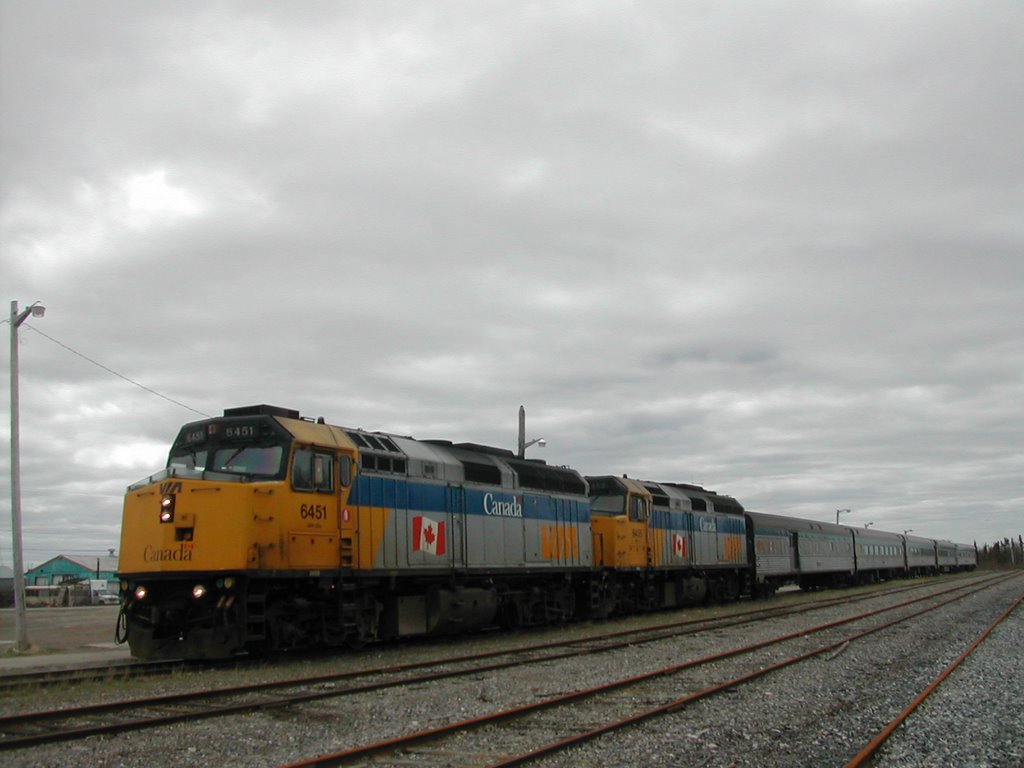
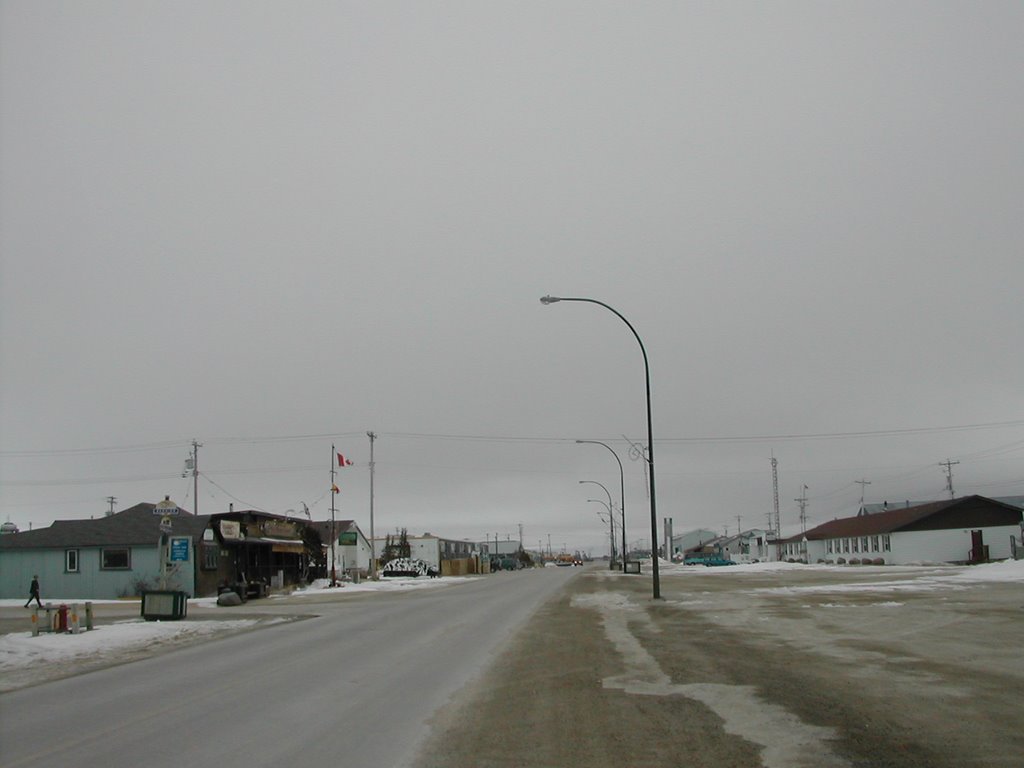
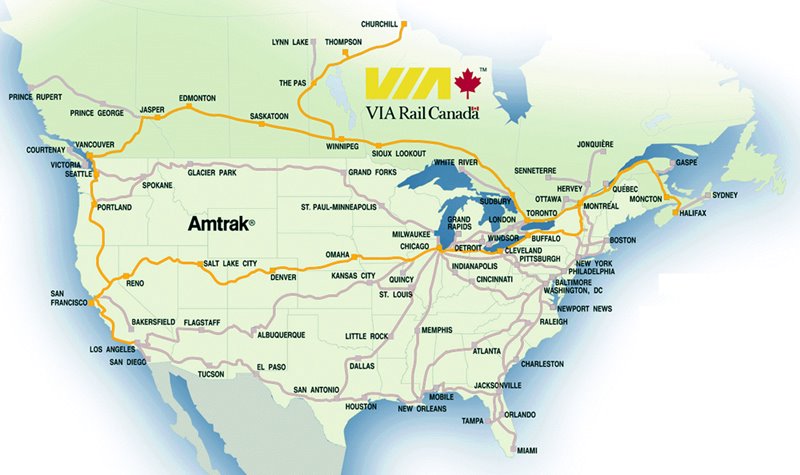
We’re about half an hour late into Thompson, having turned off the main line once more, and performed the slow manual turning manoeuvre just outside town. This time, though, there’s a longer stop, and I have plenty of time to walk into town to get some more food supplies for the rest of the trip. Tara opens up the door at the back of the train for me, and she points me in the direction of town. I walk along the rusty tracks in the opposite direction to that from which we arrived, and at a level crossing with the road to the station make a right. In fifteen minutes, I’m back in the Canada that I know: grey suburban sprawl. Featureless suburbs, carpet shops, hardware stores, car dealerships, kids out from school for lunch, their hands stuffed in brown paper bags from Kentucky Fried Chicken. It’s strange to be back in a miniature metropolis.

I turn right again at a garage where dozens of shiny Ford trucks and minivans are lined up (‘Built with pride in Ontario’) and find the side entrance to a large Wal-Mart mall. I steer clear of the Wal-Mart, but instead go into the Safeway store to buy hot soup, bagels, salami and cheese. I retrace my steps up a low hill and over the crest between electricity pylons and next to a yellow traffic sign that warns drivers to beware of crossing skidoos. Now that the snow has all gone, I doubt there’s much to look for now, but I make a precautionary glance to my left and right just in case.

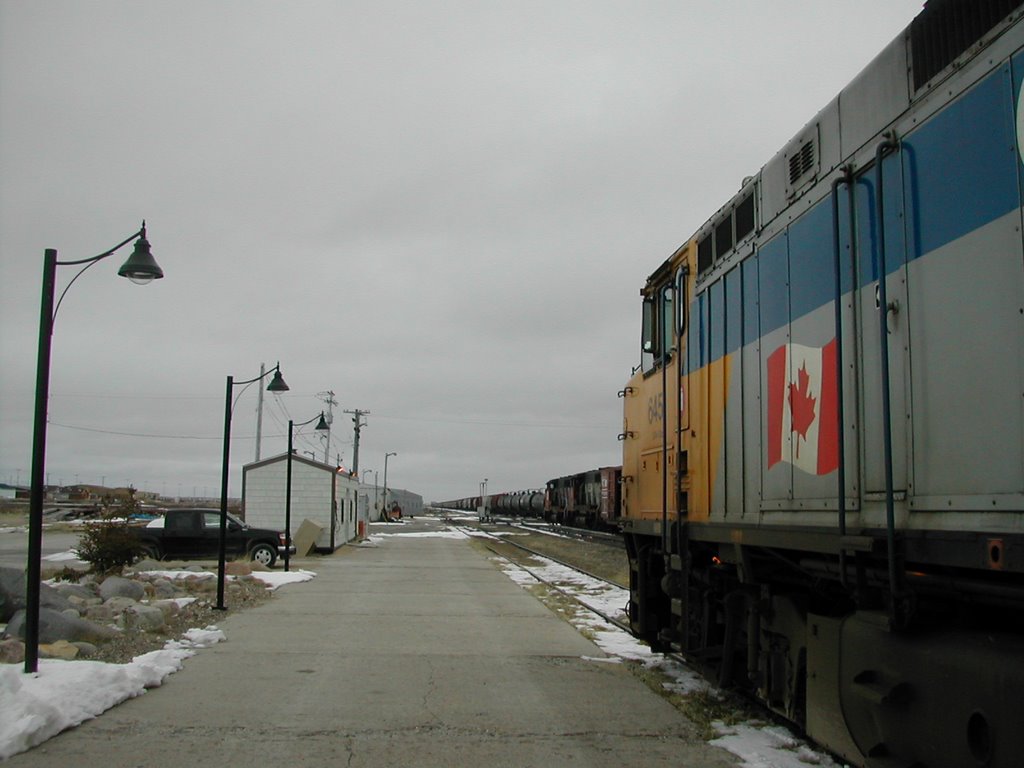
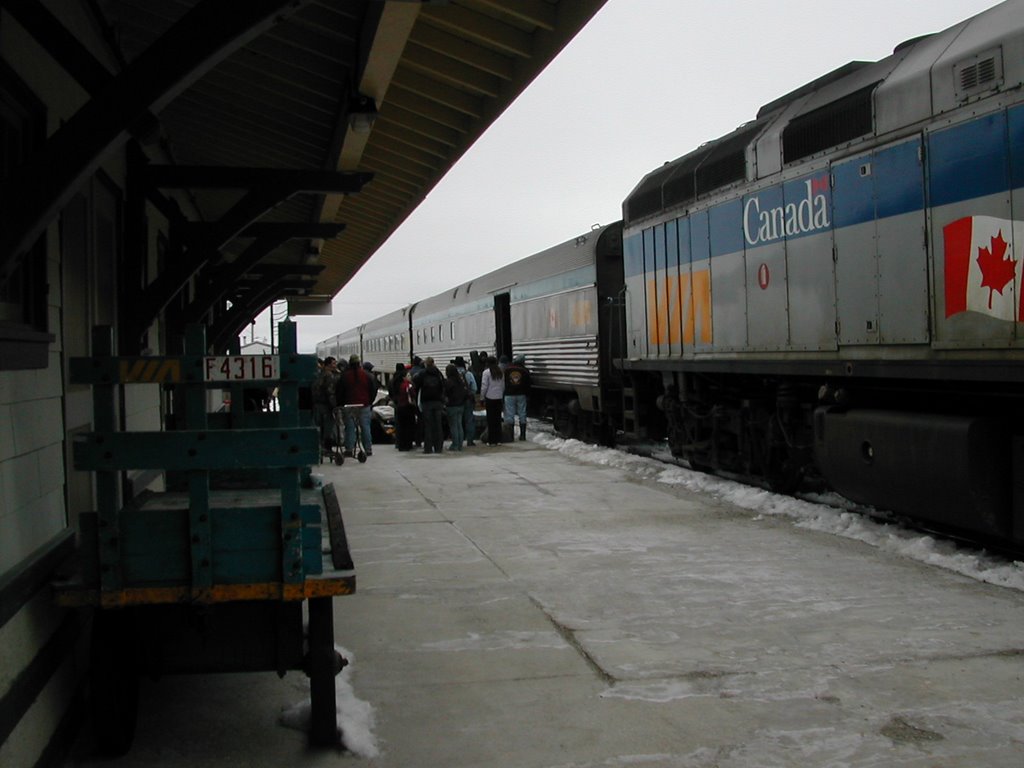
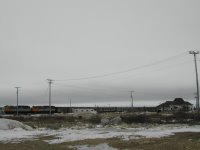
I’m back at the station with plenty of time to spare, so I walk past the train on the side of the freight sidings. There aren’t many wagons here, but to my left is a low pile of left-over ballast, and between some of the sleepers are small piles of wood chips, memories of departed loads. I walk the length of the train, take a few photographs, and then walk round to the platform side. I surprise the two Winnipeg tourists, who see me emerge from the wrong end of the station with a Safeway shopping bag. The station is a small pale yellow building. The platform has an old hand pulled cart for loading freight and baggage onto the train. I crunch across the unpaved car park, but there isn’t much to see in this muddy end of town. I re-board, and eat my scratch lunch in the part of the dining car where the tables aren’t set for lunch. All sense of obligation to Tara’s cooking has gone by now – it’s very good, but I’m still getting by on C$30 a day.

We leave on time at 12.35. The train has now emptied of it’s Churchill passengers. Vera and I are alone in the sleeper car, and there are maybe a half dozen passengers in the one unlocked coach.

Train 692: smoke stop

Train 692: the first morning

I sleep well once more, and enjoy being a little closer to the train’s centre of gravity. The upper berth is definitely more fun for a first time sleeper passenger: climbing up into it makes it even more special. The lower berth, however, is much more practical and suitable for most adults. I say good morning to Vera, who’s already awake, who says that it’s by the far the best sleeping accommodation on the train. The return of mainline VIA Rail coaches to the ‘Hudson Bay’ is to be welcomed – apparently the unreliable ‘Northern Spirit’ trains didn’t offer this budget sleeper accommodation.

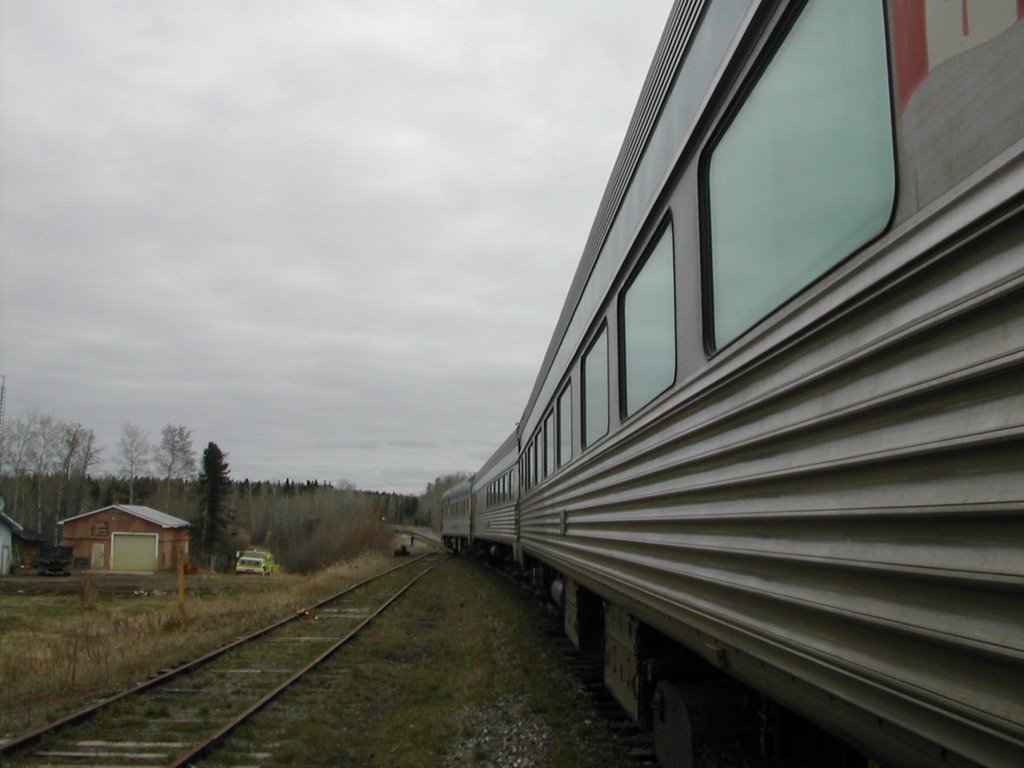
I take a shower. While I’m washing my hair I sense the train slowing down. The distant rattling of wheels over bolted tracks begins to recede through the drain beneath me, and we come to a halt. Crouching down, I can see gravel and a sleeper directly beneath me. I towel myself dry, and when I emerge from the bathroom I see that we have been pulled into a siding to allow the engineer to do a wheel check. The train’s smoking population has been allowed off to inhale the ‘fresh’ air, and they’re beside the track enjoying their morning fags.

I come forward to have breakfast. We pass a junction with another rail line that seems to go north-west to a point on the Nelson River called Kelsey. I believe that this is the site of one of Manitoba Hydro’s larger dams, although I’m not sure. Unlike Thomson’s spur, there is no passenger service on that line.

I order the ‘Continental’ breakfast. As always, I’m still not sure which continent this breakfast comes from, because it’s definitely not Europe. I substitute cereal for hot oats, which are served with brown sugar and milk, and have coffee, toast and juice to start my day. It comes to a very reasonable C$6.

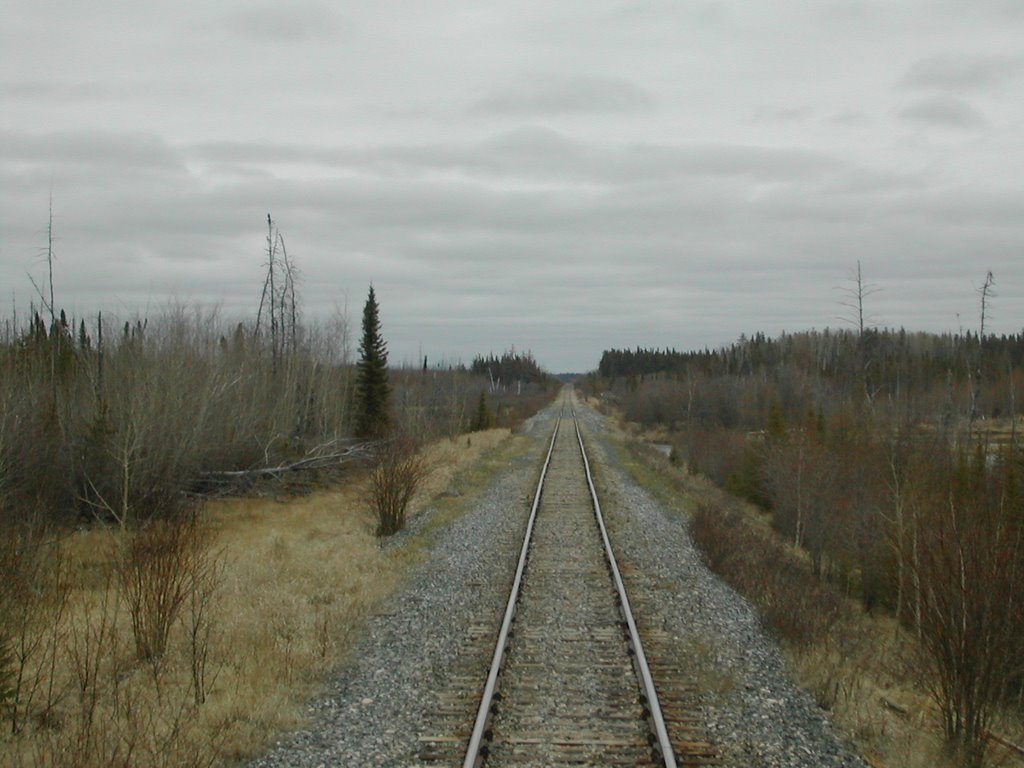
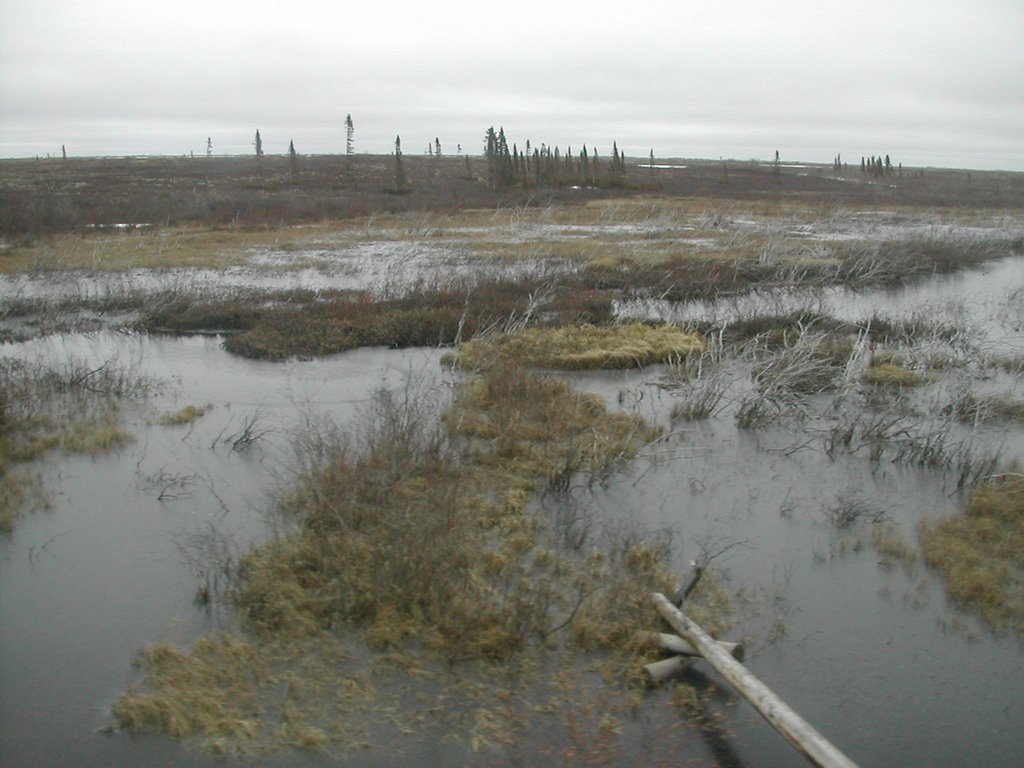
Vera is sitting near me, and as we cross a bridge high above the Nelson River (downstream from the Kelsey hydro dam) she says that it’s looking higher than she has seen it in a long while. In a recent trip south she says that the train was held up even more by very high water levels in the streams on either side of the track. I’ve yet to see a beaver on my trip, although their dams are everywhere, and these frequently have to be broken by track maintenance crews to stop overflowing water from causing subsidence to the already fragile track bed. A little later I even see a few trees felled by beavers; their trunks chewed away to leave the timber and stump with perfect exposed points, like freshly sharpened pencils.

We reach Pikwitonei at 09.30, keeping very good time so far.

Train 692: ready to return

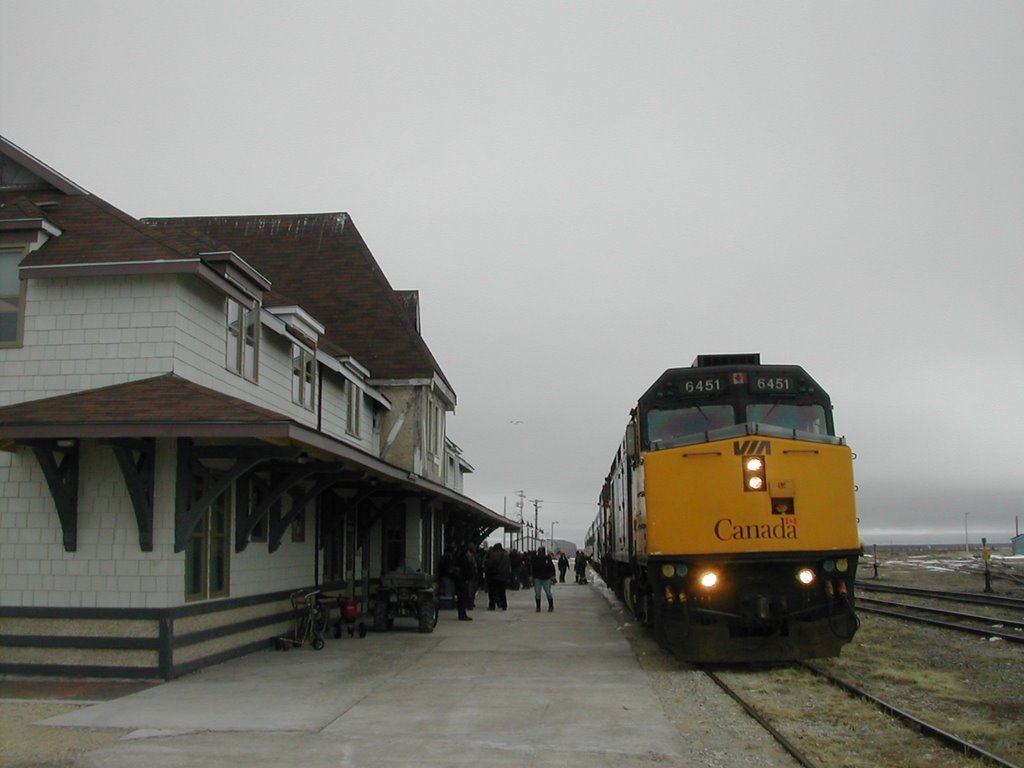
Shortly after we arrived this morning, our train reversed out of Churchill station, and was turned in a triangular turning circuit just outside town. It subsequently backed into the station, and was left there with engines running all day. From time to time I would round a corner and hear the not too distant hum of the gently throbbing locomotives. It might seem like a waste of diesel, but it’s safer than shutting down the engines and then discovering that they can’t be re-started. This especially important in the depths of winter, when a train failure could be extremely difficult to fix, and a replacement locomotive could take days to reach us. Despite their normally short consist, trains 693 and 692 to and from Churchill operate with two locomotives not for pulling power, but for safety. If one were to break down, there would not be much chance for another to reach a stranded train for some time. And in the depths of winter, if a train with a single locomotive was to break down, the heating in the passenger cars would soon drop far below freezing. It would cease to be a matter of convenience, and soon become a matter of life or death.

I’m early at the station (old habits die hard) but there is already a hub-bub on the station platform as luggage is loaded into the baggage car. The tourist office inside the old station building has a single VIA Rail ticket desk, and it’s from here that a locally employed agent sells tickets and provides information to passengers. I notice that on the desk is a pile of the new Amtrak system timetable. Perhaps a few other long distance journeys have commenced here?

Most of the tickets being sold, however, are for Thompson. There is a small group of young teenagers here this evening, all with violin cases and luggage for a couple of days away. I learn through overheard conversations that they are actually fiddles, not violins, and that they are presumably going to play in a concert or competition.

Of the handful of passengers who travelled north with me, two are returning to Winnipeg this evening as well. The two gentlemen, who I’d already met on the first night, had taken advantage of a VIA Rail special offer, which allows one passenger over the age of sixty to take a companion of any age for free. Both being over sixty, they paid one fare and split it between the two. Having lived in Winnipeg for much of their lives, they had decided (much like me) to take a trip to Churchill just for the sake of it. They had had a similarly interesting day, but had also retreated indoors in the afternoon to warm up.

Our train began boarding at about 20.15, preparing for a 20.30 departure. There was a healthy load of coach passengers, most going to Thompson and connecting to bus services from there. I boarded the sleeper car shortly afterwards.

Earlier today, Tara had mentioned that she would be making up another of the berths for another passenger. So when I re-board the train and head to the familiar couchette end of the carriage, I meet a new travelling companion. Vera has lived in Churchill since 1979, and she runs a three room bed and breakfast on Hearne Street (call 204-675-2544 for details). She has two sons in the town, and ever since she arrived here almost thirty years ago following a period in the Wrens, has called Churchill her home. One son works on a pilot boat that guides ships into the harbour. The other is an engineer in the Town Complex, and helps with the maintenance of the water supply. Tap water is sourced from the Churchill River, at a point about two miles inland from the town. Part of his job is to maintain the water heaters that heat the water three times between the river and the two. Without these (and the element heaters that many houses have in the pipes where the water enters the house) the pipes would freeze solid throughout the winter. Along with heavy duty engine block heaters that require cars to be plugged in overnight to prevent them from freezing up, it’s just another practicality in the life of the town.

It’s rewarding to finally talk to a Churchill resident for a short while. She says she is yet to be convinced that the port will ever be open for much longer, but says that despite the bitter winters she enjoys living here. Everyone knows everyone, and it’s a tight community. I ask about the inevitable flip side of remote life in Canada: are there drug or alcohol problems in Churchill? Her answer is yes – there will always be a few heavy drinkers, but the drug problem is harder to solve. A town meeting later this week will be bringing together the officers of the RCMP and local residents. Until specific information can be brought against members of the community suspected of supplying drugs (such as fatally addictive crystal meths) not much can be done.

We leave a few minutes early, and together we watch the settlement slip away. In ten or fifteen minutes, we cross the level crossing that had announced our arrival to me this morning, and we’re on our way back across the wilderness once more. Ten hours in Churchill might seem a short justification for eighty hours of travelling, but at this time of the year I didn’t miss much in town. Besides, for me the journey has been as much the destination as the town itself.

Shortly after leaving Churchill, Tara returns to make up the third pair of bunks. A passenger in coach class has decided to pay the night fare for a couchette through to Thompson, so we’ll be losing the spare pair of seats for the night. It’s fine with us – Vera goes forward to read in the coach car, and I decide to turn in early to read. For this half of the Churchill run, I’ve paid a bit more and booked a lower berth. Getting in and out of it is easier, and I get this time I get window. If there’s one complaint it’s that the lower bunk is just slightly too low: it’s not possible to lie in bed and look out of the window at anything other than the sky or the tops of the trees beside the track. But that’s hardly a major complaint. I curl up under the sheets, button the curtain closed and dive into The Blind Assassin. Beside me, my picture window fills with an ever deepening blue, as the sun sets and night falls. I’m back in my natural habitat, it seems, warm and cozy, gently falling asleep to the sound of the train rattling over the tracks. It’s Tuesday evening: I will arrive in Toronto in three days time.

Train 692

Tuesday, May 09, 2006

Churchill: farewell to the frozen ocean

Churchill: at the end of the day

The rest of the day passed slowly but leisurely. Churchill seems to shut down outside the major tourist seasons, so I was able to spend a pleasant afternoon just walking and stopping off for a coffee from time to time in one of the town’s cafés. There are a handful of attractions outside town, such as the wreckage of a freight plane that crashed near Churchill Airport in the seventies. I’m told it was brought down because of a heavy load of Pepsi, but I suspect it might have had more to do with something more mundane. Seeing these requires transport, but I decide not to spend C$20 on a taxi tour.

I explore the town some more, stopping off in the post office for stamps (and to ensure my postcards get a suitably interesting postmark) and going back to the Northern store to get some supplies for the return trip. I go back to the library when it opens again at 19.00 for a second burst of blogging, having realised how far behind in this travelogue I am. On my way out, I notice some boxes by the door. A large quantity of old books, some from Churchill Library, are being offered for free to anyone who can offer them a better home. So I rifle through, and pick out the Booker Prize winning paperback The Blind Assassin by Margaret Atwood, and an old hardback biography of the inventor of radar (something my father would doubtless approve of…). Having been turned off by the imported souvenirs I’d seen today, this would be an excellent souvenir of my trip. Inside the front cover, this decommissioned library book still carries it’s loan record and the insert library card. It was given to the For Churchill Library in 1953, and has spent the last fifty years being read by generations of Churchillers with a passing interest in radar. It adds quite a weight to my luggage, but I’m happy to leave with a special souvenir.

Just before returning to the station, I turn round the corner of the Town Complex once more and walk down to the beach. The sun is falling behind the pretty solid grey cloud cover, and the temperature is beginning to drop again. I crunch through the untouched banks of snow and down onto the sand. I stand alone, staring out across the frozen bay once more. Another cinematic reference pops into my mind – this time The Winter Guest, filmed on an unnamed Scottish island during a particularly cold winter, during which the straight between the island and the mainland freezes over. Despite being quite unbelievable for Scotland’s mild climate, it’s still an enchanting image, and throughout the film people do as I do, and come out to stare across the immensely solid yet dangerously fragile surface. I’ve never seen anything quite like this before, and the immensity of this frozen sea is almost overwhelming. Having lived in Montréal for almost eight months now, I have realised how much I miss being near to the sea. I miss the smells, the sounds, and the sense of enormity that borders seaside landscapes.

But here, there is no sound, other than the wind whistling off the ice and across my numbing cheeks. Every quality I associate with the sea has been obscured. Part of me agrees with a young female character in The Winter Guest, who runs out onto the ice, teasing her more cautious friend that he shouldn’t be afraid: he might never get the chance again to walk on the sea.

But fears of plummeting through a cracked ice flow overcome my subconscious urges. I turn my back to the sea, and walk back to the station.

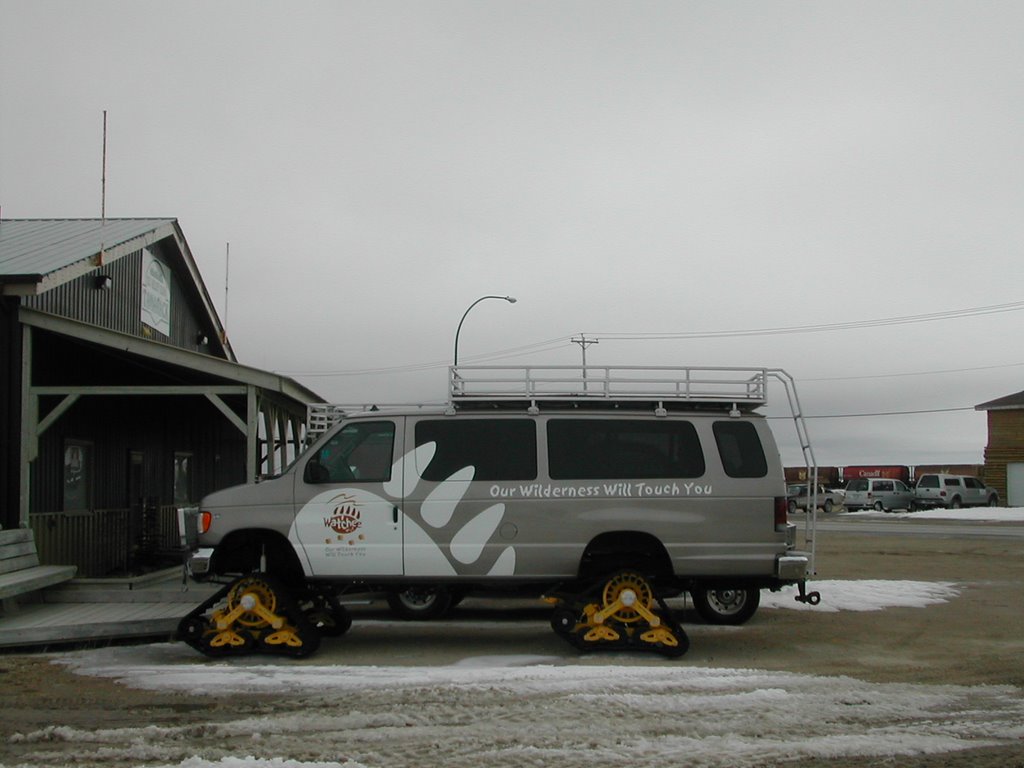
Churchill: snow mobiles


Churchill: you can't keep a blogger down

I spend the rest of the day exploring what’s left of the small town. The population of Churchill once numbered 7,000. It’s now less than 800, following the closure in 1979 of the large US Military base. American service men and women were dispatched to Churchill for cold weather training, since Churchill’s climate bore more than a passing semblance to much of that of the then Soviet Union.

The Eskimo Museum opened at 13.00, and I go in for a look round. Incredibly the museum is free, although it does depend on donations to help maintain the beautiful collection housed in the modest building next to the town’s Catholic church. The museum’s single large room is lined with glass display cabinets, and these are filled with hundreds of Inuit artefacts and sculptures. In fact the collection of ivory and soapstone figurines and carvings is easily the highlight of my trip. There are also a couple of stuffed artic animals which sit in large cases, lamely caught in poses designed by a distant taxidermist.

The museums is also worth visiting for the large collection of books that are on sale. They cover the natural environment of Churchill and also the history of this town and the region. I bump into one of the other passengers who had travelled up from Winnipeg with me, and he was pleased to have finally found a copy of the book that chronicles the history of the construction of the Hudson Bay Railway. Apparently it was sold out everywhere else, and even though there’s a copy in the display cabinet of the town council offices, no-one there seemed to know anything about it.

After seeing the museum, I visit the library, which is inside the Town Centre Complex. You can use the internet here for free for up to thirty minutes. The lady at the counter raised her eyebrows and shrugged, saying that the computers were mainly for tourists who wanted to be able to check their e-mails every day while staying in Churchill. Apparently some people don’t take to the wilderness too well (although you’ll no doubt be pleased to hear that I spent my free thirty minutes updating this blog, rather than writing emails…

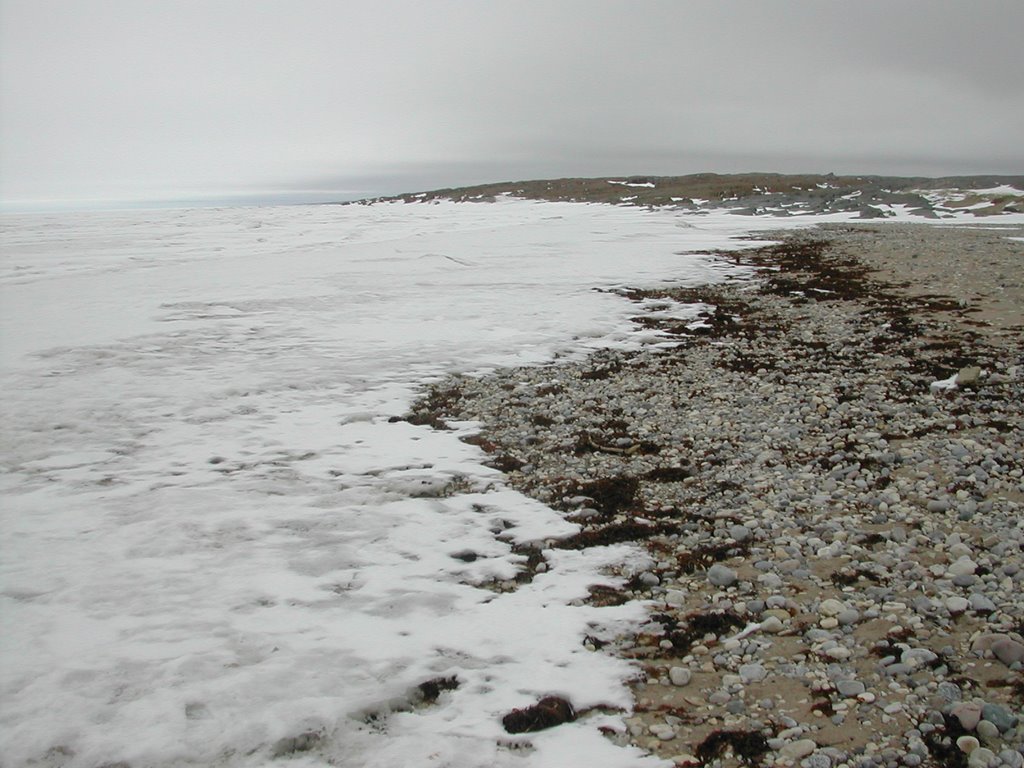
The (frozen) Hudson Bay, Churchill, MB

Churchill: until it I can't feel my cheeks

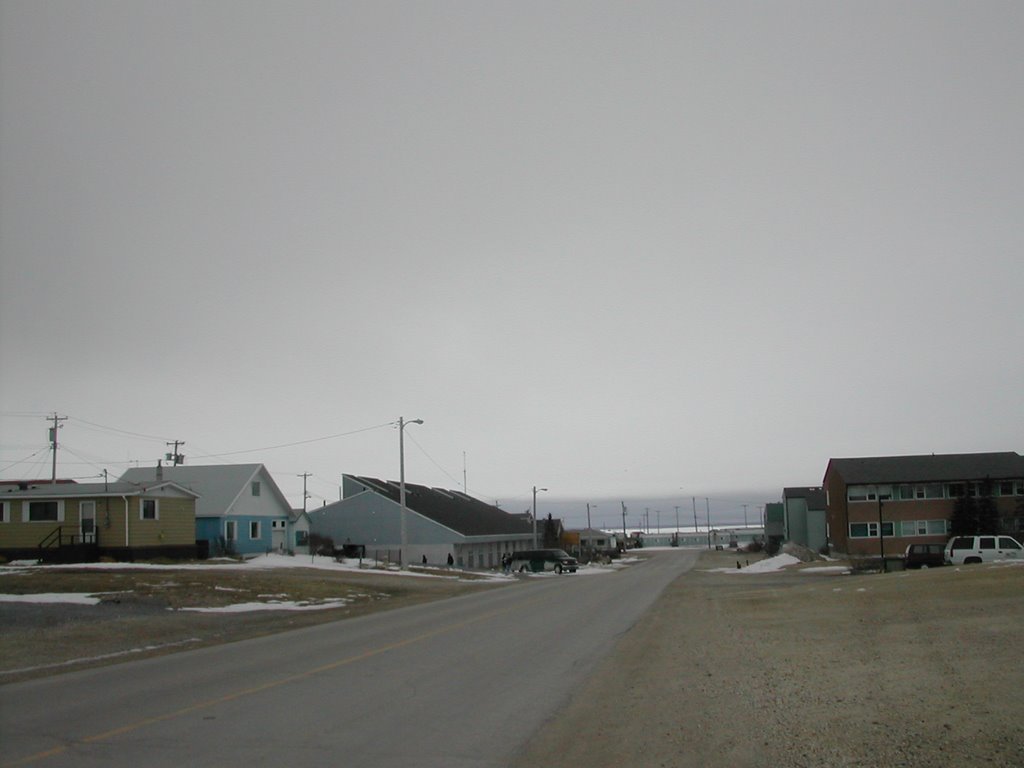
I walk back into town, cutting down through some of the residential streets at this end of town. The architecture here tells you everything you need to know about the climate. In some cases, the windows are deeply set in thickly insulated walls. On some buildings, there are no windows or openings at all on the side facing the bay.

I return to Kelsey Boulevard and stop into a large shop selling souvenirs. I’ve spent much of the last winter in much colder temperatures in Montréal, but to return to this climate again suddenly without any time to acclimatise is making me balance my time walking around town with my time inside. The shop is quiet, but I can imagine that in a busier time of year it’s hopping with tourists. All sorts of Canadiana is available to purchase, although it’s hard to find anything that you can honestly say is from Churchill. More or less everything is imported via the same long route that I came. Even the plastic polar bears are made in China.

I walk the length of Kelsey Boulevard, and decide that there’s no point holding out on a nice warm meal any longer. By the time I reach Gypsy’s Diner, I don’t need to be persuaded by the recommendation in my guidebook. It’s already sold itself to me. It’s a basic diner and bakery with a solid menu. I choose today’s lunchtime special, a beef and pork stir fry, which reminds me to warn any vegetarians thinking of moving to Churchill not to underestimate the difficulties you’re likely to encounter here. I sit and write postcards over my coffee, listening in to the gossip from a group of retired ladies on the next table.

Churchill: gloved up

I leave the Northern stores wrapped up snugly and prepared for a day out in Churchill. The Northern is Churchill’s biggest store, and it really is a ‘general’ store. It has a small supermarket with a surprisingly large selection of fresh fruit and vegetables, a small electrical department, a video rental store, a clothes department and just about every small thing you could need around the household.

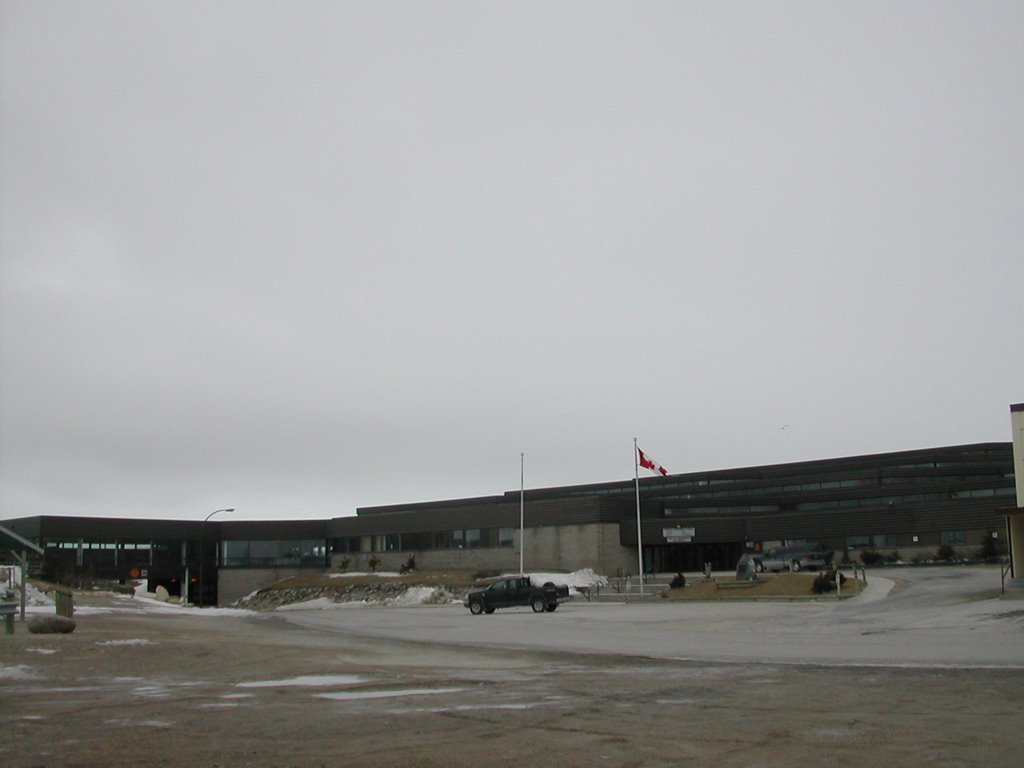
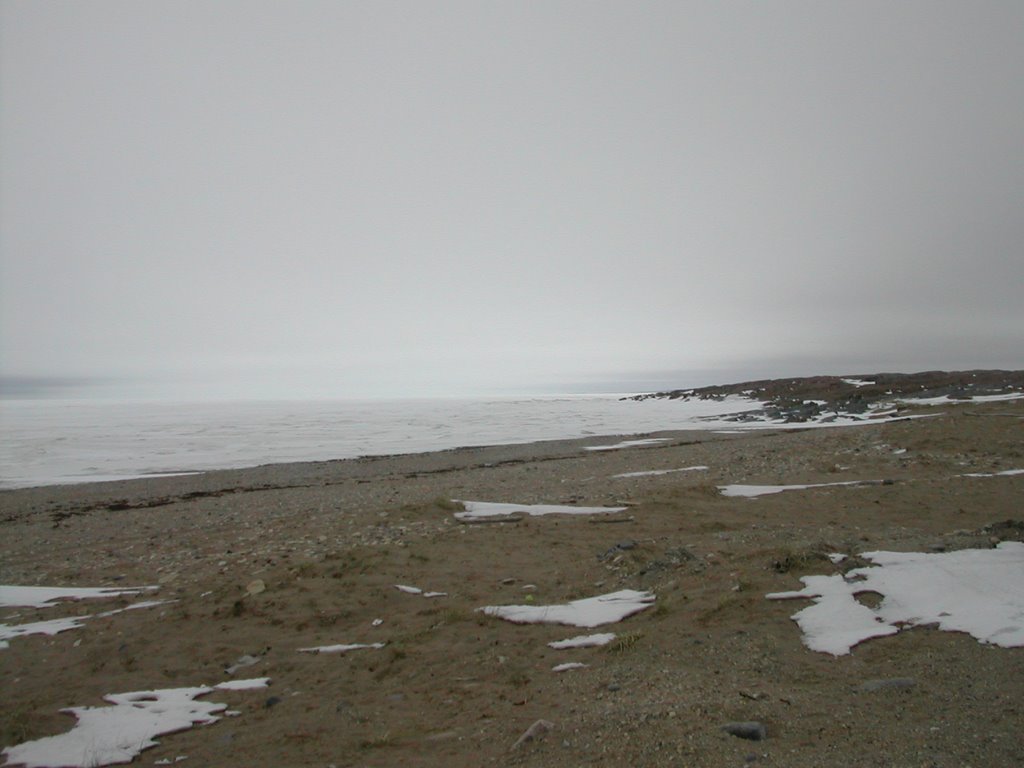
I walk back towards the station and then turn left alongside a partly snowed over park, towards the Town Centre Complex. This large, low building hugs the crest of a low hill on the north-eastern side of town, stretching along the edge of the community for several blocks. It’s not particularly pretty, but then its large amorphous shape serves a purpose. As well as housing the town’s school, hospital, theatre, library and council rooms, the large complex forms a large barrier between the town and the shore of the Hudson Bay. As soon as I walk round the side of the building to visit the beach, I realise why that’s a good idea. As far as I can see, the bay is still frozen over. All my hopes of seeing the ocean at the end of my forty hour train ride evaporate.

And because the sea is still frozen, the wind that is coming off the bay is perishing. The moment I turn the corner and walk towards the beach, the temperature drops about another ten degrees with the wind-chill. Even with my extra layers, the icy wind cuts through me, and it feels about –15C. And remember, this is May. In January this icy wind-chill factor can push the temperature down to nearly –60C.

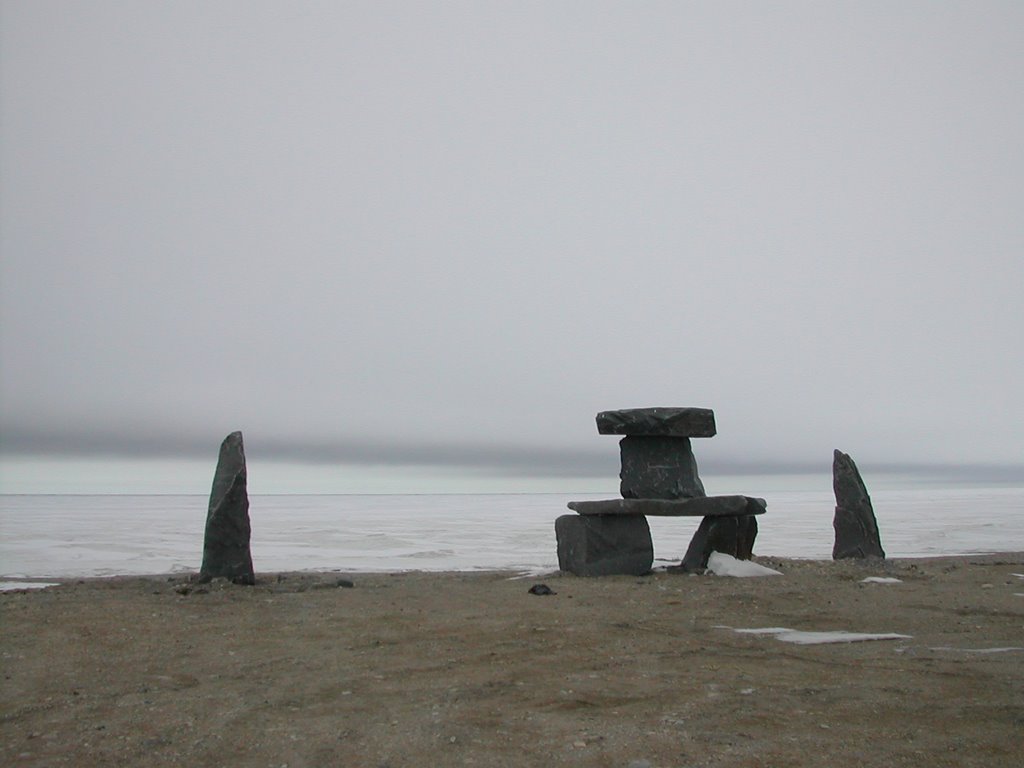
I trudge down the track towards the sandy beach. The last time I saw sand, I was in California, when it was a rather agreeable 15C. I can’t believe that just a few weeks ago I considered that chilly. On the edge of the beach stands a stone Inuit sculpture. These beautiful abstract structures don’t require much explanation. In this inhospitable environment, these simple stone structures tell you that other people have been here before; that you are not alone. They are a friendly greeting, made from the materials found lying to hand, but arranged in a way that could only be made by another human being. The precise meanings of different sculptures revealed messages about hazards, territories or even good fishing grounds. Although Churchill’s population is now predominantly white and Anglo-Canadian, this sculpture is a beautiful reminder of this territory’s traditions and origins.

I feel like I should sit and consider this barren seascape for a bit longer; maybe stop and sketch for a while. But as they say back home, it’s brass monkeys out here and I’m cold. I scoot back towards the town, but take a right and walk a little way out of town towards Churchill’s most notable landmark. Out on the edge of town stand the enormous grain elevators of the Port of Churchill. It’s because of the port that Churchill has a railway line. I don’t know the exact figures, but Churchill handles tens of thousands of tonnes of grain and other freight every year, even though it is closed in by ice for almost half of the year. In a magazine article published in Montréal before I left on my trip, Omni-Trax (the new owners of the Port of Churchill) were openly optimistic about the opportunities for increasing the volume of freight that passes through the port. Over the next few decades, it is expected that the effect of global warming will be to allow sea passage to and from Churchill for longer every year. The period that the port is iced in has already been seen to be slowly reducing. Some of the Churchill residents I spoke to were pessimistic, however, and pointed out that despite the effect global warming on the polar ice, it’s still impossible to work outside in the winter when it gets below –40C, and the winters don’t appear to be getting any warmer up here..

Churchill is the only sea port in the Canadian prairies, and grain shipped through here can reach Europe two and a half days more quickly than if shipped through some of the eastern ports, such as Montréal or Boston. Importing and exporting produce and products through Churchill avoids thousands of kilometres of railway and, because of the curvature of the Earth, allows for a quick sea crossing to Europe.

But at this exact moment, the port stands silent. The ice is beginning to break up and melt, but it will be some time before shipping commences for the summer season of 2006.

Churchill: 75% off all outerwear

Tara comes through to make my bed up as we arrive. We talk about what we're going to be doing between now and tonight's return departure back to Winnipeg. She says she's looking forward to getting some sleep in the hotel room that VIA Rail provide her with for her daytime layover. Apparently Churchill is the only place where she can sleep peacefully through the day. She recommends that I stop by Gypsy's Bakrery and Diner for lunch: she always enjoys the food there, and coming from a chef I take the advice.

I'm the only person getting off the train from the steps at the back of the sleeper car. Further up, the thrice weekly arrival is being met with great activity, as supplies and luggae are unloaded from the train. I hang around for a while, waiting for the station master to return from unloading the train so that I can leave my bags here for the day. It is, however, bitterly cold. I check the weather forecast that is pinned inside the station, and today's high is not predicted to be above -8C. This is, in fact, unseasonally cold for Churchill, and just last week a period of warm sunshine and spring like temeratures was apprently broken by a sudden snow and ice storm. Regardless, I am hopeless unprepared for this unpredicted drop in temperature, and just waiting outside my extremities are getting cold. I joke with one of the other passengers that this is quite a change from California the week before last. If I'd known I would have packed gloves and a hat. He replies that if he'd known he would have packed his thermal underwear. I fantacise about my soft silky long johns, far far away from here, stuffed in a drawer back in Montréal.

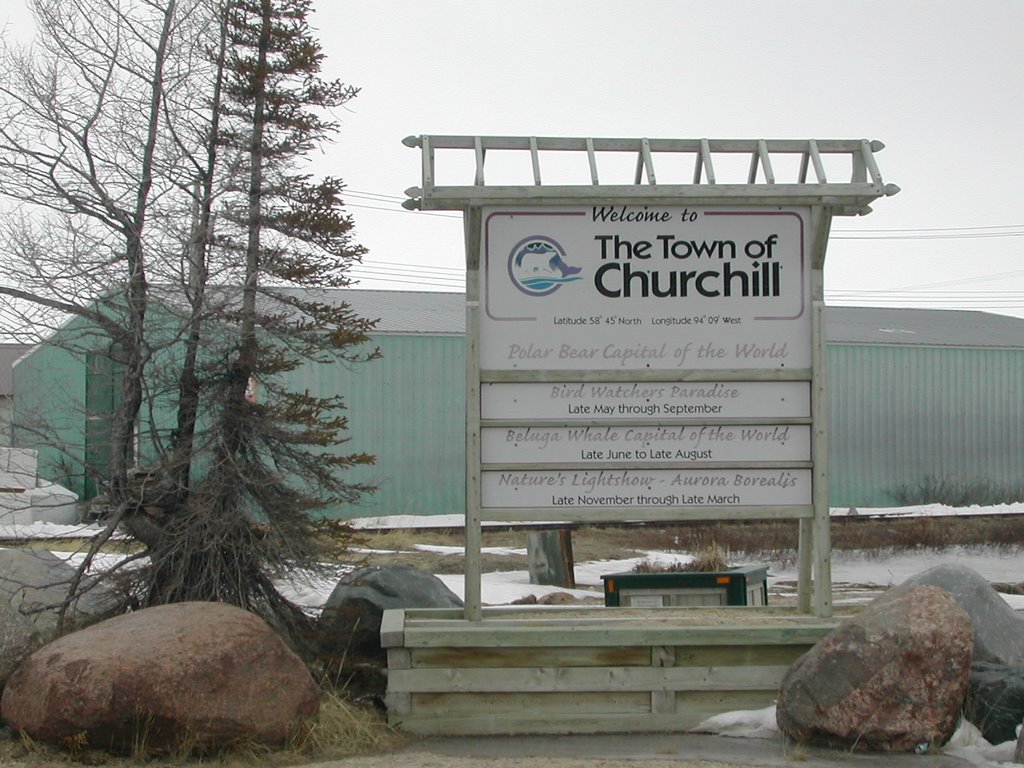
I manage to leave my bags with the station manager (no charge) and am told to be back before 20.00 to collect them. The train will be leaving tonight at 20.30. I have no intention of missing it. Just outside the large, beautifully restored station is a big sign, welcoming visitors to Churchill. It says that apart from being the 'Polar Bear Capital of the World', Churchill is a' Bird Watchers Paradise' (late May through September), 'Belguga Whale Capital of the World' (late June to late August) and home to the Aurora Borealis (late November through late March). So it's no wonder that the train was empty - I've conveniently arrived at the one time of the year when there isn't much going on in Churchill for the tourist.

I scamper up Kelsey Boulevard, the closest thing Churchill can claim to have to a busy shopping street. It's a broad tarmac road, with wide unpaved strips either side. Low-lying one and two storey buildings are dotted out at even spacings along the street in both directions. I head straight for the 'Northern' supermarket and general store. I am fully prepared to pay a fortune for some gloves and hats, knowing full well how expensive things can become up here because of their long journey to get here. Much to my amusement, however, because it's now the end of winter, there's a clearance sale on all outerwear. I pick up a 75% discount on a pair of gloves and a toque (hat). Total price: C$3.13.

I am now prepared.

Train 693: Churchill

Train 693: The second breakfast

I make my way inelegantly forward to the restaurant car, bouncing off the walls of the corridor and leaping through the vestibule connecting the carraiges, hoping not to get smacked by the door as we go over another bump in the track. I'm greeted with smiles and a friendly hello from the crew, who by now call me by my first name. This is one of the most pleasant train rides I've had, simply because I've had so many opportunities to get to know and talk with the on-board crew. I skip the larger plates and just have coffee and hot oats from the 'a la carte' menu to start my day (C$4.75). Carmel tells me that we'll be in Churchill some time before 11.00. It's particularly difficult for this train to ever make it's optimistically schedhuled 0830 arrival time. But I'm in no rush, and with a hot coffee, this is a lovely warming way to start the day. I'm back in my usual window gazing mode, drinking up the incredible bleak tundra landscape outside our windows.

I start talking with another passenger, who's also having breakfast. He's a father and a self employed truck driver from near to Winnipeg, up here for a few days helping to chaperone a school trip. The school children are heading to Churchill to learn first hand about some of their country's geography and history. In milder months, this is also a popular starting point for trips into the Wapusk National Park, which can be reached from Churchill by helicopter or (so I'm told) from the train line by kayak.

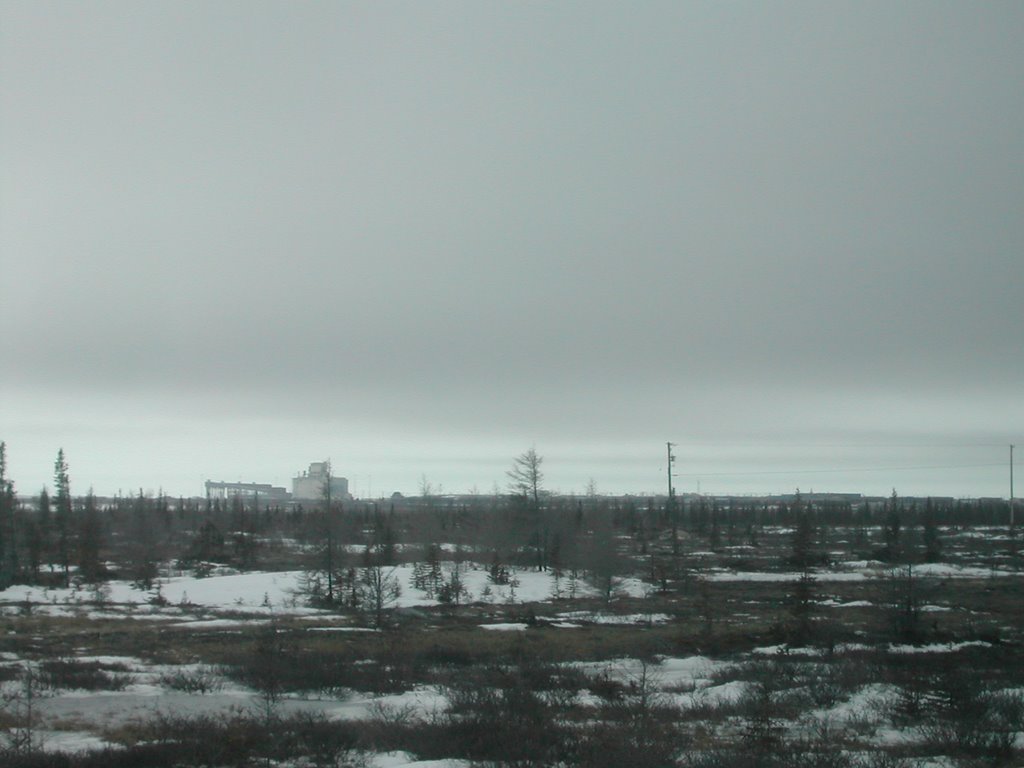
At about 10.25 I glance out of the window and notice something on the horizon. The huge, boxy grain elevators of the Port of Churchill are coming into view. Above and to the left, two birds flap together. We're nearing the Hudson Bay, and the end of the line. Off to the left I can just make out a thin silvery streak that must be the mouth of the Churchill River. Conversation in the mostly empty carraige seems to have receded, and everyone is looking out of the window at our approaching destination. I sink into the soundtrack of the train, hearing every creak, clank and high pitched squeek. It merges with an imagined electronic soundtrack that opens up to the horizon in every direction. I immediately remember an astonishing sequence in Andrei Tarkovsky's film Stalker in which three men break into a deserted post-apocalyptic 'zone'. They travel deep into the abandoned countryside on board a small self propelled rail wagon, and an intense scene of almost several minutes passes just watching the three men sitting on this car, contemplating their journey, their destination, and why they have come this far.

At 10.30, I am woken from my daydreaming. For the first time since yesterday, I hear the warning horn of the locomotives. We are passing over a level crossing, and after hundreds of kilometres of silence through uninhabited tundra, we are arriving into a human settlement.