Monday, May 08, 2006

Train 693: The Pas

At 10.15 we arrive at The Pas, the first major stop for train 693. The engineers up front change, the train is refuelled and the water tanks are filled up. A couple of people get off, including the only other sleeper passenger, and a few get on into coach.

I walk the length of the train (which doesn't take long) and talk with the station worker who is filling our water tanks. He's having a quiet day it seems, normally there are lots of chatty visitors stepping off the train and asking him questions about the train. He recalls when it was seventeen cars long. Even in the high tourist season, it seems it's never made up of more than three coaches and four sleepers.
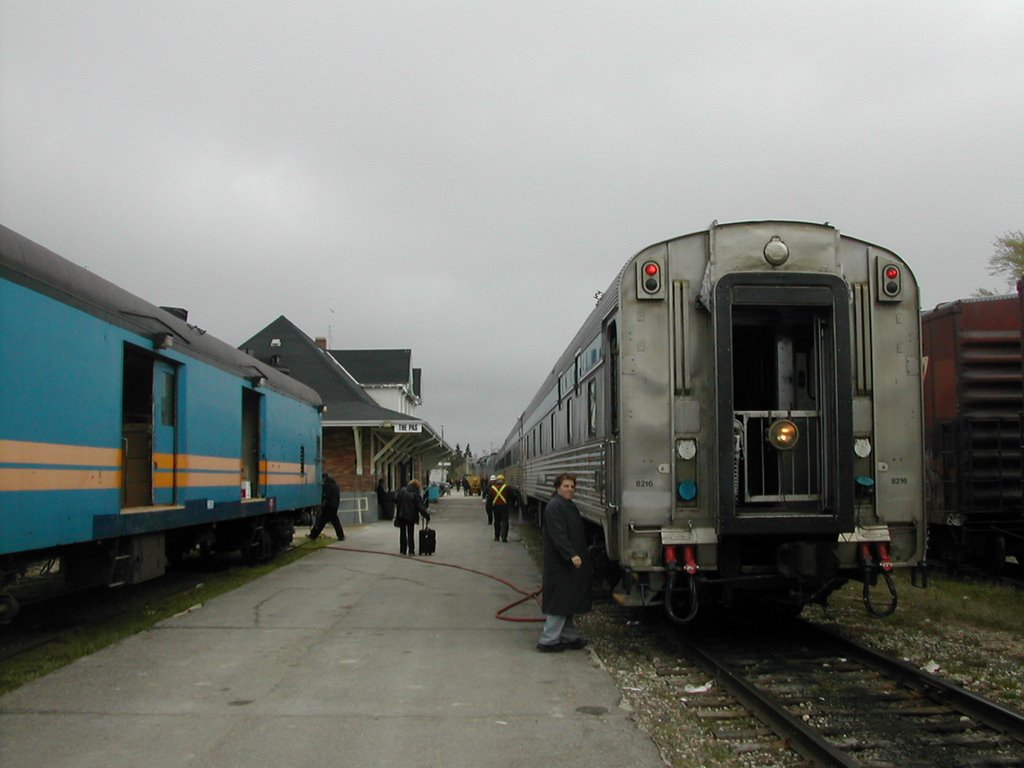
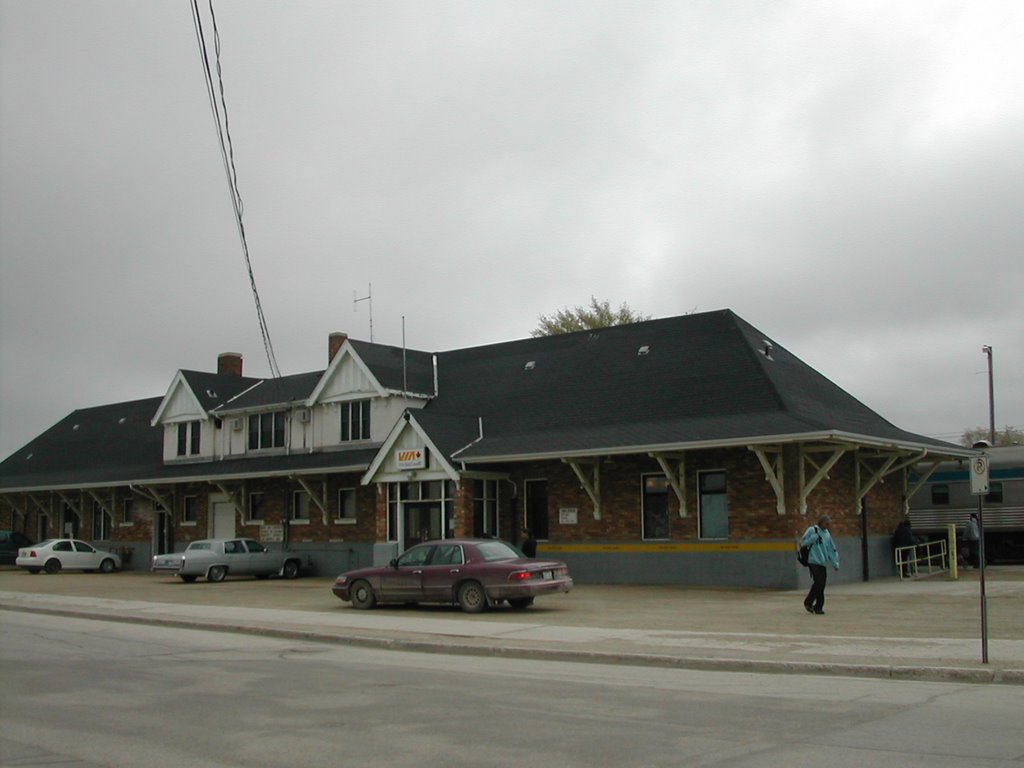
The original station building is still used, although since it handles substantially fewer passengers for fewer trains than it once did, it's a rather shabby shadow of it's former self. To the southern end of the station, parked on a side track opposite our train, are three blue and yellow VIA coaches. These are old cars, built by the Canadian Pacific Railway and subsequently used by VIA all over Canada. I'd never seen one before, though, and I have to ask what they are. I look back into my timetable and discover that they must form the twice weekly connecting train to Pukatawagan. A VIA employee (who will remain nameless) advised me against considering taking this train, which used to run as far as the town of Lynn Lake. I ask why.

"Not safe."
"Dangerous train or dangerous place?"
"Dangerous train. There have been stabbings, and there are always fights on that train. And they don't like whites."

I had imagined that my train was the closest I would get to a working Canadian train that was princiapally used by those whose communities it passed through. But watching (the mostly native) people loading luggage and goods onto the freight car of the Pukatawagan train for it's departure later that day, I couldn't help feeling distant once more. Our train was, in comparison, luxurious, and didn't make me feel any less of an outsider. Our train slipped out of the station, and the ancient blue cars of the Pukatawagan train slipped out of view. I was lost in thought as The Pas left us behind.

Train 693: the first morning

For the first time in two weeks, I am able to sleep on board a train beyond 06.00. In fact, by the time I pop open my curtain and swing my legs down onto the step ladder to my upper berth, it's nearly 08.00. I could definitely get used to this. The mattress was comfortable, the ventilation adequate, and the sleep most rewarding. My dreams were much more balanced than those I have sleeping in coach class.

I dress and walk through to the restaurant car. I'm seated on a table to myself - there's no problem with space on this train - and offered the menu by my Service Manager. The car that I'm in is identical to those used on the mainline 'Canadian' services. According to a VIA employee who I spoke to later, for about five years VIA experimented with a fleet of cars called the Northern Spirit fleet. These had been imported from Florida, but were rejected after a few years because of their hopeless unreliability in the Manitoban winters. The major difference with the mainline service here is visible - no linen tablecloths and only the bare minimum of china. However, the menu reflects the more modest approach, and prices are reasonable: C$6.75 for three blueberry pancakes, which I take with some coffee.

As I start eating, we leave our last stop in Saskatchewan - the little town of Hudson Bay. No doubt named after the final destination of the railway line that passed through, this attractive prairie town now offers plenty of confusion for the uninformed train passenger. We continue on our way, now heading back into Manitoba and towards our first major stop at The Pas (pronounced The Paah). After a few delays during the night, we're about an hour late. A few passengers have also slipped away, leaving the train at small station stops during my deep period of sleep.

I enjoy a refill of my coffee, and look out on a sunny morning.

Train 693: the first night

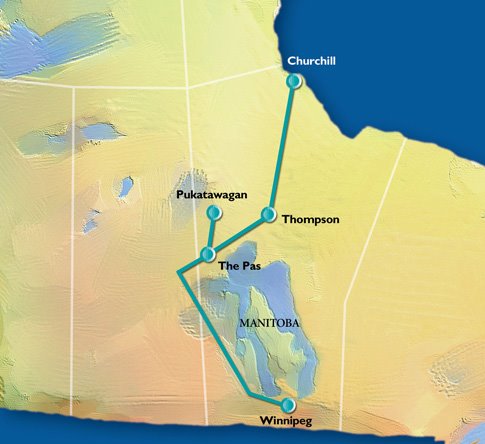
We're slipping along the tracks to the west of Winnipeg, heading for our first stop in Portage La Prairie. So I'm actually back-tracking now, but we'll soon be heading off the mainline. Although a line as the bird flies from Winnipeg to Churchill would be a neat idea, the trains can barely manage running on the old grain routes as it is. We will actually descibe a gentle arc as we head north, even crossing the border back into Saskatchewan for a few hours tonight before skirting back into Manitoba. Nothing about this train makes sense at first, but then that's what's so appealing.

Our miniscule train reveals that this is the low season. The 'Hudson Bay' does moderately well through the winter with tourists who travel from Winnipeg all the way to Churchill to see the Aurora Borealis (or Northern Lights) and the Polar Bears that can be found in great numbers around the line's northern terminus. In the summer too, there are many who travel north to see whales in the Hudson Bay, or to see the amazing variety of bird life.

But right now, we're in between seasons, in terms of both climate and tourists. Without a major tourist draw, this is a slow time of year. But with the return of warmer weather to the north, this is also a slow time of year on the train. I'm warned that once we pass north of a certain point tomorrow night, our progress will be slowed dramatically as the train crawls along unstable track. This railway line experiences as much as 90 degrees of temperature variation throughout the year, and as a result the trackbed moves a lot with the freezing and thawing of the ground.

I explore the train a bit. It's easy to spot the regulars and the once-in-a-lifetime rail trippers like me. We're the ones with cameras who are constantly checking timetables and peering out of the windows. There are a handful like me in the coach car that has been opened up (the other will remained locked until more room is needed) and I've already heard at least one other English accent (honestly, what is it about British men and trains?)

There's no meal service tonight, but a take out counter in the restaurant car serves drinks and snacks until 23hr (alcohol until 22hr). I have a hot chocolate (C$1.75) and do some notes in my book. I'm alone this evening; the crew of three are on hand at the other end of the car and are already scoring highly in my books for attentiveness. I suspect that being the only sleeper passenger for both the whole ride up and down again leads to personal service.

I head back to the sleeper car, and decide to enjoy the luxury of a shower (denied to all but the most enterprising of coach class passengers). The shower itself is responsive and powerful. The drain beneath my feet appears to drop straight down onto the tracks, although since it's the only source of outside noise into the cubicle, the clickety-clack sounds removed from my shower. I bounce back and forth under the hot water, but enjoy being able to be properly clean after so many nights on and off the train.

After stepping out of the shower, I sense the train slowing to pass through a village. Looking out through the window I make out the small community of Gladstone, Manitoba. We cross deserted streets, passing clanging and flashing barriers that bar empty streets from interupting our progress. The town is sleeping, and I am ready to sleep as well.

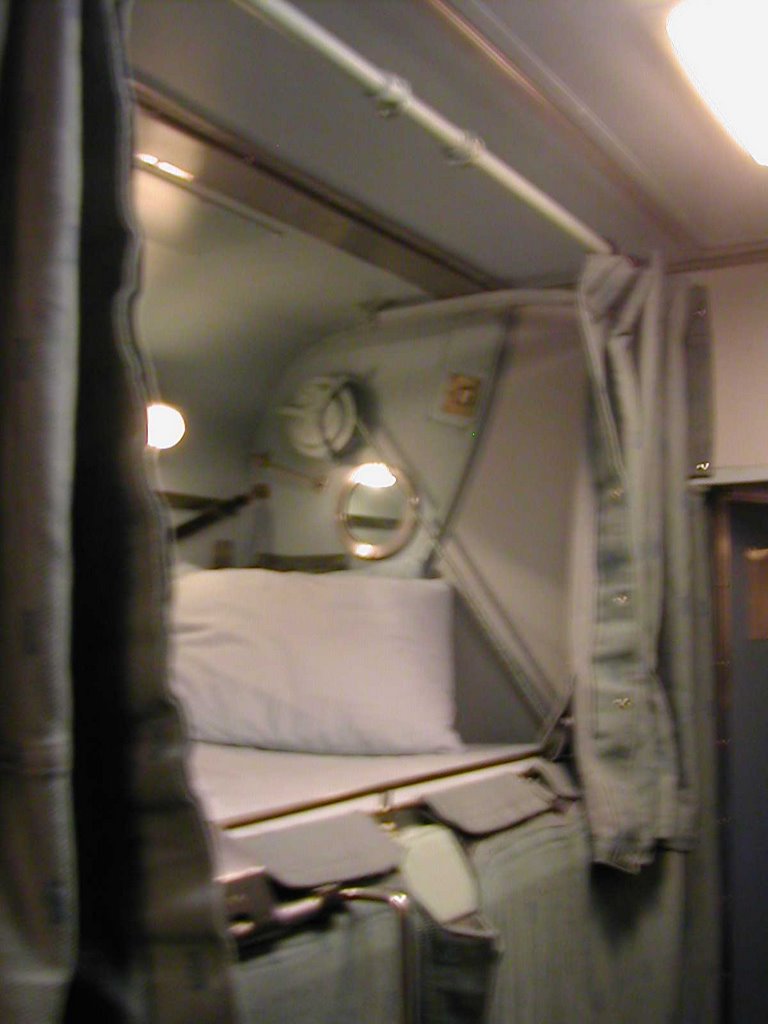
The key to making the sleeping-in-a-berth process easy is preparation. Keeping a soap bag, nightwear and tomorrow's change of clothes handy saves delving around in your luggage. I hurl everything up top, and then climb into my upper berth. There's no window, but the sounds and motions of the train are extremely conducive to slumber. I stow all my bedside accoutrements in the bedside net or the leather pockets by my pillow. There are two reading lights that can be set to two levels of brightness, so once I've buttoned my curtain shut, I'm able to read for a while. As I curl up with an appallingly bad fifties action novel (starring Johnny Fedora, a James Bond lookalike who seems to make up for his alcoholism by being in the right place at the right time) and contemplate that this is a fine way to travel. It's how I imagine Tintin crossed Europe. All I need is a little white dog curled up at my feet, and the image would be complete.

I fall asleep quickly...

Train 693: Boarding

I'm back in the station with plenty of time to spare. The agent at the ticket counter has looked after my bags, and what's more, there's no charge ($2.50 a bag at Vancouver station...). It's much quieter now that it was when I got off the 'Canadian'. During that extended stop, the station hummed with excited passengers joining the train, and continuing passengers who were allowed to get off the train to explore the station and get some fresh air. There's a beautiful domed entrance hall in Winnipeg station, but the two ticket desks and passenger lounges are all grouped together in the comparatively cramped and low-ceilinged space beneath the tracks.

20.30hr arrives, and boarding is announced. There are, to be honest, not many people in the lounge. I count maybe half a dozen of us. Unlike the 'Canadian', which is a flagship tourist train, the 'Hudson Bay' is frequently used by locals. Although it's the only form of ground transport to many remote communities north of Thompson, MB, it's also used by passengers going to southern Manitoban towns such as Dauphin and The Pas.

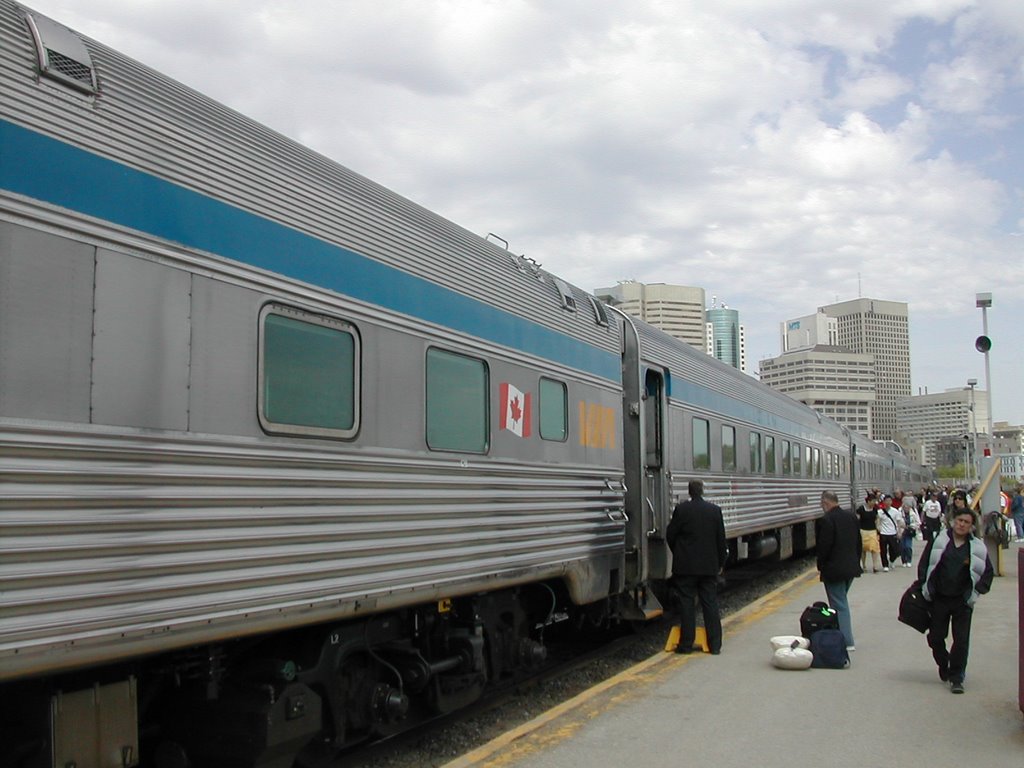
Returning up the escalators I descended earlier, I'm presented with a much more modest sight. Train 693 uses the same carraiges and locomotives as the 'Canadian', but without the elegant dome cars and without the half mile long consist. In fact, our train has just five cars behind two locomotives. There's a baggage car, two coaches, a restaurant ('Annapollis') and a sleeper ('Chateau Levis').

And for a change, I'm heading to the sleeper.

The CanRailPass and North America Rail Pass will give the ticket holder a seat in coach class, and nothing more. If, however, at any stage of a rail pass trip, you feel like a bit more luxury, you can pay the basic accomodation fare and upgrade to a sleepr. In my research I found this train to be significantly cheaper than the Canadian for such an upgrade. Although (unlike the Canadian) food isn't included in the sleeper fare, the cost of an upper berth going northbound and a lower berth returning came to C$247.17 - and that covers four night's accomodation on board the train. I'd heard prices for a single night in similar accomodation on board the Canadian in the region of C$160, so this was a real bargain.

I'm met on the platform by Carmel, the train's service manager, and Tara, the train's chef. Since there's only one sleeper on the train today, and only two passengers in it, she's doubling up as the attendant for this car. She shows a lady passenger the way to her single occupation 'roomette', and then leads me to the other end of the car to my berth (sometimes referred to as a section).

This plan varies slightly from my car, but it gives you an idea. The only other passenger in the car was in one of the purple shaded roomettes. The green shaded bedrooms were unsold, and being used for the crew. The remaining six berths were all for me. I'd booked a cheaper upper berth going north and then a more expensive lower berth going south in order to compare them.

When not converted into beds, these sections appear to be three pairs of wide facing banquette seats. In about five minutes, they can be converted into beds. The seats collapse to form a horizontal surface. A key unlocks the upper bunk, which folds down, and curtains and curtain rails fold out. A nattress for the lower bunk is stored in the upper bunk, and it's brought down to make for a more comfortable bed than just two folded seats. With fresh linen, a duvet and two fluffy pillows each, you have some very cosy accomodations.

With no other passengers for this part of the journey, the process of conversion doesn't have to get in my way: my bed has already been made up and I'm free to sit in the two unconverted pairs of seats. Tara explains everything to me, and gives me a shower amenity kit. Just across the hall from my berth is a shower room, which I look forward to sampling later. Towels, soaps etc are all included. She continues by explaining that, in her opinion, I've made the wisest choice with the berth: the mattress is wider than any of the other accomodations, and she's always slept well in them.

We pull out a few minutes ahead of schedule, and I settle down for a very interesting ride.

Train 693: The Hudson Bay

Winnipeg: across the river

The rain has lessened to a faint drizzle, and it's now safe to leave my chandelier-ed vantage point and return to street level. There's still an hour or two to kill before my next train leaves at 2045. Winnipeg may be an interesting place, but on a Sunday afternoon I'm running out of options for things to do. I decide to cross the river to explore St. Boniface. This small French community is one of the oldest in Canada outside Quebec, and my guidebook assures me that I'll 'find French culture prominent after crossing the Provencher Bridge'.

However, the rain returns, and as I'm crossing the elegant modern pedestrian bridge it gets pretty damp pretty quick. I'm in luck though, because the sensible architects who designed this bridge have built (have a guess...) a diner half way across. So I stop in from the rain to drink coffee and eat cake. The menu is billingual, but I can only hear English being spoken. There is, however, poutine on the menu board, which I had previously presumed was confined to Quebec. Maybe Winnipeg does have a French side after all.

I spend forty-five minutes or so eating my cake slowly and watching about a dozen restaurant employees doing very little. I pay the bill and head back out onto the bridge. The rain has stopped, and the clouds have cleared. I'm more optimistic about getting time outdoors. I continue across the bridge in search of 'French culture'. I find Boulevard Provencher. 'French culture' is evident, but only in French signs in shop windows and French businesses. It's a low density semi-suburban neighbourhood, which doesn't remind me much of the French Canada I know. However, I walk a few blocks this way, and then a few more that way, and eventually come round on myself via the striking statue of Louis Riel, the legendary leader of the Metis. It now stands away from the centre of Winnipeg outside a secondary school.

I walk back towards the bridge along the east bank of the river. Every year the water level in the Red River rises dramatically, and the riverside footpaths and parkland becomes swallowed by a deluge of brown water. It's now mostly receded back to it's normal level, but many of the lower levels of the riverside pavements have yet to be cleared of the mud that has been left behind.

Across the river, Winnipeg's small-city skyline manages a weak yelp of commercial importance. Not many gleaming towers, and they're mostly concrete rather than glass (concrete is such a useful architectural medium for revealing the decade in which something was built). Although I'm here on the quietest day of the week, I'm taking deep breaths of big city air, and contemplating my next train ride. This is the big one.

*j*

Sunday, May 07, 2006

Seen from a tall building: train 1


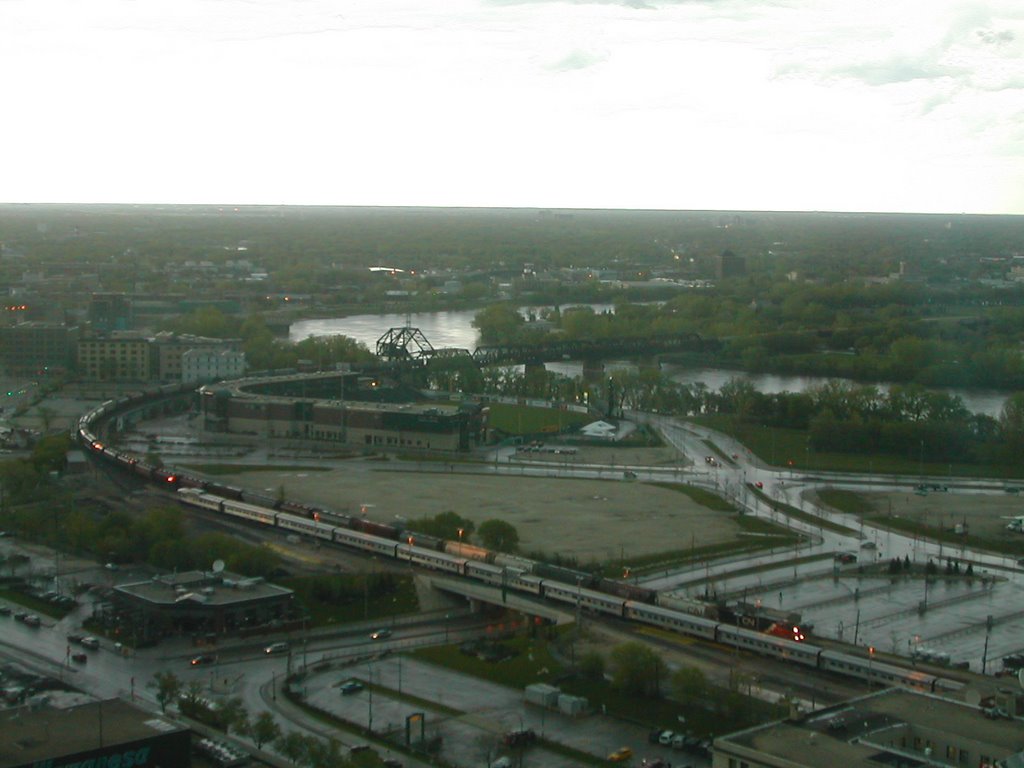
While drinking and rotating, I noticed the other 'Canadian', train 1, which arrived in Winnipeg a little late at about 1645. It hung around for about forty-five minutes before heading west. It would be in Edmonton by the next morning.

Winnipeg: Royal Crown Tower

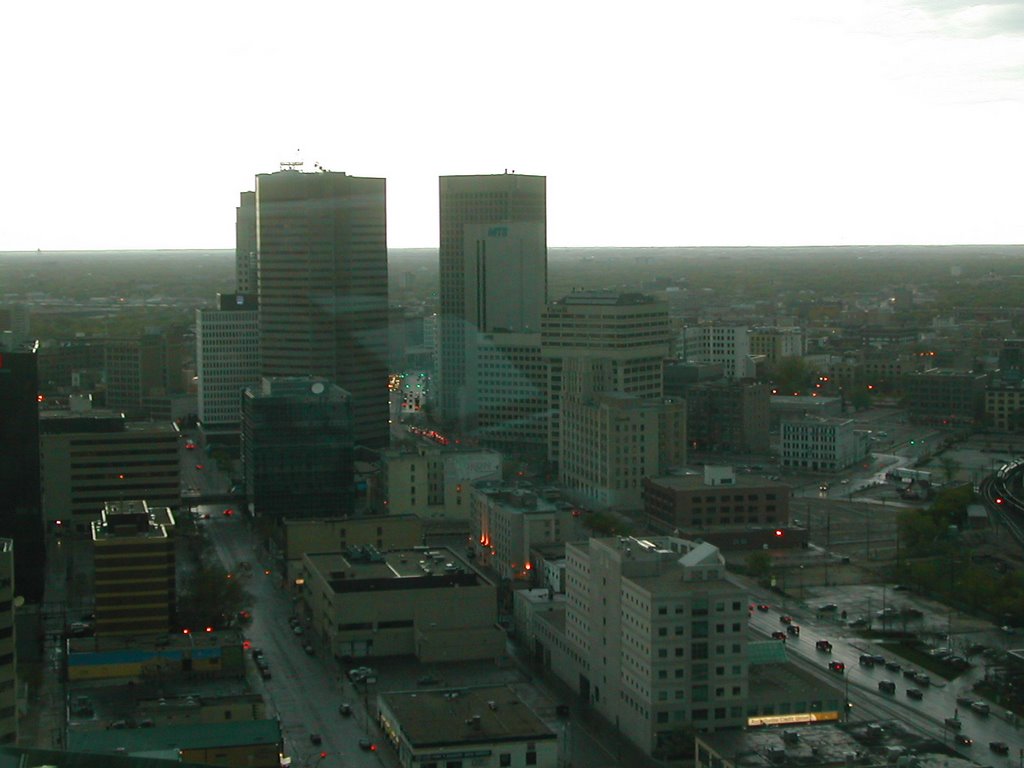
As I leave the Winnipeg Art Gallery, the humid air that had accompanied me all morning is beginning to break. A shop front thermometer had told me that it touched 26 degrees today, and the humidity suggested a thunderstorm would be brewing. Sure enough, as I walk towards the Manitoba Legislative Building, rumbles of thunder start to be heard. I begin to be able to perceive the light sky flashing to a strike of lightning. Looking around for shelter, my eyes fix on a target - not exactly close, but a good place to shelter from the approaching storm.

As I walk down York Avenue, a roll of thunder shook the street, and sets off a car alarm. I quicken my pace, and head straight for my destination - the recognisable silhouette of that compulsory feature of every major Canadian cityscape: a revolving restaurant.

Thirty storeys above Winnipeg, you can find the Royal Crown Rotating Restaurant and Lounge on top of the Royal Crown tower. It's just behind the Fort Garry Hotel, off Broadway Avenue. I find the entrance and take the elevator straight up. The lounge is quiet, with just an eldery couple taking afternoon tea. For such a modern building, the decor was somewhat.... er.... confusing. Fake embroidered tapestry fabric on chairs that I used to see brought in in bulk for weddings back home; cheap looking chandeliers hanging above the tables; and to set it all off, a strip of lace curtain lining the top of the panoramic windows.

Someone shoot the interior designer...

But that's not what I'm here for. I take a seat, ordered a beer, and begin to rotate. The storm's heart passes to the south and east of the city centre. I do two full rotations, watching the grey clouds thicken and then disperse, watching clouds of rain fall onto the city's suburbs. I'm drinking a bottle of local ale - Fort Garry Dark Ale to be precise. It's always a pleasure to drink a local brew when visiting a new city.

The waitress tries to interest me in the menu, but I'm not hungry. I stay for an hour or so, waiting for the weather to calm. It's on my second rotation that I notice the west bound 'Canadian' has arrived at the station below me. I take a few fuzzy photographs of it below me, and imagine a couple of well to do retired holiday makers looking up, and making some witty remark about how every Canadian city seems to have a revolving restaurant.

When the rain clears, I pay the small bill and head downstairs. $4.75 is a bit steep, but then you I did get a pretty decent view with it.

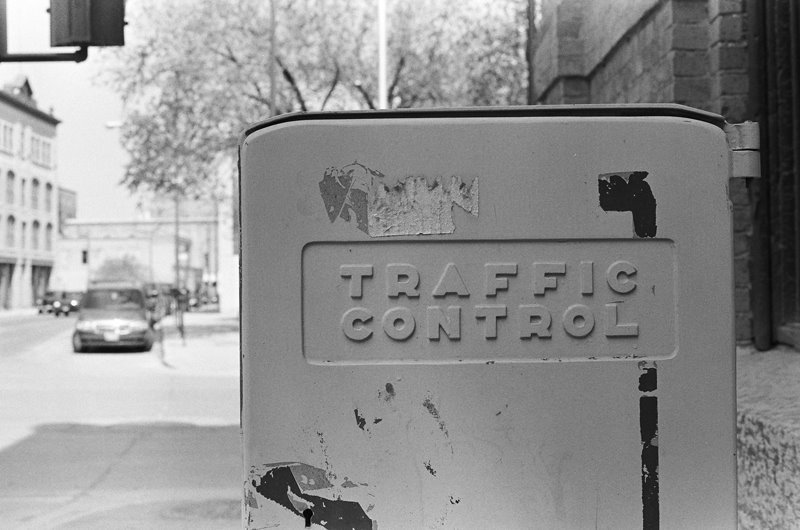
Winnipeg: traffic control

Winnipeg: WAG

It pains me to report that Winnipeg Art Gallery has gone the way of the Royal Ontario Museum in Toronto (ROM) and the Denver Art Museum (DAM) and picked up the moniker WAG. I think that along with striking architecture, all museums in Canada feel the need to make their identity felt with a single syllable three letter nickname.

However, having been unable to get into DAM, and been disappointed with the direction of the new extension of ROM, I'm pleased to find myself in Winnipeg when the WAG is open. It opened in it's current form in 1971, in an attractive modern stone building designed by Gustavo da Roza. The skin of the building is more or less entirely sheethed in stone, but's a beautifully patterned skin of Manitoba Tyndell stone, which features a wafting patten that is a joy to get lost in.

$4 gets you student admission, and it was worth every penny. There was a forgetable exhibition of contemporary art by the young radicals of Winnipeg's art scene, but the main collection of principally Canadian art was impressive. There's also a stunning collection of Inuit art, including dozens of beautiful soapstone and ivory carvings. The collection here is one of the largest of it's kind, and is well worth exploring.

A temporary show of prints by the Aboriginal/Manitoban artists Daphne Oajig also caught my eye, with beautifully bright and flowing images representing Inuit scenes and family groupings. The 'love' sequence was particularly touching.

I find that even if I limit myself to one gallery a day, there comes a mid-point when I need to rest. This was amply catered for by the attractive side rooms that are furnished with comfy chairs facing large picture windows onto the street. This gallery is well worth an afternoon of your time, and on this peaceful Sunday I thoroughly enjoyed the collection that was display.

Winnipeg: James is impressed

Shock of the month, folks, James quite likes Winnipeg. I'd known for some time that an eight hour layover would be in the itinerary to connect from the 'Canadian' to the 'Hudson Bay'. I'd no idea, however, that I'd be left feeling I wanted more time in the Manitoban city.

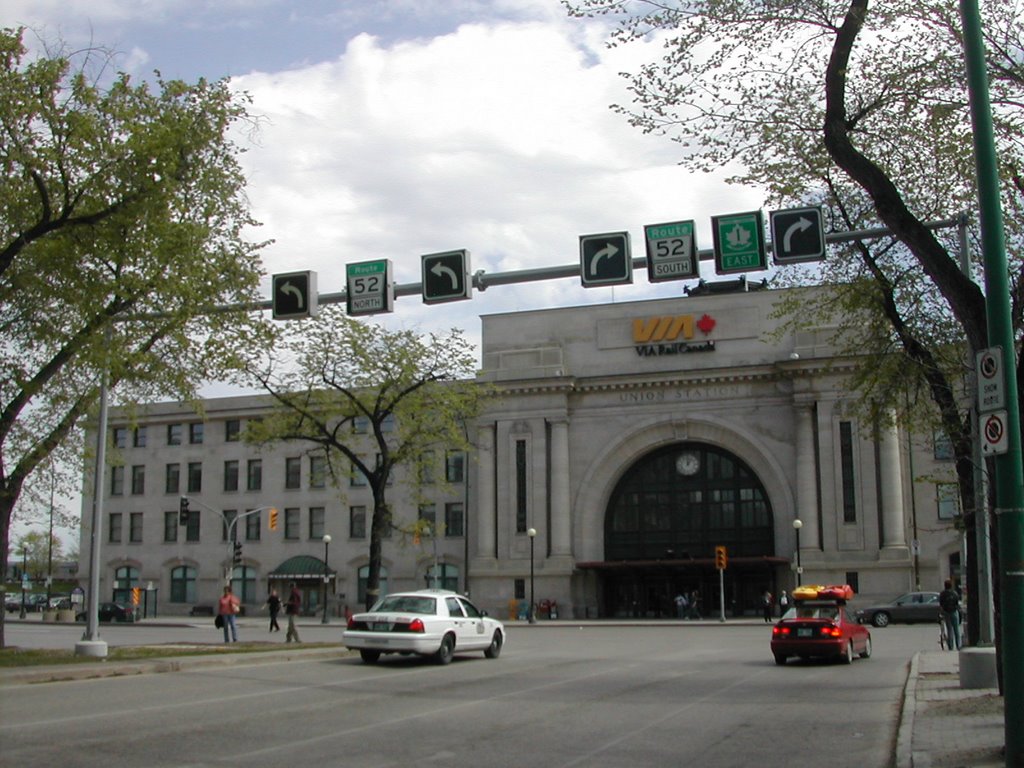
From the centrally located and rather attractive old railway station (see photo above) to the compact downtown core, I was rather taken aback. Since I didn't have any preconceptions of what the city would be like, I was happy to explore on foot and just sniff out whatever looked interesting.

Unsurprisingly for a Sunday morning, the city was pretty quiet. I strode west from the railway station's imposing facade, down the treelined Broadway Avenue. A small and mostly-in-step sea cadet parade was approaching, and turned down a side street as I neared. I can't imagine what it must be like being a naval cadet so far from the ocean. I turned and headed north, criss-crossing Portage Avenue, which is where the Trans-Canada highway enters the city and turns into a major shopping street. North of Portage things begin to get interesting. This part of town is called the Exchange District, and it's responsible for Winnipeg's affectionate nickname as the 'Chicago of the North'. Sturdy and attractive old warehouses are crammed along the narrow streets, and if it were just a little busier, it could easily be mistaken for the Windy City. I'm told that a number of American films are being shot on location here, because these streets can be dressed very easily to look like a turn of the century city.

And the signs are positive. There are more low rent arts spaces (such as the imaginatively titled 'Artspace' warehouse) than there are fancy boutiques. While there are a few new condominium developments creeping, they seem to be limited to sensitive redevelopments of the existing ex-industrial buildings. It's an extremely attractive place, and I apologise to all Manitobans for underestimating how much I would like the place.

I meander, pausing to consider visiting the Maintoba Museum. I decide against it, simply because I want to visit the Winnipeg Art Gallery, and feel that two museums in one day is pushing it.

I skirt alongside the Red River where it's tree lined banks come close to Chinatown, and then turn back towards downtown to head to the art gallery at the other end of town. The 'Best of Winnipeg' supplement in a free newspaper catches my eye while I have a snack outside an Exchange District cafe, and I drop into a jeans store on Portage to see if it really is the 'best place to buy jeans in Winnipeg'. The choice is too wide to be helpful, and I take note that they now have a store in Halifax, Nova Scotia. I shall postpone any denim related purchases until I have my fashion advisor with me...

Train 2: Winnipeg, Manitoba

Train 2: Into Manitoba

I'm awake at about 0700hr. It's a bright sunny day, and we're rolling towards the border between Saskatchewan and Manitoba. The scenery begins flat... completely, unadulteratedly, unblinkingly, perfectly flat. Albertans seem quick to point out that if you think their province is flat, you should go east for a while. They have a point.

We cross into Manitoba, and the train begins to follow an attractive river valley. With the sun above us, the dome car nice and quiet, and the conversation on board more developed that 'so, where are you going then?', it's a nice morning to be on the train. With the trees and bushes coming into leaf and still marshland water reflecting a blue blue sky, it's a beautiful day.

My Vancouverite travel companion sleeps solidly. She appears to have found the perfect position for sleeping on a pair of VIA Rail coach class seats, because she doesn't wake before we reach Winnipeg around midday. I scribble her a note, wishing her a good trip, and get my things together to leave the train once more.

Train 2: Saskatchewan

Train 2: the second night on board

As darkness settles over Alberta, our train maintains it's speed across the prairies. The engine horn is still sounding every few seconds, and the nocturnal rhythm is returning to the train.

I talk some more with the girl sitting in front of me who is going to Quebec. It's fun to talk with a west coast Canadian about the prairies and what she's looking forward to seeing in Quebec. Montreal seems a long way away to me right now. Not so much in terms of distance, but it terms of culture and memories. It feels like a lifetime since I was last there, even though it's only a few weeks. It will be strange to return next weekend, when I make a brief stop en route to Halifax.

My cunning headphone splitter plug (a great tool for making friends and exploring other people's iPods on train trips) allows me to enjoy some excellent reggae. I get a hot chocolate from the take out counter in the Skyline dome, and on the way say hello to Jenny and Sally, the two Yorkshirewomen I met a few days earlier (they'd got off the train in Jasper and spent a few days there).

I return to my seat, enjoy some more reggae, and then curl up to sleep.